6 Strategic Workforce Planning Examples to Master in 2025
- Talent People
- Aug 22, 2025
- 12 min read
In today's fast-paced business landscape, simply filling roles as they become vacant is a recipe for falling behind. To truly gain a competitive edge, organisations must move beyond reactive hiring and embrace a proactive, future-focused approach. This is the essence of strategic workforce planning (SWP), a critical discipline that aligns your people strategy with long-term business objectives.
Yet, many leaders struggle to translate theory into action. This article cuts through the noise. We will dissect six powerful strategic workforce planning examples, offering a practical blueprint you can adapt for your own organisation. You will gain a clear understanding of how to implement these advanced strategies, moving from a standard headcount forecast to a dynamic talent plan.
From scenario modelling used by global giants to agile frameworks transforming tech companies, you'll discover the specific processes, outcomes, and actionable takeaways needed to build a resilient, high-performing workforce. Explore how skills-based planning, data-driven analytics, and robust succession strategies can prepare your business not just for today's demands, but for the challenges and opportunities that lie ahead.
1. Skills-Based Workforce Planning
Skills-based workforce planning shifts the focus from traditional job titles and hierarchies to the specific skills and capabilities employees possess. Instead of planning for "10 new project managers," this strategic approach plans for the specific competencies needed to achieve future business goals, such as "advanced data analysis" or "agile project leadership." This model provides far greater flexibility and resilience in a rapidly changing market.
Organisations like IBM and Unilever have successfully implemented this strategy. IBM's SkillsBuild platform helps map employee skills against future needs, creating internal talent marketplaces. Similarly, Unilever's "Future Fit" programme maps the skills of its global workforce to identify gaps and build targeted development initiatives, ensuring its talent remains competitive.
The Core Process
This approach follows a clear, structured methodology to align workforce capabilities with strategic objectives. It moves beyond simple headcount planning to create a dynamic talent ecosystem. The core of this method involves understanding what skills you have, what skills you'll need, and how you'll bridge that gap.
The following diagram illustrates the fundamental process flow of skills-based strategic workforce planning, breaking it down into three core, sequential stages.
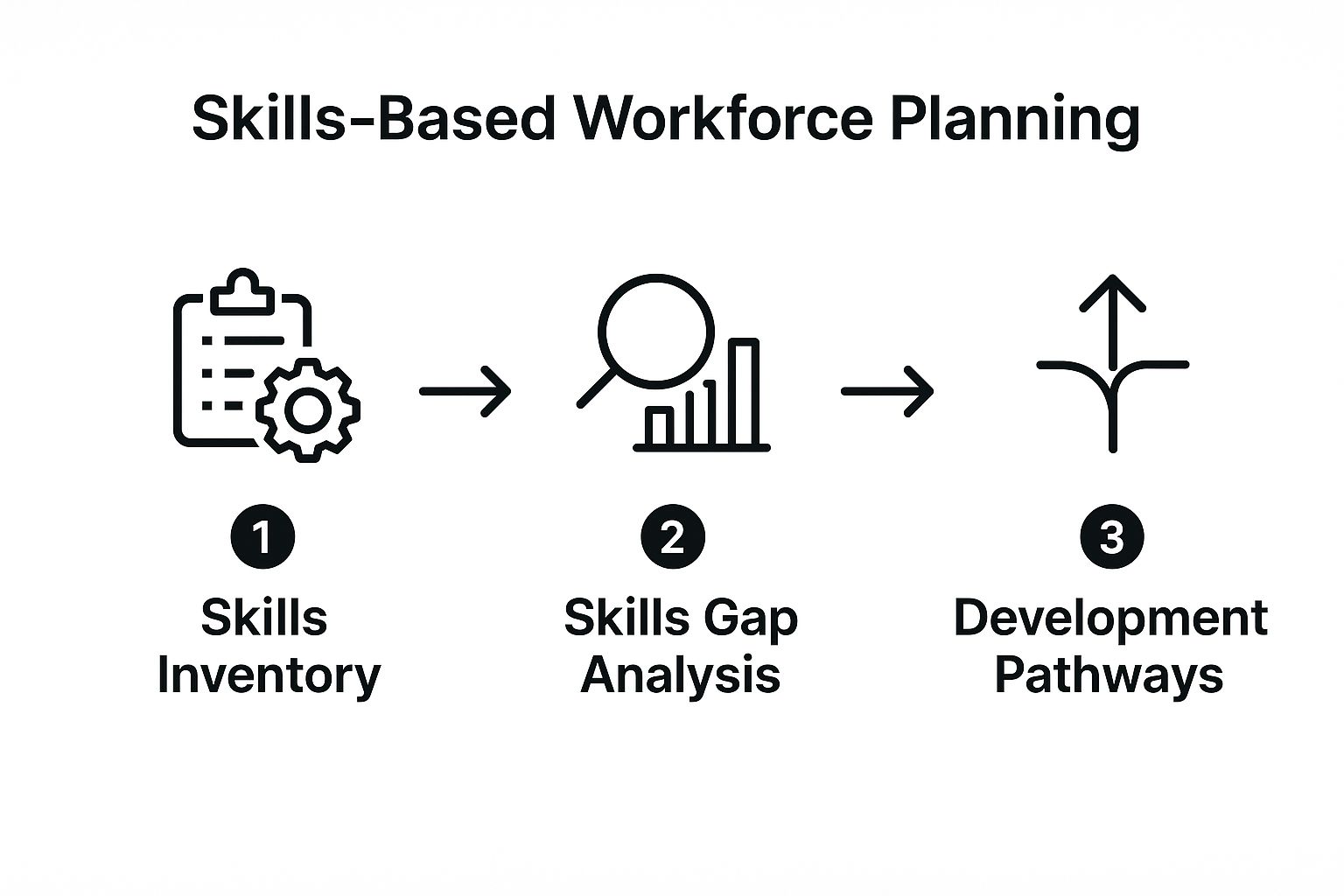
This process creates a clear, actionable roadmap from assessing current capabilities to building the future-ready workforce your organisation requires.
Actionable Takeaways
To effectively implement this as one of your strategic workforce planning examples, consider these tactics:
Start Small: Pilot a skills-based approach within a single department or project team to refine your process before a company-wide rollout.
Invest in Technology: Use robust skills assessment tools and talent marketplace platforms to automate inventory creation and analysis.
Build Clear Pathways: Define how employees can advance by acquiring new skills, creating transparent and motivating career progression opportunities outside traditional ladders.
Stay Current: Regularly update your organisation's skills taxonomy to reflect emerging industry trends and new technologies.
A crucial step in this process is the skills gap analysis. You can learn how to build your own with this free skills gap analysis template for UK teams. By focusing on capabilities, organisations can build a more agile, adaptable, and future-proof workforce.
2. Scenario-Based Workforce Modelling
Scenario-based workforce modelling is a predictive approach where organisations create multiple future scenarios to anticipate workforce needs under different business conditions. Instead of relying on a single forecast, this method develops optimistic, pessimistic, and most-likely outlooks. It helps businesses prepare for market volatility, economic shifts, and disruptions by building flexible and resilient staffing strategies.
Global giants like Shell and Microsoft have used this method effectively. Shell employs complex scenario planning to model its workforce needs for the global energy transition, considering various market speeds and regulatory changes. During the COVID-19 pandemic, Microsoft used multiple scenarios to model workforce productivity, wellbeing, and location needs, allowing it to adapt its policies and support systems dynamically.
The Core Process
This forward-looking approach enables organisations to stress-test their workforce strategies against a range of plausible futures. It moves planning from a reactive stance to a proactive one, ensuring preparedness for uncertainty. The core of this method involves identifying key drivers of change, building distinct scenarios around them, and defining corresponding workforce plans for each.
The following diagram illustrates how different internal and external drivers inform the creation of multiple future workforce scenarios, each leading to a unique strategic action plan.

This process equips leaders with a playbook for different futures, making the organisation less vulnerable to sudden market shifts and more agile in its strategic responses.
Actionable Takeaways
To effectively implement this as one of your strategic workforce planning examples, consider these tactics:
Focus on Plausibility: Develop 3-4 realistic and distinct scenarios (e.g., rapid growth, economic downturn, major technological disruption) rather than getting lost in too many variables.
Involve Cross-Functional Teams: Bring together leaders from finance, operations, and strategy to ensure your scenarios are comprehensive and grounded in business reality.
Define Clear Triggers: Establish specific data points or market events that will trigger the activation of a particular scenario's workforce plan, removing ambiguity in decision-making.
Document and Validate: Keep a clear record of all assumptions made for each scenario and review them quarterly to ensure they remain relevant to the current business environment.
A key benefit of scenario-based modelling is its ability to build organisational resilience. For further insight into building this capability, you can explore guides from strategic consultancies like Boston Consulting Group (BCG) who have popularised this approach. By preparing for multiple futures, organisations can confidently navigate uncertainty and turn potential threats into strategic opportunities.
3. Succession Planning and Leadership Pipeline Development
Succession planning is a strategic workforce planning process focused on identifying and developing high-potential employees to fill key leadership and critical roles. Rather than reacting to unexpected departures, this forward-thinking approach ensures business continuity by building a robust internal talent pipeline. It systematically prepares the next generation of leaders, safeguarding organisational knowledge and stability.
Global giants like Procter & Gamble (P&G) and Johnson & Johnson are renowned for this strategy. P&G’s famous "promote from within" culture is powered by a systematic process for developing brand managers and executives globally. Similarly, Johnson & Johnson's Credo-based leadership framework underpins its pipeline development across more than 60 countries, ensuring a consistent supply of leaders aligned with its core values.
The Core Process
This approach involves a proactive and continuous cycle of identifying critical roles, assessing potential successors, and implementing targeted development plans. It is more than just a replacement chart; it is an integrated talent management strategy that aligns individual career growth with long-term business objectives. The goal is to have a ready pool of talent prepared to step into crucial positions with minimal disruption.
The following diagram illustrates the fundamental process flow of succession planning and leadership development, breaking it down into three core, sequential stages.
This process creates a clear roadmap for nurturing future leaders, ensuring your organisation is prepared for any leadership transition.
Actionable Takeaways
To effectively implement this as one of your strategic workforce planning examples, consider these tactics:
Create Transparent Criteria: Clearly define and communicate the competencies and qualifications required for key roles to ensure the selection process is fair and objective.
Develop Multiple Successors: Avoid relying on a single candidate for a critical position. Cultivate a small pool of potential successors to increase options and mitigate risk.
Provide Stretch Assignments: Give high-potential employees cross-functional projects and assignments outside their comfort zones to build broad business acumen and leadership skills.
Benchmark Externally: Regularly compare your internal leadership talent and development programmes against industry benchmarks to identify gaps and maintain a competitive edge.
A robust succession plan is critical for long-term stability and growth. You can deepen your understanding by mastering the succession planning process. By investing in your leadership pipeline, you build organisational resilience and a culture of internal opportunity.
4. Agile Workforce Planning
Agile workforce planning adapts principles from agile software development to create a more dynamic and responsive approach to talent strategy. Instead of rigid, long-term headcount forecasts, this method uses short, iterative cycles to continuously adjust to changing business priorities. It prioritises flexibility, cross-functional collaboration, and data-driven decisions to align the workforce with immediate and emerging needs.
Financial services giant ING famously reorganised over 50,000 employees into agile squads, a move that fundamentally changed their workforce planning. Similarly, the Chinese multinational Haier uses its "RenDanHeYi" model, where self-managing micro-enterprises act as agile workforce units that plan their own talent needs in response to direct market feedback. These examples show how agility can be embedded at scale.
The Core Process
This approach trades annual planning for a continuous feedback loop, enabling organisations to pivot their talent strategy rapidly. It focuses on deploying resources where they are needed most, moment to moment, rather than adhering to a fixed yearly plan. The core of this method is built on speed, collaboration, and adaptability.
The agile model involves continuous cycles of assessing needs, deploying talent, and gathering feedback. This ensures that workforce composition and skills are constantly aligned with the most critical business objectives, allowing for rapid redeployment of talent to high-priority projects. This iterative process is key to maintaining a competitive edge in volatile markets.
Actionable Takeaways
To effectively implement agile principles as one of your strategic workforce planning examples, consider these tactics:
Pilot with Cross-Functional Teams: Start with a specific project or business unit to test agile workforce planning. Form a dedicated team with members from HR, finance, and operations to refine the process before scaling it across the organisation.
Invest in Real-Time Analytics: Use dashboards and workforce analytics tools to gain instant insights into skills availability, project needs, and talent allocation. This data is crucial for making quick, informed deployment decisions.
Train for Agility: Equip HR business partners and line managers with training in agile methodologies like Scrum or Kanban. This helps shift their mindset from rigid planning to adaptive talent management.
Establish Clear Governance: Create a lightweight but clear governance structure that empowers teams to make rapid staffing decisions without bureaucratic delays. Define roles and responsibilities for quick approvals.
The agile approach extends beyond planning and into talent acquisition. You can explore a modern guide to agile recruiting in the UK to see how these principles transform hiring. By embracing agility, organisations can build a workforce that not only meets current demands but is also prepared to adapt to future challenges.
5. Data-Driven Predictive Workforce Analytics
Data-driven predictive workforce analytics uses advanced statistical models, machine learning, and AI to forecast workforce trends and inform talent decisions. This sophisticated approach shifts HR from a reactive to a proactive function, enabling organisations to anticipate future needs, identify flight risks, and optimise talent deployment based on robust data rather than intuition alone.

Tech giants have pioneered this strategy. Google's famed Project Oxygen used data to identify the key behaviours of its most effective managers, transforming its management training. Similarly, Walmart utilises predictive analytics to optimise scheduling across its thousands of stores, ensuring staffing levels align perfectly with forecasted customer footfall, which improves both efficiency and employee satisfaction.
The Core Process
This method transforms raw workforce data into forward-looking strategic intelligence. It involves collecting and cleaning historical data, applying predictive models to forecast outcomes like attrition or performance, and translating those predictions into actionable HR interventions. The goal is to make smarter, evidence-based decisions about hiring, development, and retention.
The process hinges on a continuous cycle of data collection, analysis, prediction, and action. It requires a strong data infrastructure and analytical capability to identify patterns that predict future workforce behaviour and needs, allowing leaders to act before challenges arise.
This data-centric approach provides a powerful lens for understanding and shaping the future of your workforce.
Actionable Takeaways
To successfully implement data-driven predictive analytics as one of your strategic workforce planning examples, consider these tactics:
Establish a Clean Data Foundation: Start by ensuring your HR data (e.g., performance, tenure, demographics) is accurate, centralised, and consistently formatted.
Focus on Business-Relevant Metrics: Prioritise analytics that answer critical business questions, such as "Which factors predict high performance in our sales team?" or "Who are our high-potential employees most at risk of leaving?"
Build or Partner for Capability: Invest in developing an in-house people analytics team or partner with a specialist provider like Visier to access the necessary tools and expertise.
Ensure Ethical Data Use: Be transparent with employees about how their data is being used and establish strong governance to protect privacy and prevent bias.
By combining quantitative insights with qualitative human judgment, predictive analytics enables organisations to build a highly optimised and resilient workforce.
6. Integrated Business and Workforce Planning
Integrated business and workforce planning is a holistic approach that directly embeds workforce strategy into the core business planning cycle. Instead of treating talent management as a separate HR function, this method ensures every business decision is made with a clear understanding of its people implications. It moves beyond reactive hiring to proactively align workforce capabilities with financial forecasts, operational plans, and strategic goals.
This model is exemplified by Microsoft during its major shift to a cloud-first business. The company integrated its workforce planning directly with its product roadmap and financial targets, ensuring it had the right cloud engineering and sales talent in place to support the launch and growth of Azure. Similarly, 3M aligns its workforce planning with its R&D and innovation pipeline, ensuring it has the scientific and engineering talent needed to bring future products to market.
The Core Process
This approach synchronises the cadence, language, and goals of HR with those of finance, operations, and strategy. It treats workforce planning not as an annual HR exercise but as a continuous, integral component of strategic business management. The core of this method is creating a unified planning ecosystem where talent decisions and business decisions are one and the same.
This integration ensures that workforce plans are not just theoretical but are directly tied to budgeted, approved business initiatives. It creates a seamless feedback loop where business strategy informs talent needs, and talent availability shapes the feasibility of strategic goals.
Actionable Takeaways
To effectively implement this as one of your strategic workforce planning examples, consider these tactics:
Align Calendars: Synchronise the workforce planning cycle directly with the annual business and financial planning calendars to ensure discussions happen concurrently.
Establish Shared Governance: Create a cross-functional steering committee with leaders from HR, Finance, and key business units to oversee the integrated planning process.
Create Common Metrics: Develop and use a shared set of KPIs that connect workforce metrics (e.g., cost of hire, skills gaps) with business outcomes (e.g., revenue per employee, time to market).
Invest in Business Acumen: Train HR professionals to understand financial statements, operational models, and market strategy, enabling them to be true strategic partners.
A crucial first step is to get HR and finance speaking the same language. You can learn how to build a stronger partnership with this guide on improving HR and finance collaboration. By fully integrating these functions, an organisation can make smarter, more agile decisions that drive sustainable growth.
6 Strategic Workforce Planning Approaches Compared
Approach | Implementation Complexity | Resource Requirements | Expected Outcomes | Ideal Use Cases | Key Advantages |
|---|---|---|---|---|---|
Skills-Based Workforce Planning | High - requires technology investment and detailed skills assessment | Significant technology and time investment | Increased agility, better talent utilization, precise hiring & development | Organizations aiming to future-proof skills, improve internal mobility | Enhanced employee engagement, future-ready workforce |
Scenario-Based Workforce Modeling | High - involves complex modeling and scenario management | Resource-intensive data analysis and forecasting | Improved preparedness for market volatility, risk mitigation | Businesses facing uncertain markets, requiring contingency plans | Enhanced strategic agility, data-driven resource allocation |
Succession Planning & Leadership Pipeline | Moderate to High - long timelines, systematic processes | Investment in leadership development programs | Reduced leadership risks, stronger talent bench, better continuity | Organizations focused on leadership continuity and internal promotions | Improved retention, cost savings from internal hiring |
Agile Workforce Planning | Moderate - requires cultural change, iterative cycles | Ongoing coordination and real-time analytics | Rapid response to change, improved collaboration, short-term accuracy | Fast-moving industries needing flexible workforce adjustments | Reduced bureaucracy, enhanced employee engagement |
Data-Driven Predictive Workforce Analytics | Very High - needs advanced analytics, AI expertise | High investment in data infrastructure and skills | Highly accurate predictions, proactive retention, optimized hiring | Data-rich organizations aiming to leverage AI for workforce optimization | Evidence-based decisions, continuous improvement via analytics |
Integrated Business and Workforce Planning | High - demands cross-functional coordination and organisational change | Significant coordination and sophisticated tools | Strong alignment of workforce with business goals, better forecasting | Enterprises seeking alignment between HR and business strategy | Improved HR credibility, better resource allocation |
From Planning to Action: Building Your Future Workforce
The diverse strategic workforce planning examples we've examined, from Shell’s long-term scenario modelling to Spotify's agile talent deployment, reveal a powerful, unifying truth. Leading organisations no longer treat human resources as a reactive function. Instead, they position talent strategy as the central pillar of their business architecture, proactively shaping their workforce to meet future demands head-on.
This shift from reactive hiring to predictive talent strategy is the core lesson. It’s about moving beyond simply filling empty seats and instead, building the capabilities, leadership pipelines, and adaptable structures necessary to thrive amidst uncertainty. The examples demonstrate that there is no single "correct" approach; the best strategy is one that aligns directly with your organisation's unique context, challenges, and strategic goals.
Synthesising the Core Strategies
The journey through these case studies offers a clear blueprint for action. We saw how a skills-based approach, like Unilever’s, decouples talent from rigid job roles, creating a more fluid and resilient workforce. We also learned how predictive analytics can transform intuition into data-backed certainty, allowing companies to anticipate talent gaps before they become critical problems.
The key takeaways from these models are not just theoretical; they are practical and adaptable:
Integration is Non-Negotiable: The most successful workforce plans are not created in an HR silo. They are developed in lockstep with finance, operations, and executive leadership, as seen in integrated business planning models. This ensures talent strategy directly enables and accelerates core business objectives.
Adaptability is Your Greatest Asset: The era of the five-year static plan is over. Agile workforce planning and scenario-based modelling provide the frameworks needed to pivot quickly, whether in response to a market disruption, a technological shift, or a new competitive threat.
Focus on Capabilities, Not Just Headcount: The real value lies in understanding the skills your organisation has today and the skills it will need tomorrow. This focus on capabilities is fundamental to building a future-proof talent pipeline and ensuring long-term competitive advantage.
Your First Steps Towards Strategic Action
Embarking on this journey can feel daunting, but the path forward is one of iterative progress, not perfection. Don't aim to implement a complex, all-encompassing system overnight. Instead, identify your most pressing business challenge. Is it a looming leadership gap? A critical skills shortage in a key technology team? An urgent need to scale operations for a new project in the energy sector?
Start there. Select the workforce planning model that most directly addresses that single, high-impact problem. Pilot the approach within a specific department or project, measure the results, and learn from the process. This focused, incremental method builds momentum, demonstrates value to stakeholders, and creates the internal expertise needed to scale your efforts across the organisation. The goal is to turn strategic workforce planning from an abstract concept into a tangible, value-creating business discipline. The future of your business is being written today; ensure you have the right people, with the right skills, to lead the way.
Ready to translate these strategic workforce planning examples into a competitive advantage for your business? Talent People specialises in building the project-based and specialist teams that drive growth in the energy and technology sectors. Contact us today to learn how our strategic advisory and embedded hiring solutions can help you build the high-performing workforce your future demands.