A Founder's Guide to Hiring for Startups
- Talent People

- Jul 17, 2025
- 18 min read
Before you even dream of writing a job description, you need to get crystal clear on what roles will actually move the needle for your business. This isn't about filling seats with generic titles; it's about a deep, honest look at your startup's biggest hurdles. Every pound of your precious funding must be invested in people who solve problems, not just people who fill a role.
Defining the Roles That Truly Matter

So many startups make the same mistake: they jump into hiring without a real strategy, burning through cash and losing momentum. The knee-jerk reaction to "hire a marketing person" or "find a developer" is understandable, but it's treating the symptom, not the cause.
The question you should be asking is much more powerful: "What is the single biggest bottleneck holding back our growth right now, and what kind of person can smash through it?" This simple reframing forces you to think about outcomes, not just job functions. Suddenly, a vague "Marketing Manager" becomes a laser-focused "User Acquisition Specialist" who eats, sleeps, and breathes paid social campaigns. This shift changes everything—how you define the role, where you look for candidates, and how you measure success.
Performing an Honest Needs Analysis
Alright, before you even whisper a job title, it's time for a ruthless needs analysis. Get the founding team together and map out your core objectives for the next six to twelve months. And be specific. Is the goal to double your user base? Cut customer churn by 20%? Ship three major product features?
Once you have those objectives nailed down, work backwards to see where the gaps are.
What’s falling through the cracks? Are support tickets piling up unanswered? Is your sales pipeline looking a bit anaemic?
What skills are the founders missing? If you’re all product gurus, you probably have a massive commercial blind spot. Be honest about it.
Where are you wasting valuable founder time? If the CEO is spending 15 hours a week fiddling with bookkeeping, that’s a flashing red light telling you to hire someone to run finance or operations.
This isn’t about making a wish list of dream hires. It's about pinpointing the one or two roles that will unlock the most progress towards your immediate goals.
"A poor culture fit can bring down the entire venture, while a strong fit can strengthen morale, boost productivity and encourage innovation." - Indeed
This quote from Indeed gets to the heart of it. You’re not just filling a gap in your skillset; you’re adding a crucial piece to your company’s cultural DNA.
In the earliest days, startups need a handful of key players to get things moving. The exact mix depends on your business model, but certain roles tend to provide the most immediate value.
Key Role Priorities for Early-Stage Startups
Role Type | Primary Focus | Key Responsibilities | Impact on Growth |
|---|---|---|---|
Product Manager | Product-Market Fit | Guiding product development, gathering user feedback, defining feature roadmaps. | Ensures you're building something people actually want and will pay for. |
Full-Stack Developer | Building the Core Product | Writing code for both front-end and back-end, deploying updates, fixing bugs. | Directly builds the value you deliver to customers; speed is critical. |
User Acquisition Specialist | Driving Initial Traction | Running paid ad campaigns, managing SEO/content, experimenting with growth channels. | Acquires the first crucial users and provides data on what marketing works. |
Operations/Finance Lead | Creating Internal Stability | Managing budgets, handling payroll and invoices, setting up processes, HR tasks. | Frees up founder time and ensures the business runs smoothly without chaos. |
These roles form the bedrock of a scalable startup, each one addressing a fundamental business need—building, selling, or supporting.
Navigating the UK Hiring Climate
The current UK job market adds another layer to consider. While a significant 67% of UK employers still intend to hire, the pace has definitely slowed. It now takes an average of 42 days to fill a role, which feels like an eternity in startup land.
We’re also seeing a huge lean towards temporary roles as companies try to stay flexible in a wobbly economy. For founders, this means every hire has to count. Being strategic and decisive isn't just good advice; it's a survival tactic. You can get more insight from these recruitment sector trends and what they mean for your startup.
Generalists vs. Specialists: The Classic Startup Dilemma
It's one of the oldest debates in startup circles: do you hire a generalist who can juggle multiple tasks or a specialist who has deep knowledge in one specific area?
In the very early days—think employees one to five—generalists are worth their weight in gold. You need adaptable, scrappy problem-solvers who are comfortable with chaos and can switch from customer support to writing a blog post without missing a beat.
But as you grow, the need for specialists becomes urgent. A generalist can get your marketing off the ground, but you'll need a performance marketing expert to scale your customer acquisition from 100 to 10,000. The trick is knowing when you’ve hit that turning point. A common pitfall is to keep hiring generalists when your problems have become highly specialised, which is a fast track to inefficiency and stalled growth.
Writing Job Posts That Top Talent Can't Ignore

Let’s be honest, a job description is often the very first time a candidate "meets" your startup. So why do so many founders treat it like a dry, administrative task? It’s so much more than a checklist of duties. Think of it as your sales pitch, your culture manifesto, and your first quality filter, all rolled into one.
In a market swimming with opportunities, a generic job post is the fastest way to attract uninspired applicants. You’re not just looking to hire a "Software Engineer." You're inviting someone to come and build a groundbreaking FinTech platform from scratch, giving them real ownership over features that thousands of people will use. Framing it this way isn't just semantics; it's a fundamental shift in how you approach hiring.
Move Beyond Duties and Sell the Mission
High-flyers aren't chasing a bulleted list of responsibilities. They’re driven by making an impact, learning something new, and being part of a story they believe in. Your job post needs to shout this from the very first sentence.
Start by answering the questions that actually matter:
What's your mission? Don't just say what you do. Tell them why it's important.
What interesting problems will they get to solve? Frame challenges as exciting opportunities. Instead of "maintain legacy code," try "modernise our core platform to boost performance by 50%."
What does success look like here? Paint a clear picture of what they’ll achieve in their first six to twelve months. This helps them visualise their future impact.
A corporate job description says, "You will be responsible for managing social media accounts." A startup job description should say, "You will build our brand voice from the ground up and own the strategy that gets us our first 10,000 followers." One is a task; the other is an adventure.
Your job description should reflect the culture of your company, down to what you include in it and the type of language used in it. A good post makes it clear what makes your startup unique and what makes your company culture special.
This is a crucial point. You need to inject your company's personality into the text. Ditch the corporate jargon and cringey buzzwords like "ninja" or "rockstar." Use authentic language that sounds like your team actually talks. The words you choose are a powerful filter.
Be Radically Transparent About Compensation
It wasn’t long ago that salary details were a closely guarded secret. Not anymore. In the UK, being upfront about pay has become a massive advantage for attracting the right people and building trust from day one. In fact, for many job seekers, a missing salary range is a major red flag.
Being transparent isn’t just about saving time. It’s a powerful signal that you’re a fair and open-minded employer. For startups that can't always match corporate salaries, this is your moment to frame the entire compensation package.
Provide a clear salary range. It's a basic sign of respect for a candidate's time.
Highlight your equity offer. Explain what it means in simple terms—a real share in the future success they’ll help create.
List your other benefits. Don’t forget things like private health insurance, pension contributions, and a budget for professional development.
This holistic approach to pay is a cornerstone of a smart talent acquisition strategy for startups and helps you compete on overall value, not just the payslip.
Emphasise What Makes Startup Life Great
You can't offer the same perks as a giant corporation—and that’s your secret weapon. The modern UK labour market is tight, and what candidates want is changing. They’re looking for more than just money; they crave flexibility, autonomy, and a genuine work-life balance. Many are happy to trade a slightly higher salary for the freedom of remote work or more control over their own schedule.
Your job description should be screaming these benefits from the rooftops.
Try phrases like these:
"Enjoy a genuine work-life balance with flexible hours—we trust you to manage your own time."
"Work from anywhere in the UK. We're a remote-first team focused on results, not desk time."
"You'll have a direct line to the founders and see your ideas go live in days, not months."
Right now, the startups winning the war for talent are those offering both competitive compensation and meaningful flexibility. By clearly articulating the unique culture and freedom your startup provides, you'll write a job post that top performers simply can't scroll past.
Sourcing and Screening Candidates Like a Pro

So, you've written a brilliant job description. That’s a great start, but it's only half the battle. Now you actually have to get it in front of the right people.
Just posting on job boards is like fishing with a single line in a vast ocean. You might get a nibble, but you’re unlikely to land the best catch. Hiring for a startup demands a more proactive, almost guerrilla-style approach to finding great talent.
It's one thing to find good people, but it's another to manage the flood of applications without burning out. This is where smart sourcing and screening strategies come in. They help you uncover talent in unexpected places while keeping your process organised and, most importantly, human.
Think Beyond the Job Board
Let's be honest: the best people often aren't even looking for a new job. They’re what we call "passive candidates"—happy where they are, but potentially open to a conversation about a truly compelling opportunity. This is where your network becomes your most powerful hiring tool.
Start by tapping into your team's own professional circles. Talented people almost always know other talented people. Don't send them the full, formal job post. Instead, create a punchy, one-paragraph brief about the role and encourage everyone to share it. A referral from a trusted colleague is infinitely more powerful than a cold job advert.
You also need to show up where your ideal candidates hang out online. This means getting active in niche communities.
Looking for developers? Dive into specific subreddits, contribute to open-source projects on GitHub, or join conversations on Stack Overflow.
Need a designer? Browse portfolios and connect with creators on platforms like Behance or Dribbble.
Hiring a marketer? Join specialised Slack communities or get involved in thoughtful discussions in industry-specific LinkedIn groups.
The key here is to add value first. Don’t just drop a link to your job opening and run. Participate, offer advice, and build genuine relationships. When you finally do reach out about the role, it’ll feel like a warm introduction, not an unsolicited pitch. If you want a few more ideas, you can explore some other effective candidate sourcing strategies that are working well right now.
Mastering the Art of the CV Screen
Once the applications start landing in your inbox, the goal is to quickly sort the promising from the not-quite-right. This isn't about finding someone who ticks every single box on a list; it’s about spotting raw potential, adaptability, and a genuine culture fit.
A classic mistake is getting swamped by manual tracking. A spreadsheet seems fine at first, but it quickly descends into chaos. This is where an Applicant Tracking System (ATS) can be a real lifesaver, even for a tiny team. A simple ATS helps you organise candidates, track their progress, and collaborate with your team, ensuring no one great slips through the cracks.
When you're scanning CVs, you need to look for clues that go beyond job titles.
A poor culture fit can bring down the entire venture, while a strong fit can strengthen morale, boost productivity and encourage innovation.
This is why screening for cultural alignment is so critical. Look for evidence of traits that are non-negotiable in a startup environment:
Signs of Initiative: Did they start a side project? Did they lead a new initiative in a previous role, even if it wasn’t officially in their job description?
Adaptability: Look for experience in fast-paced or unstructured settings. A long history of working only in large, slow-moving corporations could be a red flag.
A Sense of Ownership: Pay attention to their language. Do they talk about "my projects" and "I achieved," or is it all vague, passive phrasing?
This approach helps you build a shortlist of people who not only have the skills on paper but also possess the mindset to truly thrive in the unique world of a startup. Your interview time is precious; a smart screening process makes sure you spend it with the candidates who have the highest potential.
Running Interviews That Actually Predict Success
Let's be honest. The traditional interview—a casual chat about a CV—is a terrible way to figure out if someone can actually do the job. For a startup, where every single hire has a massive impact on your culture and momentum, getting this wrong isn't just a mistake. It can be a fatal one.
The stakes are sky-high. An astonishing 95% of UK businesses admit to making a bad hire each year. With the average cost of recruitment hitting £6,125, and a bad manager potentially costing you over £132,000, you simply can't afford to get it wrong. As some recent UK statistics show, these aren't just numbers; they represent lost time, money, and morale.
This is why designing a process that genuinely tests skills and problem-solving ability is your best defence against a costly mis-hire.
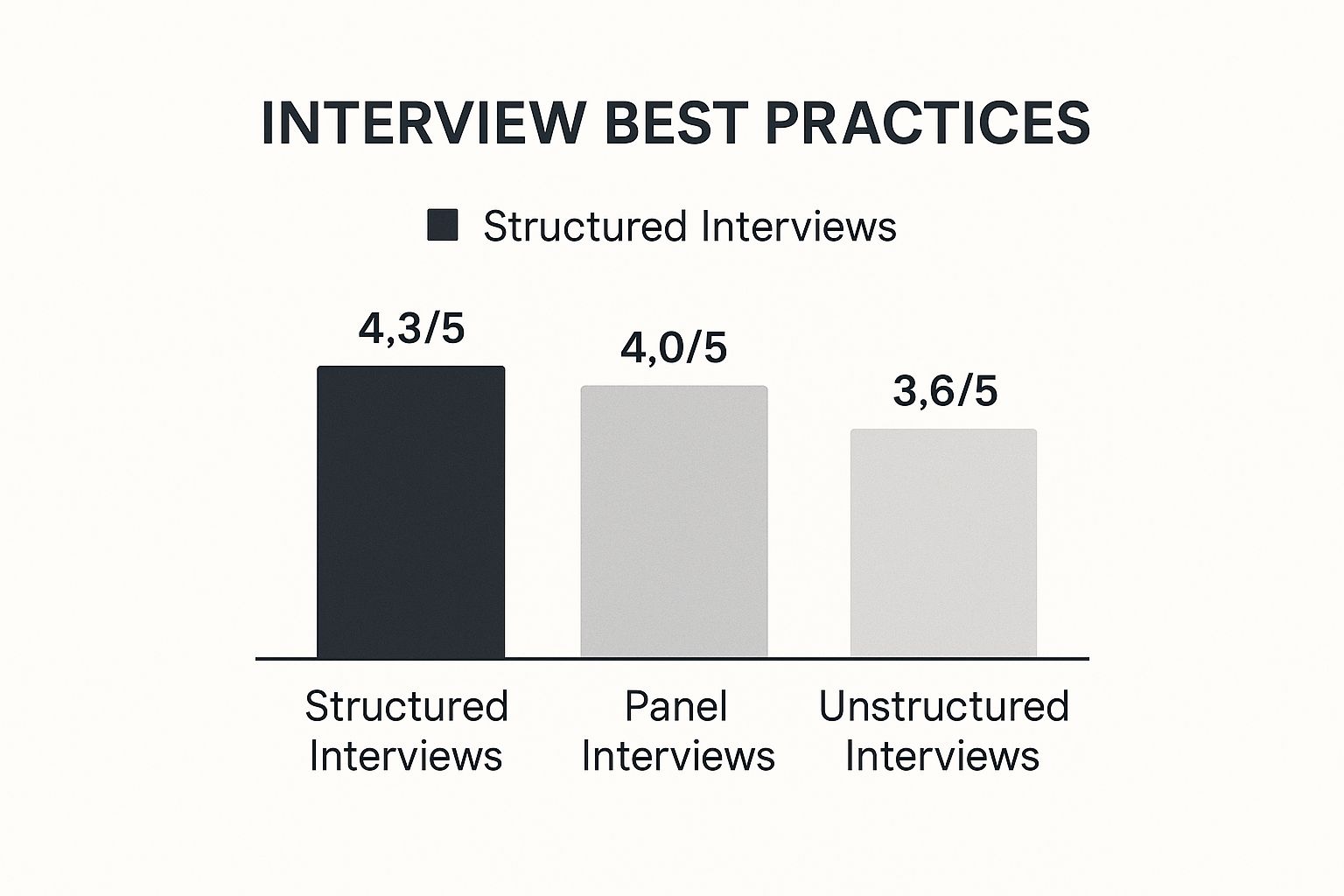
As the data clearly shows, just having a chat isn't enough. Structured, evidence-based methods consistently give you a much clearer picture of a candidate's potential.
Build a Structured and Consistent Process
To get a fair comparison between candidates and minimise your own unconscious bias, you need structure. It's that simple. This means asking every candidate for a given role the same core questions in the same order. It’s not about being robotic; it's about creating a level playing field where you can judge answers on substance, not on who you "clicked" with more.
A solid structured interview process usually involves:
A consistent question bank: Develop a set of questions that link directly back to the skills and values you defined in the job description.
A pre-defined scoring guide: Create a simple scale (e.g., 1-5) to rate answers for each key competency. This forces objectivity into your review.
Involving the team: Always have at least two people in the interview. This brings in a second perspective and helps cancel out individual biases.
This approach is a critical shift away from relying on "gut feel" and towards making decisions based on actual evidence.
Use Behavioural Questions to Uncover Past Performance
The best predictor of how someone will act in the future is how they've acted in the past. So, instead of asking vague hypotheticals like, "How would you handle a difficult client?", get them to talk about real-life experiences.
The magic phrase is: "Tell me about a time when..."
Examples of powerful behavioural questions:
"Tell me about a time you had to learn a new skill from scratch to get a project over the line. How did you do it?"
"Describe a situation where you had a strong disagreement with a manager or colleague. What was the core issue and how did you resolve it?"
"Walk me through a project that failed. What was your specific role, what did you learn from it, and what would you do differently today?"
These kinds of questions reveal so much more than a list of skills on a CV. They expose a candidate’s problem-solving style, their resilience, and whether they can learn from mistakes—all essential traits for surviving, and thriving, in a startup.
A great interview process gives as much weight to culture and values as it does to technical skills.
This means your questions need to probe not just what a candidate can do, but how they do it and whether their approach aligns with your company’s DNA.
To better understand which methods to use, it helps to compare them side-by-side. Different techniques are better suited for assessing different attributes, and a blend is often the most effective approach.
Interview Technique Comparison
Interview Technique | Best For Assessing | Pros | Cons |
|---|---|---|---|
Structured Interview | Core competencies, consistency, fairness | Reduces bias, easy to compare candidates, legally defensible | Can feel rigid if not delivered well, requires upfront preparation |
Behavioural Interview | Problem-solving, resilience, past performance | Strong predictor of future behaviour, reveals soft skills | Relies on candidate's honesty, can be rehearsed |
Work-Sample Test | Hard skills, practical ability, thought process | The most accurate predictor of technical skill, shows how they work | Can be time-consuming for candidates, hard to design a fair test |
Unstructured "Chat" | General personality, basic rapport | Feels natural and conversational, low-prep | Highly prone to bias, poor predictor of job performance |
Ultimately, a combination of structured, behavioural, and practical tests gives you the most complete and reliable view of a candidate.
Try a Practical Work-Sample Test
Think about it: you wouldn't hire a chef without tasting their food. So why would you hire a developer without seeing their code, or a marketer without reviewing a campaign plan they've built? The days of abstract brain-teasers are over; what you need are relevant, practical tests.
A good work-sample test should tick three boxes:
It must be directly related to the job. Give them a small, real-world problem they would actually face in their first few months.
It must respect their time. Keep the task concise. A one-to-two-hour task is usually plenty to gauge their skills.
It should form the basis of a discussion. Don't just take the submission. Use it as a talking point in the final interview to dig into their thought process and how they approach problems.
For an engineer, this could be a small coding challenge using a tool like Codility. For a content writer, a short article on a relevant topic. This is the single clearest way to see their capabilities in action, moving you beyond a polished CV and towards a hire who can genuinely deliver.
Closing the Deal and Onboarding for Retention
You’ve done the hard work of interviewing and assessing, and you've found someone who feels like the perfect fit. The finish line is just ahead, but this is a critical stage where a surprising number of startups drop the ball. Securing that ‘yes’ demands a sharp, competitive offer, and turning that initial excitement into a long-term, committed employee all comes down to a brilliant onboarding experience.
That limbo period between a verbal agreement and their first day can be a minefield. The best people often have several offers on the table, and any sign of hesitation or disorganisation from you can plant a seed of doubt. Speed and clarity are your best friends here. Once you know they're the one, move fast.
Crafting an Irresistible Offer
A compelling offer is so much more than a salary figure. It's the whole story of why joining your startup is the single best move for their career right now. You’re not just filling a vacancy; you're inviting them to come and build something that matters.
Your offer needs to lay out the entire value proposition, clearly and persuasively:
Base Salary: This needs to be competitive and transparent. Put forward a clear figure that lines up with the market rate you’ve already discussed. No surprises.
Equity: Don't just throw out a number of options. Take a moment to explain what it actually means—the vesting schedule, the company's current valuation, and its potential as a genuine share in the success they will help create.
Key Benefits: Remind them of the perks that truly count, like your flexible working policy, remote work options, professional development budget, or private health insurance.
Make the offer letter personal. It costs you nothing. Reference a specific conversation you had during the interviews or mention a project you’re genuinely excited for them to get their hands on. This tiny detail shows they aren’t just another hire; they are the hire.
"Your first few hires will absolutely be critical in the long term success of your business." - Ryan Allis, Hive
This hits the nail on the head. Getting these final steps right isn't just about filling a role; it's about setting the foundation for your company's culture and future growth.
From Offer Acceptance to Day One
So, they’ve said yes. Fantastic! But your work isn't over—in fact, the real work of retention is just beginning. This "pre-boarding" phase is your chance to make your new hire feel welcomed, prepared, and genuinely excited before they even show up.
Get the contract and any other essential paperwork sent over digitally. It’s best to get the admin out of the way early. But more importantly, send a welcome package. It doesn’t need to break the bank—some company swag, a great book relevant to your industry, or even a gift card for a local coffee shop makes a massive impression.
About a week before they start, email them a detailed schedule for their first week. This simple gesture goes a long way in calming first-day nerves and shows that you're organised and respect their time from the get-go.
Designing an Onboarding Experience That Sticks
A great onboarding process is probably your single most powerful retention tool. Done right, it immerses new starters in your culture and gives them everything they need to start contributing in a meaningful way, fast. It’s so much more than a stack of forms and an IT login.
A proper, structured plan should cover at least the first month and focus on a few key things:
Culture Immersion: Set up informal coffees or lunches with people from different teams, not just their direct line manager. This is how they start building real relationships across the business.
Role Clarity: Give them a clear 30-60-90 day plan. This document should spell out their main priorities, what they should focus on learning, and what success looks like at each milestone. It gives them immediate direction.
Early Wins: Hand them a small, achievable project they can tackle in their first week. Nothing builds confidence and a sense of accomplishment faster than getting a meaningful task over the line.
Building a plan from scratch can feel like a huge task. To make sure you’ve got all your bases covered, it's worth following an [onboarding checklist for new employees](https://www.talentpeople.co/post/onboarding-checklist-for-new-employees-7-essential-steps), which can help structure the whole journey from acceptance to their first 90 days. A world-class onboarding programme doesn't happen by accident; it's designed with care and intention.
Answering Your Burning Questions About Startup Hiring
Even with a solid plan, hiring for a startup throws up some uniquely tricky questions. As a founder or hiring manager, you'll find yourself wrestling with the same challenges time and again – from figuring out equity splits to knowing exactly when to bring on your first team member.
Let's get straight into the most common questions I hear from UK startups and tackle them with some direct, no-nonsense advice. Getting these answers right is about more than just filling a seat; you're making foundational decisions that will define your company's future.
How Much Equity Should We Offer Early Hires?
There's no magic number here, but a good rule of thumb for your first ten employees is somewhere between 0.5% and 2%. This is nearly always given as stock options that vest over a four-year period, with a one-year "cliff." That cliff is crucial – it means they have to stick around for at least a year before any of that equity becomes theirs.
Of course, the final offer depends on a few things. You need to consider the seniority of the role, the candidate’s specific experience (and their network), plus your startup's valuation and funding stage. A seasoned Head of Engineering joining you at the pre-seed stage is going to command a much bigger slice of the pie than a junior marketer who comes on board after your Series A.
The key is to frame equity as a genuine stake in the future you're all building together, not just a way to make up for a lower salary.
Be completely transparent when you make the offer. Lay it all out: the number of shares, the company's latest valuation, and the full vesting schedule. This honesty builds immediate trust and helps the candidate see the real long-term value you're putting on the table.
Can We Really Compete with Big Tech Salaries?
Look, trying to go pound-for-pound with a corporate giant on base salary is a game you'll almost certainly lose. The good news? You don't have to play it. Instead of getting hung up on the payslip, you need to sell what makes you different.
You have advantages that big tech simply can't match. Hammer these points home:
Real Impact: In a startup, a new hire can genuinely shape the product and see their work go live in days, not months. It's a powerful feeling.
No Red Tape: Sell the freedom. Great ideas don't have to die in committee meetings. You can move fast and get things done.
Learn from the Founders: The chance to work directly with the people who built the company from scratch is a massive learning opportunity for anyone ambitious.
A Mission That Matters: Why does your startup exist? People want to solve meaningful problems, not just be a cog in a massive machine.
The Upside of Equity: Frame the equity component as the real financial prize—the chance to own a piece of something that could become life-changing.
Plenty of brilliant people will happily trade a cushy corporate salary for more autonomy, faster career growth, and the excitement of building something new. You just have to present the whole package – salary, equity, flexibility, and mission – to tell the complete story.
When Is the Right Time to Make Our First Hire?
It's simple, really. The right time to make your first hire is when a founder is constantly sinking time into a critical task that is not their core strength, and it's actively holding the business back.
This is all about spotting the real bottleneck. For example, if you’re a product-obsessed founder who's now spending 20 hours a week clumsily handling sales calls instead of making the product better, that's your sign. Your time is more valuable elsewhere, and the business is starting to suffer for it.
Don't just hire to fill a title you think you're "supposed" to have, like a "Head of Marketing" before you've even got a product. Hire to solve a painful, specific problem that's slowing you down right now.
What Are the Biggest Red Flags in a Startup Candidate?
Beyond the obvious stuff like showing up unprepared, certain red flags are particularly dangerous in a startup. You have to tune into the subtle clues that tell you someone just won't cut it in the organised chaos of an early-stage company.
Keep an eye out for these warning signs:
A Lack of Curiosity: If they aren't asking you tough, insightful questions about your business, your customers, or your challenges, they probably aren't that interested.
An Obsession with Title and Salary: Money matters, but if that’s all they want to talk about, they might not have the mission-driven mindset you need to get through the tough times.
An Inability to Talk About Failure: Ask them about a mistake they made or a project that went wrong. If they blame everyone else or claim they’ve never failed, run a mile. Startups need resilient people who learn from their mistakes.
Discomfort with Ambiguity: Some people need a highly structured, predictable day. Those people will flounder in a startup. You need someone who can create their own path and make progress with incomplete information.
Spotting these signs early can save you from a bad hire – a mistake that is not only expensive but can seriously damage team morale.
Building a high-performing team in a competitive market is one of the toughest challenges for any high-growth company. At Talent People, we specialise in designing and delivering project-based hiring solutions that help you find the right people faster. Whether you're scaling in energy, technology, or entering new markets, we can help you build the team you need to succeed. Learn how our agile recruitment services can accelerate your growth.

Comments