A UK Guide to Hiring Project Managers
- Talent People

- Jul 19, 2025
- 14 min read
Getting your project manager hire right all starts with one crucial step: figuring out what kind of project manager your business actually needs. This isn't about finding a generic, one-size-fits-all PM. It's about identifying a professional whose specific skills will solve your unique problems and help you hit your goals.
Why a Generic Job Description Will Fail You
Before you even dream of writing a job advert, you need to do some serious internal reflection. Honestly, the success of your entire hiring process hangs on this initial work. Without a crystal-clear picture of your ideal candidate, you're just setting yourself up for a flood of unqualified applicants, hours of wasted interview time, and a hire that ultimately doesn't move the needle.
One of the most common mistakes I see is businesses grabbing a generic project manager template off the internet and hitting "post". This completely misses the point. Think about it: a technical PM steering a software team needs to live and breathe Agile and the development lifecycle. A construction PM, on the other hand, needs to be an expert in site management, safety regulations, and supply chain logistics. These roles are worlds apart.
Pinpoint Your Exact Needs
To avoid that trap, you’ve got to start by looking at where your company is right now. Get your team together and ask some tough questions:
What does our project pipeline actually look like? Are you juggling dozens of small, fast-moving projects? Or are you focused on a few massive, complex undertakings? The answer tells you whether you need a master multitasker or a deep, strategic planner.
Where is the pain? What are your biggest project-related headaches? Are deadlines a constant source of stress? Is scope creep eating your budget alive? Is getting stakeholders to communicate a daily battle? Naming these problems helps you find someone with the right skills, whether that’s in risk management, financial oversight, or masterful communication.
What does success look like in 12 months? Be specific. Define clear, measurable outcomes. Something like, “Successfully launch Product X by Q4,” or “Reduce project budget overruns by 15%.” This turns a vague job into a results-driven position that high-achievers will be drawn to.
A project manager isn't just there to tick off tasks on a list; they're there to solve business problems. Define the problem you need solved, and you'll find the right person to solve it.
Distinguishing Between Hard and Soft Skills
Once you have that context, you can start mapping out the required skills. Every project manager needs a core set of abilities, but the emphasis changes dramatically depending on your specific situation.
Hard skills are the technical, teachable abilities. Figure out which ones are absolute non-negotiables for your team.
But it's the soft skills that often separate a good project manager from a truly great one. Take a look at your team dynamics. Do you have a junior team that needs a strong mentor and leader? Or do you have a room full of senior experts who just need a skilled facilitator to keep them aligned?
Your answer will show you whether to prioritise leadership, sharp negotiation skills, or top-tier conflict resolution. Building a detailed profile that balances these hard and soft skills is the foundation for hiring a project manager who won’t just do the job, but will absolutely thrive.
Writing a Job Advert That Attracts Top Talent

A generic job description is the fastest way to get lost in the sea of online postings. When you're hiring a project manager, remember this: your advert isn’t just a list of duties. It's your first sales pitch, a marketing document designed to grab the attention of discerning professionals.
The best candidates aren’t just scrolling for a job; they're looking for a mission. So, you need to write an opening that hooks them immediately. Forget the tired clichés like, "We are seeking a motivated project manager." Instead, talk about your company's purpose and the real impact this person will have.
Why not describe the groundbreaking projects they'll be leading? Or the complex problems they'll get to solve? This approach frames the role as a genuine challenge, which instantly appeals to ambitious individuals who want to make a tangible difference.
Showcase Your Culture and Growth
Top-tier talent isn't just looking for a good salary; they're drawn to environments where they can truly thrive. Your job advert has to paint a vivid picture of what it's really like to be part of your team. This is a massive part of the process, and you can learn more about how to [improve the candidate experience with our top strategies and tips](https://www.talentpeople.co/post/how-to-improve-candidate-experience-top-strategies-tips).
Talk about the team: Is it a close-knit, collaborative crew, or a place where people have more autonomy? Be honest.
Share your values: What does your company actually stand for? Do you champion innovation, genuinely support work-life balance, or invest in continuous learning?
Show them the future: Don't just list today's responsibilities. Map out where this role can go. Mention specific opportunities for professional development, certifications, or future leadership positions.
A great job advert answers the candidate's unspoken question: "What's in it for me?" Stop focusing on your requirements and start selling the unique value of the role and your company.
Address Compensation with Confidence
Let’s be honest, talking about money shouldn't feel awkward. In today's competitive market for project management talent, being transparent about salary is a huge advantage. That vague "competitive salary" line? It often puts off high-calibre candidates who know exactly what they're worth.
Getting the numbers right starts with proper benchmarking. Recent research from the Association for Project Management (APM) shows average project manager salaries have climbed from £42,500 to around £47,500, with even bigger jumps for senior roles. It's also regional; places like the East of England and Northern Ireland have seen average salaries leap by about £5,000. Always factor in local market rates. You can dig into the full [project management salary survey findings on apm.org.uk](https://www.apm.org.uk/project-management-salary-survey/).
By putting a clear salary range in your advert, you show fairness and respect for a candidate's time. This simple act of transparency builds trust from the very first click and helps you attract professionals who are genuinely aligned with what you can offer.
Sourcing and Engaging In-Demand Candidates

If you're only posting job adverts to hire your next project manager, you're fishing in a very small pond. You're only reaching people who are actively looking for a new role.
The reality? The best project managers—the ones who consistently deliver—are usually busy excelling in their current jobs. They aren't scrolling through job boards. To get their attention, you have to go out and find them. This requires a shift from passively waiting for applications to proactively building a network of talent.
Think of it less like filling a vacancy and more like building a community. Start by figuring out where these top-tier professionals spend their time online and offline. Sure, LinkedIn is a given, but you need to dig deeper.
Consider industry-specific forums, local chapters of the Association for Project Management (APM), or even niche communities on platforms like Slack or Reddit. That’s where the real conversations are happening.
Go Where the Talent Lives
Reaching out to passive candidates is a different ball game. They aren't asking you for a job, so you have to give them a brilliant reason to even reply. Generic, copy-and-paste messages are a complete waste of time. It's all about personalisation.
Your first message needs to show you've actually done your homework. Reference a specific project they led that caught your eye, or a skill they’ve highlighted on their profile. A genuine, straightforward approach is usually the most effective.
For example, try something like this:
"Hi [Name], I was seriously impressed with your work on the [Project Name] initiative. We're about to tackle a similar challenge in the renewables sector, and I think your experience in [Specific Skill] could be a game-changer for us. Would you be open to a quick, informal chat about it next week?"
This message is short, specific, and respects their time. It focuses on their expertise and presents an interesting challenge, not just another job spec.
Build Your Talent Pipeline Internally
While you're looking externally, don’t forget the incredible talent network you already have: your own team. A well-designed employee referral programme can be your secret weapon in recruitment. Your best people often know other great people in their professional circles.
To make your referral programme a success, you need three key things:
Offer proper incentives: A significant bonus shows you genuinely value their recommendations. This isn't the place to be stingy.
Make it dead simple: Provide a crystal-clear process for submitting referrals. The easier it is, the more people will do it.
Communicate: Keep your employees in the loop about the progress of the person they referred.
You also need to decide whether to handle the search yourself or bring in a specialist recruitment agency. An agency can grant you immediate access to a pre-vetted network of candidates, which is a lifesaver if you're under pressure or hiring for a niche role. On the other hand, keeping the search in-house gives you total control over the candidate experience. Weighing up different [recruitment strategies for high-growth industries](https://www.talentpeople.co/post/top-recruitment-strategies-for-high-growth-industries-2025) will help you find the right balance.
The real aim here isn't just to fill today's empty seat. It’s to build a living network of qualified project management professionals who know your company and are keen on future opportunities.
Ultimately, smart sourcing is a long game. By actively engaging with professionals, building genuine relationships, and leveraging your internal networks, you create a sustainable pipeline. This proactive approach means that next time you need to hire a project manager, you won’t be starting from zero—you’ll be choosing from the best.
How to Run an Effective Interview Process
The CV tells you what a candidate has done. The interview tells you how they do it. This is your chance to get a real sense of their capabilities, their problem-solving style, and, most importantly, whether they’ll genuinely fit with your team. A well-thought-out interview process is crucial for seeing how a project manager really thinks and acts under pressure.
I’ve always found a two-stage process works best. Start with a screening call to cover the basics—their core experience, high-level skills, and whether their salary expectations are in the right ballpark. Think of it as a sanity check. The second, deeper interview should involve the key people they'll be working with. Bringing in team members or department heads isn't just about getting a second opinion; it’s about building buy-in from the very beginning. It makes a huge difference.
Moving Beyond Standard Questions
Let's be honest, anyone can rehearse answers to "What's your biggest weakness?". To really get under the skin of a candidate, you need to ditch the generic questions. Instead, focus on questions that force them to think on their feet and share real stories.
Situational and behavioural questions are your best tools here.
Situational: "Imagine one of your key stakeholders is demanding a last-minute change that threatens to blow the project timeline. Walk me through how you'd handle that conversation and what you'd do next."
Behavioural: "Tell me about a time a project you were leading was seriously at risk of failing. What specific steps did you take to pull it back from the brink?"
Leadership: "Describe your approach to getting a team's motivation back after a major setback."
With these, there’s no single “right” answer. What you’re listening for is their thought process, their communication style, and how they navigate tricky relationships.
Putting Skills to the Test
Talk is one thing, but seeing someone's skills in action is another. A practical task is, in my opinion, a non-negotiable step when hiring a project manager. It’s the single best way to see how they apply their knowledge.
A mock project planning exercise is a classic for a reason. Give them a brief for a fictional project—something relevant to what you do—and ask them to sketch out the key phases, identify potential risks, and outline a communication plan. Another great option is a case study where they analyse a past project of yours (anonymised, of course) and explain what they would have done differently. This gives you a direct window into their strategic thinking.
The goal isn't to catch them out. It's to create a realistic simulation of the challenges they'd face every day. How they tackle the problem is often far more revealing than the final answer.
This is where you can see how different skills come into play.
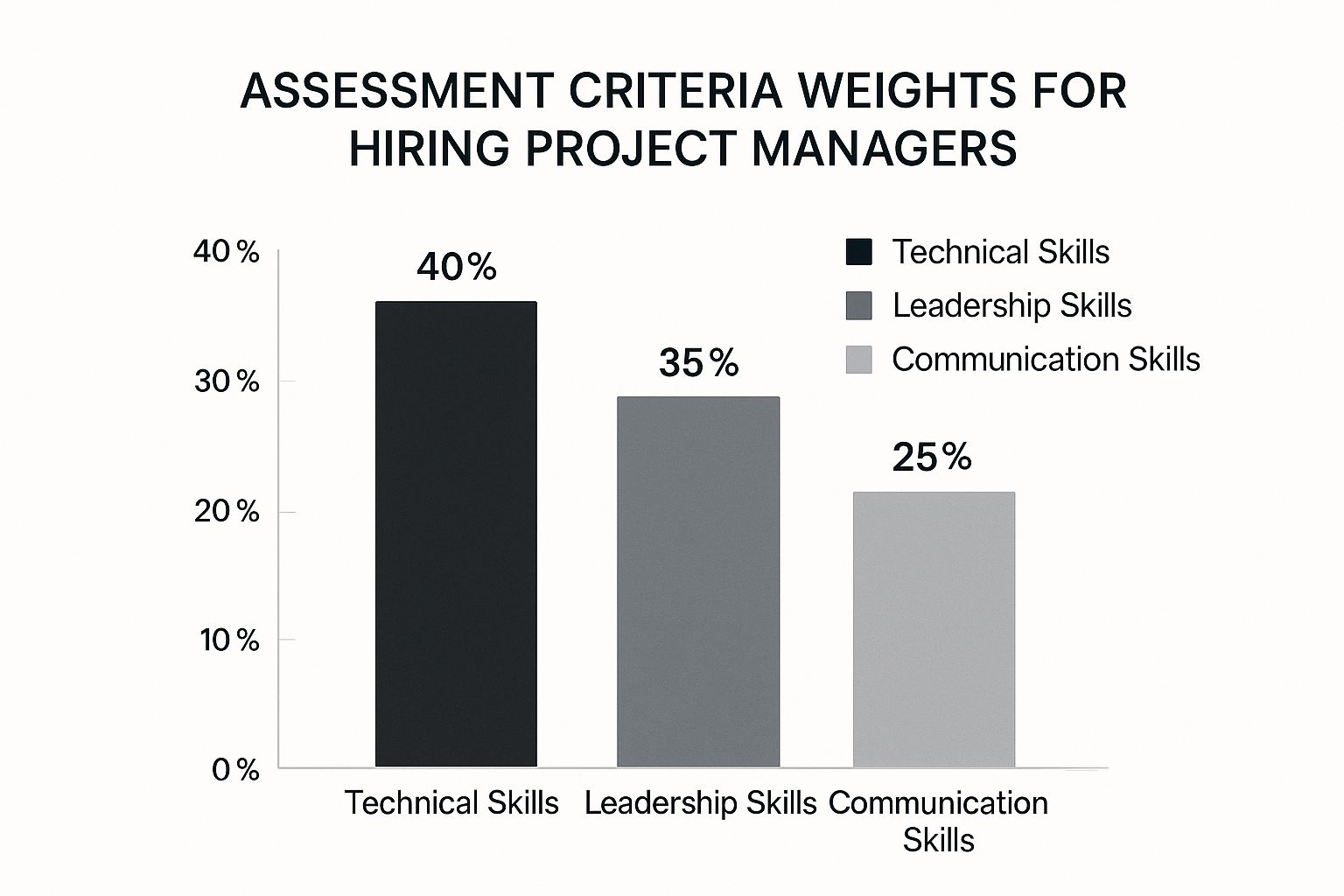
As you can see, while technical know-how is the foundation, leadership and communication are just as vital for a project manager to truly succeed. This balance of skills also explains why salaries can differ so much. Experience in high-demand sectors like energy and consultancy can push average salaries to around £62,500.
Location is a huge factor, too. For example, about 30% of project managers in London earn over £70,000, while in the North East, that figure is closer to 9%. If you're curious, you can find more detailed data on how project manager salaries have increased across the UK on apm.org.uk.
To help you benchmark your own offers, here's a look at some typical salary ranges.
UK Project Manager Salary Averages by Region and Sector
This table outlines the average salaries for project managers across different UK regions and key industries, helping you benchmark your compensation packages.
Region / Sector | Average Salary | Percentage Earning £70k+ |
|---|---|---|
London | £67,500 | 30% |
South East | £62,500 | 22% |
Scotland | £57,500 | 15% |
Midlands | £55,000 | 12% |
North West | £54,000 | 10% |
North East | £52,500 | 9% |
Consultancy | £62,500 | 28% |
Energy | £62,500 | 25% |
IT/Tech | £60,000 | 20% |
Construction | £58,000 | 18% |
Source: Data compiled from APM and other industry salary surveys.
Having a clear understanding of these benchmarks ensures your offer is competitive enough to attract the high-calibre candidates you're looking for, no matter where you're based.
Making The Offer And Onboarding For Success

After all the interviews and assessments, making an offer can feel like you’ve reached the finish line. But really, it’s the start of a whole new phase. Getting your top candidate to say ‘yes’ is a huge win, but what happens next—the offer and the onboarding—is what truly sets the stage for their long-term success with your company.
The offer itself needs to be handled with confidence and clarity. My advice? Always make the offer over the phone first. It allows you to convey genuine excitement and answer any initial questions they might have on the spot. Straight after the call, send a formal written offer that lays out every single detail: salary, benefits, official start date, who they'll be reporting to, and any other key terms. No room for confusion.
Be ready to negotiate. A top-notch project manager knows their worth, and you should always anticipate a potential counter-offer from their current employer. Don’t see this as a battle. Instead, view it as a final conversation to confirm you’re both on the same page. If you did your homework on salary benchmarking, you’ll know whether their request is fair or if it’s misaligned with the market.
Setting Your New Hire Up For Success
Once they've accepted, the real work begins. A messy, last-minute welcome can quickly kill the buzz of starting a new job. A structured onboarding plan is hands-down the best tool you have to get your new project manager settled in and contributing quickly.
This isn’t just about sorting out a laptop and a welcome email. It’s a strategic process. For someone hired to create structure and manage projects, how you manage their arrival speaks volumes.
A great onboarding experience doesn’t just feel good—it improves how quickly someone gets up to speed, boosts their engagement, and can increase retention by as much as 82%. Their first few weeks are too important to leave to chance.
A solid plan gives them purpose from day one. To get started, you might want to look at our onboarding checklist for new employees with 7 essential steps. It's a brilliant resource for building a process you can use again and again.
The First 90 Days: A Strategic Blueprint
The most effective onboarding programmes I’ve seen are broken down into manageable phases. The classic 30-60-90 day plan is a proven framework that works because it sets clear, evolving goals for your new hire.
Here’s a practical example of what that could look like:
First 30 Days: Focus on Learning and Immersion * Meet the key players: Arrange informal chats and formal meetings with all the main stakeholders, their immediate team, and other department heads they’ll be working with. * Understand the tools: Get them hands-on training with your project management software (like Jira or Asana), communication platforms, and any internal systems. * Review past projects: Let them dig into the documentation from a couple of successful projects and one or two that were more challenging. This gives them a real-world look at how your company operates.
Days 31-60: Focus on Contribution and Planning * Take ownership of a small project: Hand them a low-risk project or a self-contained part of a bigger one. It’s a great way to build confidence and let them put what they've learned into practice. * Identify early wins: Encourage them to spot small process improvements they can implement. Quick wins are fantastic for morale. * Deep-dive into project health: Ask them for an initial assessment of the current project portfolio. A fresh pair of eyes can be invaluable.
Days 61-90: Focus on Proactive Leadership * Lead project planning sessions: By now, they should be comfortable enough to drive the planning for new initiatives. * Mentor or support others: This helps cement their position as a leader and resource within the team. * Present strategic recommendations: They should be able to offer informed suggestions on how to improve project delivery or team workflows.
This structured approach turns onboarding from a simple tick-box exercise into a proper strategic investment in your new hire’s future. It sends a powerful message that you’re committed to their success. In a market where job satisfaction is high—with 81% of project professionals reporting they are satisfied in their roles—a standout onboarding experience is crucial for keeping the great people you hire.
Frequently Asked Questions About Hiring Project Managers
When you're looking to hire a project manager, a few key questions almost always come up. Getting these right can be the difference between a good hire and a great one. Let's walk through some of the most common queries we see from UK businesses.
Getting clear on these points from the start helps you sidestep common hiring traps and build a process that finds someone who genuinely fits your company.
What Qualifications Really Matter?
It’s easy to get hung up on certifications. Everyone asks whether they should look for someone with a PRINCE2 or PMP qualification. While these are great indicators of theoretical knowledge, they don't tell you if someone can actually perform under pressure.
Don't let the alphabet soup of acronyms distract you from the single most important qualification: a proven track record. Real-world success is what counts. You need someone who can talk you through projects they’ve delivered that are similar in scale, complexity, and budget to what you have planned.
Think of certifications as the theory test and their project portfolio as the practical driving exam. You want the person who has already proven they can handle the road, not just read the highway code.
How Important Is Industry-Specific Experience?
This is the classic "it depends" question, but the deciding factor is usually how technical your projects are. For highly specialised sectors like construction, engineering, or complex IT software development, you absolutely need someone who knows the landscape. A PM who doesn't understand the specific jargon, risks, and regulations will be playing catch-up from day one.
However, if the role is more focused on managing stakeholders, improving processes, or leading diverse teams, an excellent project manager can often parachute in from a completely different industry and thrive. In these situations, focus on the core skills that are transferable anywhere.
Look for:
Exceptional communication: Can they keep everyone, from the execs to the junior staff, on the same page?
Proactive risk management: Are they skilled at spotting trouble on the horizon before it becomes a full-blown crisis?
Expert stakeholder engagement: Do they have the finesse to manage expectations and build a consensus?
These fundamentals are the bedrock of good project management, no matter the industry.
Should We Use A Recruitment Agency?
This really comes down to a strategic decision based on your internal resources. A specialist recruitment agency can be a game-changer if you're stretched for time, need to fill the role urgently, or are searching for a very niche skill set. They have deep networks of passive candidates—those brilliant people who aren't actively job-hunting but would move for the perfect role.
The flip side is that handling the search yourself gives you total control over the process and how your company is presented. It can also be more cost-effective, assuming your team has the time and the know-how to run an effective search. Your choice should balance your immediate needs, budget, and in-house capabilities.
At Talent People, we connect high-growth organisations with the kind of project management talent that thrives in complex, fast-moving markets. Our agile, project-based hiring solutions ensure you find leaders who are ready to deliver from day one. Find out how we can help you build your high-performing team.

Comments