Employer Branding for Recruitment: Attract Top Talent Easily
- Talent People

- Jul 14, 2025
- 17 min read
Ever wonder what makes a company a "great place to work"? It’s not just about perks and pay cheques. It’s about their employer brand – the gut feeling people have about working there.
Think of it as your company's reputation as an employer. It's the collection of stories and perceptions that current, past, and potential employees share about your culture, values, and the opportunities you offer. A strong, genuine brand acts like a magnet, pulling in the right kind of talent.
Why Your Employer Brand Is Non-Negotiable Today
Here’s the thing: every company has an employer brand. The only question is whether you’re actively shaping it or letting it be defined by hearsay, inconsistent employee experiences, and dusty old job descriptions.
Leaving it to chance is a huge risk. Taking control means you stop reactively scrambling to fill roles and start proactively building a pipeline of fantastic people who are genuinely excited to join your team. You get to tell your own story.
The Power of Perception in Attracting Talent
When your employer brand is clear and authentic, it does more than just fill jobs faster; it changes the game entirely. By showcasing what it’s really like to work for you, you connect with people who share your values and vision. This natural filtering process leads to some serious benefits:
Better quality applicants: You don't just get people with the right skills; you get people who will thrive in your environment.
Improved employee retention: When the reality of the job matches the promise, new hires are far more likely to stick around for the long haul.
Lower hiring costs: A strong reputation means talented people come to you, reducing your reliance on expensive recruitment agencies.
A strong employer brand is your most effective recruitment tool. It's the difference between actively hunting for talent and having talent actively hunt for *you*.
Actively managing your brand transforms recruitment from a stressful cost centre into a real competitive advantage. The table below illustrates the stark difference between a managed approach and letting your brand drift.
Managed vs. Unmanaged Employer Brand Outcomes
Recruitment Aspect | Managed Employer Brand | Unmanaged Employer Brand |
|---|---|---|
Candidate Quality | Attracts skilled, culturally-aligned candidates | Receives a mix of qualified and mismatched applicants |
Application Volume | Consistent inbound flow of interested talent | Unpredictable, often requires active sourcing |
Time-to-Hire | Shorter hiring cycles due to a pre-vetted pipeline | Longer, drawn-out processes to find the right fit |
Hiring Costs | Lower reliance on paid ads and recruitment agencies | Higher spend on sourcing and third-party fees |
Employee Retention | Higher retention as expectations match reality | Higher turnover due to culture-clash and unmet expectations |
Company Reputation | Seen as an employer of choice | Reputation is inconsistent or unknown |
As you can see, the outcomes aren't even close. A managed brand puts you in control, delivering consistent, high-quality results across the board.
Staying Ahead in Today's Hiring Market
Even with economic shifts and a UK unemployment rate recorded at 4.4%, finding the right people remains a top concern. In fact, a staggering 57% of HR professionals still cite talent attraction as their biggest hiring challenge.
To win, smart companies are borrowing from the marketing playbook. They're using targeted messaging and clear brand positioning to stand out in a crowded market. This strategy isn't just about getting people through the door; it's about creating a great experience from onboarding to long-term retention. It proves that a powerful employer brand is crucial for the entire employee journey. You can learn more about these recruitment trends and their impact on UK businesses.
The Building Blocks of a Magnetic Employer Brand

A powerful employer brand isn’t something that just appears out of thin air. It’s carefully built, piece by piece, from several core components that need to work in harmony. Think of it like building a house. You need a solid foundation, a distinct architectural style, and a welcoming interior to make it a place people truly want to live.
The same idea applies directly to employer branding for recruitment. To build a brand that genuinely connects with the right talent, every element has to be authentic and consistent. Let's break down these essential building blocks.
Your Employer Value Proposition (EVP)
At the very heart of your employer brand lies the Employer Value Proposition (EVP). This is the bedrock, the core promise you make to every single employee. It answers that one crucial question every candidate is thinking: “Why should I work for you over all the other options out there?”
Your EVP is so much more than a simple list of benefits or a salary bracket. It’s the unique blend of rewards, culture, and opportunities that people get in return for bringing their skills and dedication to your team. A strong EVP makes it crystal clear what makes your company a special place to build a career.
For an EVP to really work, it must be:
Authentic: It has to reflect the real, day-to-day experience of your team—not some polished, aspirational fantasy.
Compelling: It should shine a light on what makes you attractive to your ideal candidates. Is it groundbreaking projects, rapid career growth, or a deep commitment to work-life balance?
Distinct: It needs to set you apart from the competitors who are all trying to attract the same people.
Think about a brand like Patagonia. Their EVP is woven into their commitment to environmental activism and employee well-being. This naturally pulls in talented people who share those exact values, making their recruitment efforts incredibly focused and successful.
Your EVP is your brand's true north. It's the give-and-get agreement between the company and its people, defining the value that keeps everyone engaged and motivated.
The Personality of Your Workplace Culture
If the EVP is the promise, then your company culture is how that promise comes to life every single day. Culture is the personality of your business—it’s the shared values, unspoken rules, and common behaviours that define how work actually gets done. It's what makes a workplace feel collaborative and innovative versus one that feels rigid and top-down.
You can see your culture in action through things like:
The leadership styles and how decisions are made.
The general feeling of teamwork and collaboration.
The focus placed on learning and development.
The way you celebrate and reward good work.
A positive, clearly defined culture is a massive advantage in recruitment. When candidates see a culture that clicks with their own values and how they like to work, they start to feel a sense of belonging before they've even sent in their CV. That initial connection is vital for keeping them around for the long haul.
Brand Voice and Visuals
Finally, how you talk about your EVP and culture is just as important as what they are. This is where your brand voice and visual identity step in to do the heavy lifting.
Brand Voice: This is the consistent tone and style you use everywhere, from your job descriptions to your social media updates. Are you formal and corporate, or more casual and witty? Your voice should be a natural extension of your culture and resonate with the people you want to hire.
Visual Identity: This covers your logo, colour scheme, and the types of photos and graphics you use. Keeping your visuals consistent across your careers page, LinkedIn profile, and other recruitment channels makes you look professional and instantly recognisable.
When you bring all these elements together, you create an employer brand that is cohesive, authentic, and magnetic.
Your Step-by-Step Employer Branding Playbook
Building an employer brand that genuinely attracts the right people isn't something that happens overnight. It's a deliberate process. This playbook will walk you through the practical steps to get it right, moving from abstract ideas to concrete actions that build a rock-solid foundation for your employer branding for recruitment.
The journey starts by taking an honest look in the mirror to figure out where you stand today. From there, you'll get crystal clear on who you want to hire and what you need to say to them. This is all about tangible actions—like surveying your team and seeing what the competition is up to—that lead to confident and effective results.
Start With an Internal Audit
Before you can broadcast your story to the world, you have to understand the story being told within your own company. The most powerful and authentic brand messages come directly from the real, day-to-day experiences of your current employees. The first step is to gather some honest feedback.
Anonymous surveys are a brilliant way to do this. Ask your team what they genuinely love about working for you, what they think makes the company special, and where they feel things could be better. Their unfiltered answers are pure gold—the raw material for your entire brand story.
Your employees are your most credible brand ambassadors. Their daily experiences are the truest reflection of your company culture and the ultimate test of your Employer Value Proposition (EVP).
Define Your Ideal Candidate Personas
Once you’ve got a handle on your internal reality, it’s time to define who you’re trying to attract. It's impossible to write compelling messages if you don't know who you're talking to. This is where candidate personas come into play.
A candidate persona is a semi-fictional sketch of your ideal hire. It needs to go much deeper than just a job title and a list of skills. Think about:
Motivations: What really gets them out of bed in the morning, career-wise? Are they hunting for innovation, stability, or a deeper sense of purpose?
Challenges: What are their biggest headaches in their current job or during their job search?
Information Channels: Where do they actually hang out online? Are they glued to LinkedIn, lurking in niche industry forums, or scrolling through specific social media feeds?
Creating just two or three detailed personas helps you sharpen your messaging and pick the right channels to reach the right people. This simple step ensures your recruitment marketing budget isn't wasted, focusing your efforts on individuals who are far more likely to thrive with you. Adopting targeted methods like this is a core principle of modern talent acquisition. For a deeper dive, our guide to agile recruiting in the UK is a great resource.
Craft Your Core Messages and Choose Your Channels
With your internal truths uncovered and your ideal candidates defined, you can now start crafting your core messages. These are the key stories and value points that will be the backbone of all your content. Don’t just list benefits; focus on what truly makes you different.
Next, decide where you're going to tell these stories. The key is to be strategic—don't try to be everywhere at once. Use what you learned from your candidate personas to select the channels that will give you the most bang for your buck.
Your Careers Page: Think of this as your brand’s home base. It must be more than just a dry list of vacancies. It should be an engaging window into your culture, showcasing employee stories and clearly explaining what people get from working with you.
Social Media: Go where your ideal candidates are. Use LinkedIn for professional insights and to establish thought leadership. Meanwhile, a platform like Instagram can offer a more visual, behind-the-scenes peek at your team and work environment.
Job Review Sites: You need to actively manage your reputation on sites like Glassdoor. Make a point to respond to all reviews—the good and the bad. It shows you're listening and aren't afraid of transparency.
This infographic shows a simple flow for seeing how these activities connect to your brand perception and, ultimately, your recruitment success.
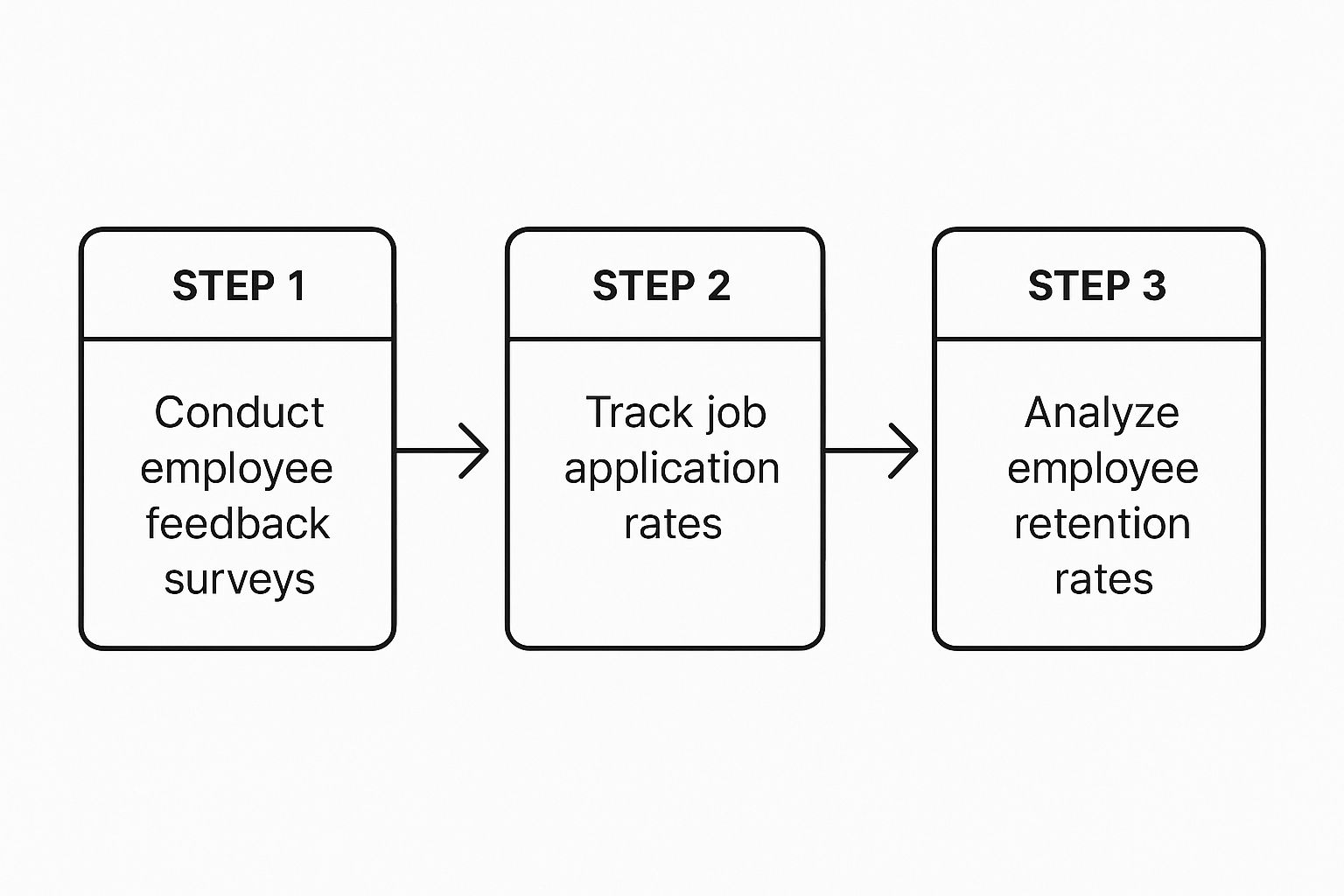
This process reveals a powerful feedback loop. By starting with your own team's insights and consistently tracking things like application and retention rates, you create a cycle of continuous improvement for your employer brand.
How to Showcase Your Brand in a Digital World

Your employer brand doesn’t just live in a policy document; it's out there in the digital world, shaping what potential candidates think about you every single day. To make your employer branding for recruitment truly work, you need to tell your story on the right digital stages. This isn't just about posting on a job board anymore—it's about creating a whole online ecosystem that builds trust and makes a genuine connection.
The trick is to figure out where your ideal candidates are actually spending their time and then tailor your message to fit the platform. LinkedIn, for instance, is brilliant for professional storytelling, sharing industry insights, and cementing your reputation as a leader in your field. On the other hand, platforms like Instagram or even TikTok can offer a more relaxed, unpolished peek into your company culture—think team events, behind-the-scenes snippets, or a day in the life of your team.
This strategic, multi-channel approach isn't just for a handful of companies; it's quickly becoming the norm. Recent findings show that 72% of UK companies already have a formal employer branding strategy in place, with another 19% busy creating one. And where are they focusing? Social media. A massive 98% of UK firms now use it for recruitment. But the key is authenticity. According to research from HR.com, 61% of people are far more likely to engage with posts that feature real employees over slick, corporate stock photos. You can read more about these findings on employer branding from HR.com.
Optimise Your Digital Touchpoints
To really bring your brand to life, you need to zero in on the digital assets that candidates interact with the most. Each one is a chance to make an impression.
Your Careers Page: Think of this as your brand’s digital home. It shouldn’t be a boring list of job openings. Turn it into a vibrant hub with employee testimonials, videos that show off your work environment, and a crystal-clear explanation of your Employer Value Proposition (EVP). This is where you turn a curious visitor into an eager applicant.
Professional Networks: Platforms like LinkedIn are for more than just posting jobs. Use them to share company milestones, celebrate your team's successes, and publish articles that show you know your stuff. It helps position your company as a place where professionals can truly build a career.
Review Sites: Make no mistake, candidates will look you up on sites like Glassdoor. The best approach is to be proactive. Encourage your current team to leave honest reviews, and make sure you respond thoughtfully to all feedback—the good and the bad. It shows you’re transparent and genuinely care about being a great place to work.
Create Content That Genuinely Connects
At the end of the day, the content that resonates most is authentic and tells a human story. Stock photos and corporate buzzwords just create distance. Real stories build bridges.
A candidate’s experience with your digital channels is a direct reflection of your brand. A smooth, informative, and engaging online presence signals a well-organised and employee-focused company.
By carefully managing these online interactions, you're not just marketing—you're investing in the entire candidate journey. A strong digital footprint doesn't just attract top talent; it sets the stage for a fantastic first impression. If you’re looking to go a step further, you can explore our guide on how to improve the candidate experience with top strategies and tips.
Alright, let's move from theory to reality. It's one thing to understand the concepts behind employer branding, but it’s another to see how it works in the wild.
We're going to break down how some top UK companies put these ideas into practice, turning their employer branding for recruitment into a powerful magnet for talent. By looking at examples from fast-paced tech firms to household-name retailers, you'll see how a unique Employer Value Proposition (EVP) becomes real, compelling content that speaks directly to their ideal candidates.
Think of these as mini-case studies. They're packed with practical ideas you can borrow and adapt for your own company, whatever your size or industry.
Example One: The Tech Scale-Up
Imagine a fast-growing tech company in London or Manchester. They're not just competing for customers; they're in a constant battle for the best software engineers, product managers, and data scientists. Their employer brand isn't built on decades of history. It’s built on the promise of innovation, autonomy, and the chance to make a real impact—fast.
So, where do they show up? They go where the tech talent lives online. Think specialised forums, active GitHub profiles, and a heavy presence on LinkedIn. Their content is anything but corporate fluff. Instead, you'll find:
Behind-the-scenes videos that give a raw look at their agile development process.
Blog posts written by their own engineers, diving deep into a tough technical problem they recently cracked.
"Ask Me Anything" (AMA) sessions on platforms like Reddit, where senior developers answer unfiltered questions from the community.
This strategy cuts through the noise. It skips the generic corporate jargon and gets straight to what truly motivates top tech professionals: the opportunity to solve interesting puzzles alongside other brilliant people.
Example Two: The Major Retailer
Now, picture a large UK retailer. Their recruitment challenge is completely different. They need to attract a huge number of people for a vast range of roles—from part-time store assistants to logistics experts and marketing executives in their head office.
Their employer brand needs a wider reach. It often revolves around stability, being a pillar of the local community, and offering clear, structured career paths within a large, successful organisation. Their strategy is broad and multi-channelled. They might use Instagram to showcase team spirit and local charity events, while their main careers site features detailed video testimonials from employees who started on the shop floor and are now in management. This layered approach ensures their brand connects with all the different people they need to hire.
The common thread here is authenticity. The best brands don't just invent a culture for their recruitment campaigns. They shine a spotlight on the culture that’s already there, making it visible and attractive to the right people.
The Growing Importance of Flexibility
There's been a seismic shift in what people want from a job, and flexibility is at the epicentre. It’s no longer a nice-to-have; for many, it's a deal-breaker. An estimated 28% of the UK working population now works in a hybrid model, mixing home and office life.
Even more telling, a recent survey found that a staggering 71% of office workers would reject a job offer if it meant a long commute. This isn't just a preference; it’s a fundamental change in priorities. Today's talent values trust and autonomy over old-school presenteeism.
Winning employer brands get this. They actively show how they support flexible working, focus on skills rather than rigid qualifications, and trust their people to get the job done. To see how this trend is affecting hiring, you can explore some marketing recruitment insights about what to expect. This proves that to be effective, an employer brand must evolve along with our definition of what makes a workplace great.
Measuring the Real Impact of Your Employer Brand
So, you’ve put in the work to build a great employer brand. But how do you actually know if it's making a difference? It’s easy to get sidetracked by things like social media likes, but those don't tell the whole story. To see the real value, you need to connect your branding efforts to concrete results in your business.
Tracking the right numbers shows you what’s working and what’s not. This isn’t about vanity; it’s about measuring the real-world impact on your hiring success and, ultimately, your bottom line. It’s how you prove that your investment is paying off.
Key Metrics That Truly Matter
To get the full picture, you need to look at metrics across the entire journey, from the first time someone hears about you to how long they stay with the company. These figures tell a story about how healthy and effective your employer brand really is.
Here are a few of the most important metrics to keep an eye on:
Application Completion Rate: This one’s simple but powerful. It tracks the percentage of people who start an application compared to those who actually finish it. If you see a big drop-off, it might mean your application process is clunky or your brand’s promise isn’t strong enough to keep them engaged.
Cost-per-Hire: Think of a strong employer brand as a talent magnet. It naturally pulls people in, so you don't have to rely as much on costly recruitment agencies or job ads. If your cost-per-hire starts to go down, it’s a clear sign your brand is doing the heavy lifting for you.
Quality of Hire: This is arguably the most critical measure of success. It looks at how well new hires perform in their first year. When you attract candidates who are a genuine cultural fit, they tend to get better performance reviews and settle into their teams much more quickly.
Focusing on these practical numbers helps you build a solid business case for your branding work.
Linking Brand Strength to Business Success
A compelling employer brand does more than just make recruitment easier—it makes the whole organisation stronger. The data you gather can shine a light on the wider employee experience and point out where you can improve.
For example, if you see a high number of quality applicants coming from employee referrals, that's a massive win. It’s proof that your current team is happy and engaged enough to become your best brand ambassadors.
When your employees become your best recruiters, you've achieved the gold standard of employer branding. It proves your internal culture perfectly matches the external promises you're making.
A great brand also has a direct effect on keeping your people around. When someone joins your company because they believe in its values and vibe, they’re far more likely to stay for the long haul. This lowers staff turnover and all the costs that come with it. For more on this, our guide to reduce staff turnover in your UK business offers practical strategies.
To help you translate these ideas into action, the table below breaks down some of the most important metrics for tracking your employer branding success.
Key Metrics for Employer Branding Success
Metric | What It Measures | Why It Matters for Recruitment |
|---|---|---|
Source of Hire | Where your successful candidates come from (e.g., referrals, careers page). | Shows which channels are delivering the best talent, helping you focus your budget. |
Time-to-Hire | The number of days between opening a job and a candidate accepting an offer. | A shorter cycle often indicates a stronger pipeline of pre-interested candidates. |
Offer Acceptance Rate | The percentage of candidates who accept a formal job offer. | A high rate suggests your brand and EVP are compelling and competitive. |
By consistently tracking these figures, you can move from simply doing employer branding to strategically managing it for tangible, long-term results.
Common Employer Branding Questions Answered
Even with a solid plan in place, putting your employer brand into action can throw up some practical questions. It’s one thing to talk theory, but another to make it work on the ground. Let's clear up a few of the common hurdles that can get in the way.
How Can a Small Business Build an Employer Brand with a Limited Budget?
You don’t need a massive budget to create a powerful employer brand. What you truly need is to be genuine and smart with your efforts. For smaller businesses, the trick is to play to your strengths and use channels that deliver a big impact for a small cost.
Start with your greatest asset: your people. Encourage them to share their honest experiences on professional networks like LinkedIn. Make a point of gathering positive reviews on sites like Glassdoor, and build a simple, straightforward careers page. Zero in on what makes you unique. Is it the close-knit team? The direct access to leadership? The opportunity to make a real difference in a smaller company? Consistency will always beat cash.
The most common mistake is creating a brand that doesn't match the actual employee experience. Authenticity is crucial. If your marketing promises a collaborative, flexible culture but the reality is rigid and siloed, you will quickly lose trust and damage your reputation.
How Long Does It Take to See Real Results?
Building a strong reputation is a marathon, not a sprint. While you might see some quick wins, like a bit more traffic to your careers page in a few weeks, the real, meaningful change takes time to build.
You can realistically expect to see some early positive signs within 3-6 months. This could be a noticeable uptick in the quality of applications you receive or better engagement on your social media posts. The bigger prizes, however—like a significant drop in your cost-per-hire or better employee retention rates—usually start to become clear after about 12-18 months of consistent, authentic work.
What Is the Single Biggest Mistake to Avoid?
The most damaging mistake you can make is faking it. It's incredibly tempting to create an "aspirational" brand that sells the culture you want to have, rather than the one you actually have. This approach always ends badly.
Great candidates can smell a disconnect from a mile off. If your job ads shout about flexibility and autonomy, but new hires are met with a culture of micromanagement, that trust is broken instantly. This doesn't just lead to people leaving quickly; it creates negative word-of-mouth that can poison your reputation for years. Your employer brand must be a true reflection of your day-to-day reality, warts and all.
We've covered some of the most pressing questions that come up when putting an employer branding strategy into practice. To make things even clearer, here’s a quick-reference table with answers to a few more common queries.
Frequently Asked Questions
Question | Quick Answer |
|---|---|
How do I get my employees involved? | Start by asking for their stories. Run internal surveys, conduct informal chats, and feature them in your content. Make it easy for them to share pre-approved posts on social media and recognise them for their contributions. |
What if we receive negative reviews online? | Address them professionally and transparently. Thank the reviewer for their feedback, acknowledge their experience without getting defensive, and briefly state how you are addressing the issue. Ignoring them is the worst thing you can do. |
Should our employer brand change over time? | Yes, it should evolve. As your company grows and your culture matures, your brand should reflect that. It’s not about constant rebranding, but about periodic reviews to ensure it remains authentic and relevant to who you are now. |
Is employer branding only for recruitment? | Not at all. While it’s a powerful recruitment tool, it’s also crucial for employee retention and engagement. A strong brand reminds your current team why they joined and why they should stay, fostering a sense of pride and belonging. |
Hopefully, these answers give you the confidence to move forward and build a brand that truly attracts and keeps the right people.
Building a high-performing team in a competitive market requires more than just a good brand; it requires a specialist recruitment partner. Talent People designs agile, project-based hiring solutions for high-growth organisations in complex sectors like energy, renewables, and technology. If you need to build a team that delivers, discover how Talent People can accelerate your success.

Comments