Mastering Tech Talent Acquisition in the UK
- Talent People

- Jul 18, 2025
- 14 min read
Hiring the right tech talent is about more than just filling an empty seat. It’s a strategic game of identifying, attracting, and bringing on board the skilled professionals who will genuinely drive your business forward. This isn't just recruitment—it's about building a sustainable pipeline of talent by making your company a place where great people want to work.
Building Your Tech Recruitment Foundation
Before you even think about posting a job advert, you need to lay the groundwork. A solid tech talent acquisition strategy starts by connecting your hiring efforts directly to the company's biggest goals. Getting this right from the beginning saves you from expensive hiring mistakes and makes the entire process run much smoother.
The UK's tech recruitment scene is finding its feet again after a period of uncertainty. With the economy expected to grow and big names like Google and Microsoft investing heavily, the race for top tech talent is as fierce as ever. A recent LinkedIn survey really brought this home, revealing that 68% of UK tech professionals were on the lookout for a new job. That’s a huge opportunity for companies that are ready to capture their attention.
Define Your Ideal Candidate Persona
Generic job descriptions just don't cut it anymore. To find the right people, you have to know exactly who you're looking for. This means creating detailed candidate personas for your key roles.
Forget the vague wish list. Think about what a 'Senior DevOps Engineer' or a 'Mid-Level Full-Stack Developer' truly wants. What does their perfect day at work look like? What technologies get them excited, and what kind of team culture will help them do their best work?
A powerful persona should cover:
Technical Skills: The specific languages, frameworks, and tools they need to know inside and out.
Soft Skills: How they collaborate, solve problems, and communicate with the team.
Motivations: What gets them out of bed in the morning, beyond a paycheque? Is it the freedom to innovate, or the chance to tackle really complex problems?
Think of your persona as a North Star for your hiring process. It ensures everyone, from the recruiter to the final interviewer, is completely aligned on what a brilliant hire for that role actually looks like.
Craft a Compelling Employer Value Proposition
Your Employer Value Proposition (EVP) is your core promise to every candidate. It's the unique mix of benefits, culture, and opportunities that makes your company stand out. For tech professionals, this often goes way beyond salary. They’re looking for meaningful projects, chances to keep learning, and the autonomy to make a real impact.
Nailing your EVP is a crucial piece of the puzzle. A well-thought-out plan can be the deciding factor for a top candidate. If you're looking for a structured way to build this out, using a talent acquisition strategy template can help you cover all your bases.
This table breaks down the core elements that tech candidates value most in a potential employer, helping you craft a more compelling offer.
Key Components of a Tech Employer Value Proposition (EVP)
Component | Description | Example for a Tech Role |
|---|---|---|
Compensation & Benefits | The complete financial package, including salary, bonuses, equity, and perks like health insurance or a pension scheme. | A competitive base salary, a performance-based bonus, stock options, and a comprehensive private health plan. |
Career Development | Opportunities for growth, learning new skills, and advancing within the company. | A £2,000 annual learning budget, access to platforms like Pluralsight, and a clear path from Senior to Principal Engineer. |
Work Environment | The physical and cultural atmosphere, including flexibility, team dynamics, and the tools provided. | A hybrid work model (3 days in-office), ergonomic workstations, and a collaborative, no-blame culture. |
Company Culture | The shared values, beliefs, and behaviours that define the organisation. | A focus on innovation and open communication, with regular "demo days" and transparent leadership all-hands meetings. |
By focusing on these areas, you create an EVP that resonates deeply with the kind of talent you want to attract.
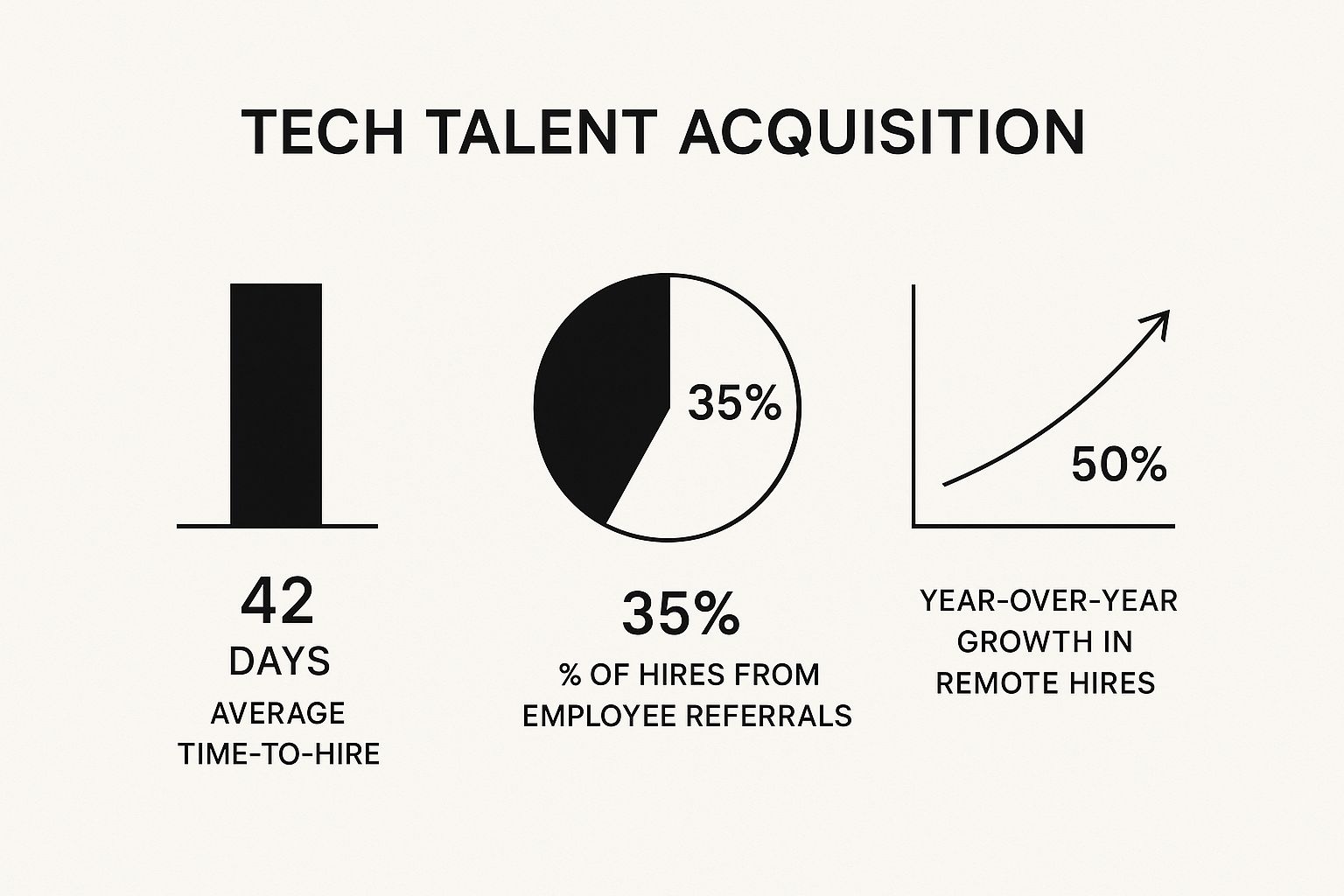
The data here is clear. While hiring quickly is always a goal, building strong internal referral networks and offering flexible work are incredibly powerful tools in today's market.
How to Find and Engage Top Tech Talent

Alright, you’ve got your strategy mapped out. Now comes the real work: finding the talent. If your plan is to just post an ad on a job board and wait for a flood of perfect applications, I have some bad news. That approach stopped working years ago.
Today's tech recruitment is an active pursuit. You have to go out and find the best people where they live and breathe technology, not just where they happen to look for jobs. Top-tier developers, data scientists, and security experts aren't spending their days scrolling through job sites. They're busy building, sharing knowledge, and contributing to communities that matter to them.
Go Beyond LinkedIn
Look, LinkedIn is a great tool, but it's just one tool in the box. Relying on it exclusively means you're missing out on a huge pool of talent. The most skilled technical minds are often most active on platforms centred around their actual work.
Think about it:
GitHub: Don't just scan profiles for keywords. Dive into a candidate’s repositories. See how they code, what projects they contribute to, and what they’re passionate about. When you finally reach out, you can mention something specific you noticed. It shows you’ve done your homework.
Stack Overflow: Someone with a high reputation on Stack Overflow is a proven problem-solver. See who is consistently providing the best answers in your tech stack. These are the experts you want on your team.
Specialist Communities: There are niche Slack channels, Discord servers, and forums for everything. Whether it's a community for Python developers or a forum dedicated to machine learning, that's where the real conversations are happening.
Personalise Your Outreach
Nothing gets your message deleted faster than a generic, copy-and-paste template. In this market, personalisation is non-negotiable. Your first message needs to prove you’ve actually looked at their work and aren't just spamming a list.
A great outreach message is a conversation starter, not a demand for their CV. Reference a specific project they worked on, a blog post they wrote, or an insightful answer they gave in a forum. This small effort shows you see them as an expert, not just another name on a spreadsheet.
That first interaction sets the tone for the entire relationship. Getting this right is a huge part of creating a positive experience from the start. We go into much more detail in our guide on how to improve the candidate experience with top strategies.
Nurture Your Talent Pipeline
The best time to start recruiting for a role was six months ago. The second-best time is now. Building and nurturing a talent pipeline means you're never starting your search from a complete standstill. Keep in touch with promising people, even if you don’t have the perfect role for them right now.
This is especially true in the UK, where hiring is notoriously difficult. While 68% of UK employers are looking to hire, a massive 79% say they struggle to find people with the right skills—particularly in software development and cybersecurity.
This skills shortage, paired with a 45% increase in skilled worker visas, highlights just how critical it is to both nurture homegrown talent and source globally.
By keeping these relationships warm, you create a network of qualified, passive candidates who already know your brand. When the right role finally opens up, your ideal hire is just a friendly conversation away.
Crafting a Tech Interview That Actually Works
Let's be honest: your interview process is one of the loudest signals you send about your company culture. Get it right, and you become a magnet for great engineers. Get it wrong, and you'll send them running for the hills.
A modern tech interview needs to be a two-way street. It’s not just about you grilling the candidate; it’s about them interviewing you, too. The goal is to move beyond abstract brain-teasers and high-pressure scenarios. Instead, create an experience that genuinely reflects the day-to-day work they’d be doing. This gives you a much clearer picture of their real-world skills and gives them a sneak peek into the role, leading to a better fit for everyone.
Building a Sensible Interview Funnel
A well-thought-out interview funnel should build momentum, not burnout. Spreading out your evaluations across a few distinct stages gives you different perspectives on a candidate without asking them to commit to exhausting, day-long interview marathons.
Here’s a structure I’ve seen work wonders:
The First Chat (30 minutes): This is usually with a recruiter or the hiring manager. It’s a simple conversation to get a feel for their background and what they’re looking for next in their career. Crucially, this is where you check for alignment on the big things: salary expectations, remote vs. office work, and what truly motivates them.
The Technical Conversation (60 minutes): Next, they’ll talk to a senior engineer. This isn’t a pop quiz. It’s a deep dive into their past projects, the technical decisions they made, and how they solved tough problems. You're trying to understand how they think, not just what they know.
The Hands-On Challenge (90-120 minutes): This is the core technical test, where they get to show off their practical skills. We’ll dig into what this looks like below.
The Team Fit Discussion (45-60 minutes): A final, more relaxed chat with a couple of people they’d be working with, maybe even someone from a different department. The goal here is to see how they communicate and collaborate, and to give them a chance to ask questions of their potential peers.
It's Time to Rethink the Technical Test
The classic whiteboard interview is, thankfully, on its way out. Why? Because it’s a terrible predictor of actual job performance. It mainly tests how well someone performs under intense, artificial pressure. We can do so much better.
Your technical assessment should feel like a collaborative problem-solving session, not an interrogation. The best candidates want to see how your team works, and this is your first opportunity to show them.
Instead of the whiteboard, try one of these more practical and respectful approaches:
Modern Technical Assessment Methods
Method | Description | Why It Works |
|---|---|---|
Pair Programming | The candidate pairs up with one of your engineers to tackle a small, real-world problem. They use their own laptop and tools. | This mirrors a typical workday. You get to see their coding skills, how they communicate, and how they take feedback—all in a live, collaborative setting. |
Take-Home Project | You give them a small, clearly defined project to complete on their own time, usually over a few days. Be respectful—it should take no more than 3-4 hours. | This lets people show you their best work, free from the pressure of a live audience. It’s brilliant for assessing code quality, structure, and attention to detail. |
System Design Talk | This is a high-level discussion where the candidate architects a solution to a broad problem. It's especially effective for senior roles. | It reveals their ability to think about the bigger picture—scalability, trade-offs, and architecture. These are skills you can't easily test with a small coding challenge. |
Finally, a quick but critical tip: train your interviewers. It’s amazing how much of a difference this makes. Give them structured questions and clear criteria for what "good" looks like. This helps massively in reducing unconscious bias and making fairer decisions. When your panel is aligned, every candidate—whether you hire them or not—walks away with a positive impression of your tech talent acquisition process.
Crafting the Offer and Onboarding for Retention

Getting a 'yes' from your top candidate feels like crossing the finish line, but in reality, it's just the start of the next crucial phase. The period between offer acceptance and their first day is surprisingly delicate. This is your chance to cement a great candidate experience and turn a promising hire into a loyal, long-term asset.
It all starts with putting together an offer that’s not just competitive, but genuinely compelling. In the fast-paced UK tech scene, you need to do your homework on salaries and benefits. Don't just rely on broad industry reports; dig into real-time data for similar roles in your specific city and niche. The total package is what really counts. Equity, bonuses, a truly flexible work policy, and a solid learning budget can often be the deciding factor over a slightly higher base salary elsewhere.
The Art of Negotiation
When it's time to talk numbers, think of it as a collaborative conversation, not a battle of wills. Be open about your salary bands and walk them through the value of the entire compensation package. Confidence comes from preparation—knowing your market data and the absolute top of your budget before you even pick up the phone.
A candidate who feels respected and heard during negotiation is far more likely to join with real enthusiasm. The goal isn't to 'win' by getting the lowest possible number; it's to kick off a professional relationship built on mutual trust and fairness.
Once the contract is signed, the pre-boarding work begins. Radio silence at this stage is a huge mistake and can create doubt. Keep in touch with light, regular communication. A bit of company swag in the post, a welcome email from the team, or a heads-up about some exciting company news goes a long way. These small gestures make them feel like part of the team before they've even set foot in the office.
Building a First-Class Onboarding Experience
Nothing says "we're disorganised" like a chaotic first day, and that's a massive red flag for any new starter, especially sharp tech talent. A well-structured onboarding plan is non-negotiable if you want to set people up for success and keep them around for the long haul.
To make their first week as smooth as possible, you absolutely must have a few things sorted:
Equipment Ready: Their laptop, monitors, and all software access should be ready and waiting on their desk. Spending your first few days chasing IT is a real momentum killer.
A Dedicated Mentor: Assign a 'buddy' or mentor—someone who isn't their direct manager. This gives them a go-to person for navigating the company culture and asking those 'silly' questions they might not want to bother their boss with.
Clear 90-Day Goals: The hiring manager should have a clear, achievable set of goals mapped out for their first three months. This gives them immediate direction and a tangible way to start making an impact.
Putting a solid plan together is vital. To get you started, this detailed onboarding checklist for new employees with 7 essential steps is a great resource. A strong start directly impacts engagement levels and shows you’re invested in their success right from the beginning.
Navigating the Current UK Tech Hiring Climate
Anyone involved in tech recruitment knows it’s a market that never sits still. To succeed, especially in the UK right now, you need more than just a plan; you need a strategy that can bend without breaking. Understanding the current climate is your starting point for building a hiring function that can handle whatever the economy throws at it. It’s all about staying agile.
One of the biggest shifts we're seeing is a real move towards flexibility. While the brakes have been put on permanent hiring in many places, the market for temporary and contract roles has genuinely taken off. This tells a story of businesses prioritising agility when the economic future feels a bit uncertain. For companies that can adapt their hiring, this is a massive opportunity.
Recent market analysis backs this up, showing that temporary roles now account for about 75% of the recruitment market's value. Even with a complicated labour market and fewer permanent jobs being filled, the core demand for tech skills hasn't gone away. We’ve also seen the pool of available candidates grow, partly due to recent redundancies. This has created a competitive field where smart companies can really gain an advantage. If you want to dive deeper into these figures, you can explore more insights about the UK recruitment sector's outlook.
Embracing Flexibility with Contract Roles
Bringing in contractors isn't just a quick fix; it's a smart strategic move. It gives you the power to scale your tech teams as projects demand, without the overhead and long-term commitment of a permanent hire.
This model works brilliantly for a few common scenarios:
Project-specific needs: You can quickly pull in a specialist for a fixed-term gig, like getting a new mobile app over the line or handling a major cloud migration.
Covering critical gaps: It’s the perfect way to fill an essential role immediately while you take the time needed to find the right permanent person.
Trying before you buy: A "contract-to-hire" setup is a fantastic way to see how a candidate performs and fits with the team culture before you make a long-term offer.
The real advantage here is agility. When project timelines and business priorities can shift at a moment's notice, having a flexible workforce is a huge competitive edge.
Sharpening Your Financial and Technological Edge
To do well in this climate, you also need to be disciplined with your recruitment budget and processes. Every single hire, whether they’re permanent or temporary, has to deliver real, measurable value. That means it’s time to get serious about tracking your recruitment metrics.
You should be measuring things like:
Time-to-Hire: How long is it taking you to fill those crucial tech roles? If it’s too long, you’re losing the best people to your competitors. Simple as that.
Cost-per-Hire: What’s the total investment to get someone new on board? Knowing this number helps you justify your budget and find ways to be more efficient.
Quality of Hire: Six months down the line, are your new hires actually hitting their performance goals? This is the metric that connects your team's efforts directly to business results.
At the same time, you can’t ignore the tools of the trade. Modern platforms, often powered by AI, can take a lot of the grunt work off your plate, like sifting through CVs or scheduling interviews. This frees up your recruiters to do what they do best: build relationships and have proper conversations with candidates.
When you pair that financial discipline with the right technology, your tech talent team will be in a much stronger position to handle the challenges—and opportunities—of the UK market.
Answering Your Toughest Tech Hiring Questions

No matter how solid your tech talent strategy is, tricky questions and unexpected roadblocks are part of the game. Being ready for them is what separates the good from the great. Let's tackle some of the most common questions I hear from hiring managers and recruiters out in the field.
Think of this as your go-to guide for smoothing out the kinks in your process, from battling the big-budget giants to making your technical tests fairer and more effective.
How Can We Compete Against Companies With Bigger Budgets?
This is the big one, isn't it? If you're a startup or a growing business, it’s easy to feel like you're priced out of the market when giants are throwing around massive salaries. But money isn't everything, and you can absolutely win top talent by changing the conversation.
Your secret weapon here is your Employer Value Proposition (EVP). You need to get crystal clear on what makes your company a genuinely fantastic place for a tech professional to build their career. Most of the time, the real magic lies in the things money can't buy.
Focus on what you can offer that they can't:
Juicy technical problems and the chance to work with a modern tech stack.
Real autonomy and a direct line of sight between their code and the business's success.
A tight-knit, collaborative engineering culture where people can learn and grow together.
Genuine work-life balance and flexible working that a larger, more rigid corporation might struggle with.
Never underestimate the power of a brilliant candidate experience. A fast, transparent, and respectful hiring process shows you value people's time and expertise from day one. It can make all the difference.
What Is the Best Way to Assess Technical Skills?
The old-school, high-pressure whiteboard interview is on its way out, and for good reason. We've all realised it tests how well someone performs under stress far more than it reveals their actual, day-to-day coding ability. The goal is to see how someone solves problems in a way that feels like the real job.
Your best bet is to shift towards practical assessments that mirror the work they’ll actually be doing. You want to see how they think, collaborate, and write clean code in a realistic setting.
Effective Alternatives to Whiteboard Interviews
Assessment Method | Why It Works So Well |
|---|---|
Pair Programming | The candidate teams up with one of your own engineers to tackle a real problem. It’s a brilliant way to see their communication and teamwork skills in action. |
Take-Home Project | Giving them a small, time-boxed assignment allows them to produce their best work without someone watching over their shoulder. It’s perfect for judging code quality and attention to detail. |
System Design Review | For more senior roles, a chat about architecting a solution to a complex problem is invaluable. It shows you how they think at a high level and plan for scale. |
How Do We Attract a More Diverse Range of Candidates?
Building a diverse team doesn’t happen by accident; it requires deliberate, focused effort. The first step is to give your job descriptions a thorough audit. Use online tools to scrub them of biased or gender-coded language that might be subtly discouraging great people from applying.
Next, you have to actively fish in different ponds. Look beyond your usual networks and post your roles on platforms dedicated to underrepresented groups in the tech world. It's also vital to make sure your interview panel is diverse and that every interviewer has had training to spot and mitigate their own unconscious biases.
Finally, show, don't just tell. Your careers page, your social media, and every message you send should reflect your genuine commitment to creating an inclusive workplace where everyone has the chance to thrive.
At Talent People, we live and breathe this stuff. We specialise in helping high-growth organisations build the high-performing tech teams they need to win. Our project-based, embedded hiring solutions mean you find the right people, faster. Learn how we can accelerate your tech talent acquisition.

Comments