Mastering the Recruitment Outsourcing Process
- Talent People

- Jul 26, 2025
- 18 min read
Diving into recruitment outsourcing is more than just offloading work to an agency. It's a strategic partnership. And like any good partnership, it starts with a bit of honest self-reflection. Before you even think about picking up the phone to talk to potential providers, you need to get your own house in order by setting clear goals and building a watertight business case. This groundwork is what separates a successful outsourcing venture from a frustrating one.
Defining Your Recruitment Outsourcing Goals

Starting this journey without a clear destination is a classic mistake. The most crucial first step in the recruitment process outsourcing journey is looking inwards. It’s easy to say "hiring is too slow," but you need to dig deeper to find the real root of the problem. That means conducting a frank, no-holds-barred audit of how you currently recruit.
You need data. Solid, cold, hard facts. Forget gut feelings or what you think is happening. You need a baseline to measure any future improvements against.
Time-to-Hire: Seriously, how long does it take? Track the days from when a job ad goes live to when your new hire walks in for their first day. Do this for different roles—you’ll quickly see where the real logjams are.
Cost-per-Hire: This is the big one, and it's more than just job board fees. You need to account for your recruiter's salary, agency commissions, tech subscriptions, and even the hours your hiring managers sink into interviews. Knowing the true cost is eye-opening.
Quality of Hire: This can feel a bit fuzzy, but it's vital. Check the performance reviews of new starters after their first year. Who's getting promoted? Who's leaving within 12 months? This tells you if you're actually hiring the right people.
Pinpointing Your Real Bottlenecks
Once you’ve got the numbers, the true story begins to unfold. Maybe you’re struggling to find qualified candidates for those niche roles in the renewables sector. Or perhaps your interview process is so clunky that top tech talent is dropping out before you can even make an offer.
I saw this with a fast-growing energy company. Their time-to-hire for project engineers was creeping over 90 days. The data showed it wasn’t a sourcing issue—they had plenty of applicants. The bottleneck was a chaotic interview scheduling process that involved several senior managers with impossible diaries. That’s a specific problem an outsourcing partner can solve.
A successful partnership isn’t about just handing over a to-do list; it’s about giving an expert a clear problem to fix. Vague goals like "find better candidates" will only ever get you vague results.
Setting Concrete and Measurable Goals
Armed with a clear understanding of your pain points, you can now set proper SMART goals (Specific, Measurable, Achievable, Relevant, and Time-bound). These aren't just for a PowerPoint slide; they become the foundation of your business case and the very key performance indicators (KPIs) you'll use to manage your RPO partner.
So, instead of a woolly objective like "we need to hire faster," you get something sharp and focused:
"Reduce the average time-to-hire for our senior technology roles from 75 days to 45 days within the next six months."
And instead of "we need to save money," you make it tangible:
"Decrease our overall cost-per-hire by 15% in the next financial year by cutting our reliance on contingency recruitment agencies."
You could also aim to access a new talent pool in a specific market, like Saudi Arabia, or focus on improving new hire retention by 20% to slash first-year turnover. Goals like these transform the entire conversation. You're no longer talking about a simple cost-cutting exercise; you're making a strategic investment in the future growth of your company. And that's something your board will actually listen to.
Choosing the Right RPO Partner and Model

Once you've mapped out your internal goals, you’re ready to start looking for the right recruitment partner. This is a huge decision, and it’s about far more than just comparing price lists. You aren't simply buying a service; you're inviting a team to represent your brand to the talent market.
Get this choice wrong, and you could be facing wasted time, a string of poor hires, and a dent in your employer brand. But the right partner? They become a true extension of your own team, driving growth and finding talent you'd never be able to access on your own.
Evaluating Potential RPO Providers
Your evaluation needs to be a proper deep dive. You're looking at a provider's capabilities, their track record, and how well their team will gel with yours. Don't get distracted by a slick sales presentation. Instead, focus on asking sharp questions that get to the heart of how they really operate.
A great place to start is their industry expertise. If you're in the renewables sector, for example, you need a partner who knows the difference between a wind turbine technician and a solar project developer. Ask for specific case studies of projects they’ve delivered in your niche. Who were the clients? What roles did they fill? And what were the results? Be direct.
Next, have a close look at their technology. Lots of RPO providers have access to fancy sourcing tools, but what matters is how they use them. Ask which specific platforms they use to find those hard-to-reach passive candidates, beyond just posting on LinkedIn. Do they have their own database or an established network in key regions like the Middle East or Africa? This is absolutely vital for specialist roles in tough markets.
A critical, yet often overlooked, element is cultural fit. The RPO team will be interacting with your hiring managers and candidates daily. They must be able to speak your company's language and embody its values. A mismatch here can create friction and undermine the entire partnership.
Decoding the Different RPO Models
"Recruitment process outsourcing" isn't a one-size-fits-all term; it covers a whole spectrum of services. Understanding the main models is key to picking one that actually fits your needs, whether you have a short-term project or want a complete overhaul of your hiring.
Here’s a breakdown of the common options:
Project-Based RPO: This is perfect when you have a specific, time-sensitive hiring goal. Maybe you need to hire 20 engineers for a new facility in Namibia or build a sales team for a product launch. The project has a clear start and end, focused on delivering a set number of people.
On-Demand RPO: Think of this as having a recruiter on retainer. It gives you the flexibility to ramp your recruiting support up or down as your hiring needs change. It's a great fit for companies with unpredictable hiring patterns that need an agile solution without a long-term contract.
End-to-End RPO: This is the most comprehensive model. The provider takes on the entire recruitment journey, from sourcing and screening all the way through to offer management and onboarding. It's a genuine strategic partnership, best for organisations that want to completely transform their talent acquisition function.
The Ultimate Vetting Checklist
To bring some structure to your decision-making, use a checklist. This helps you compare each potential partner against the same essential criteria, ensuring nothing gets missed.
Key Vetting Questions:
Industry & Role Experience: Can you provide three recent, relevant case studies in our sector (e.g., energy, technology, mining)?
Sourcing Strategy: What percentage of your placements come from proactive sourcing versus just sifting through job board applications?
Technology & Tools: Which Applicant Tracking Systems (ATS) do you work with? Can you integrate with our current systems?
Cultural Fit Assessment: How do you get to know our company culture and values? How will you make sure this comes across in the candidate experience?
Performance Metrics: How will you measure and report on success? Ask to see sample reports covering metrics like time-to-hire, quality of hire, and cost-per-hire.
Gathering these details will give you a well-rounded view, moving you past the sales pitch to see the practical reality of what they can deliver. To dig even deeper, check out our guide on how to improve your recruitment process with top tips for success, which offers more insights into building a high-performing hiring function.
You’ve signed the contract, shaken hands, and now you’re ready to go. But this is where the real work starts. The success of any outsourced recruitment partnership hinges on what happens next: the integration. Get this right, and your new provider becomes a seamless, high-performing extension of your team. A clunky start, however, can create friction and kill momentum before you’ve even begun.
This isn't about just flicking over a list of job openings. It’s about methodically weaving your RPO partner into the very fabric of your company—your operations, your culture, your way of doing things. The first 90 days are absolutely critical. This is your window to set the tone, build trust, and lay the foundation for a truly successful long-term relationship.
This flow chart gives you a bird's-eye view of the typical stages involved, from the initial deep dive into your needs to making that final, crucial hire.
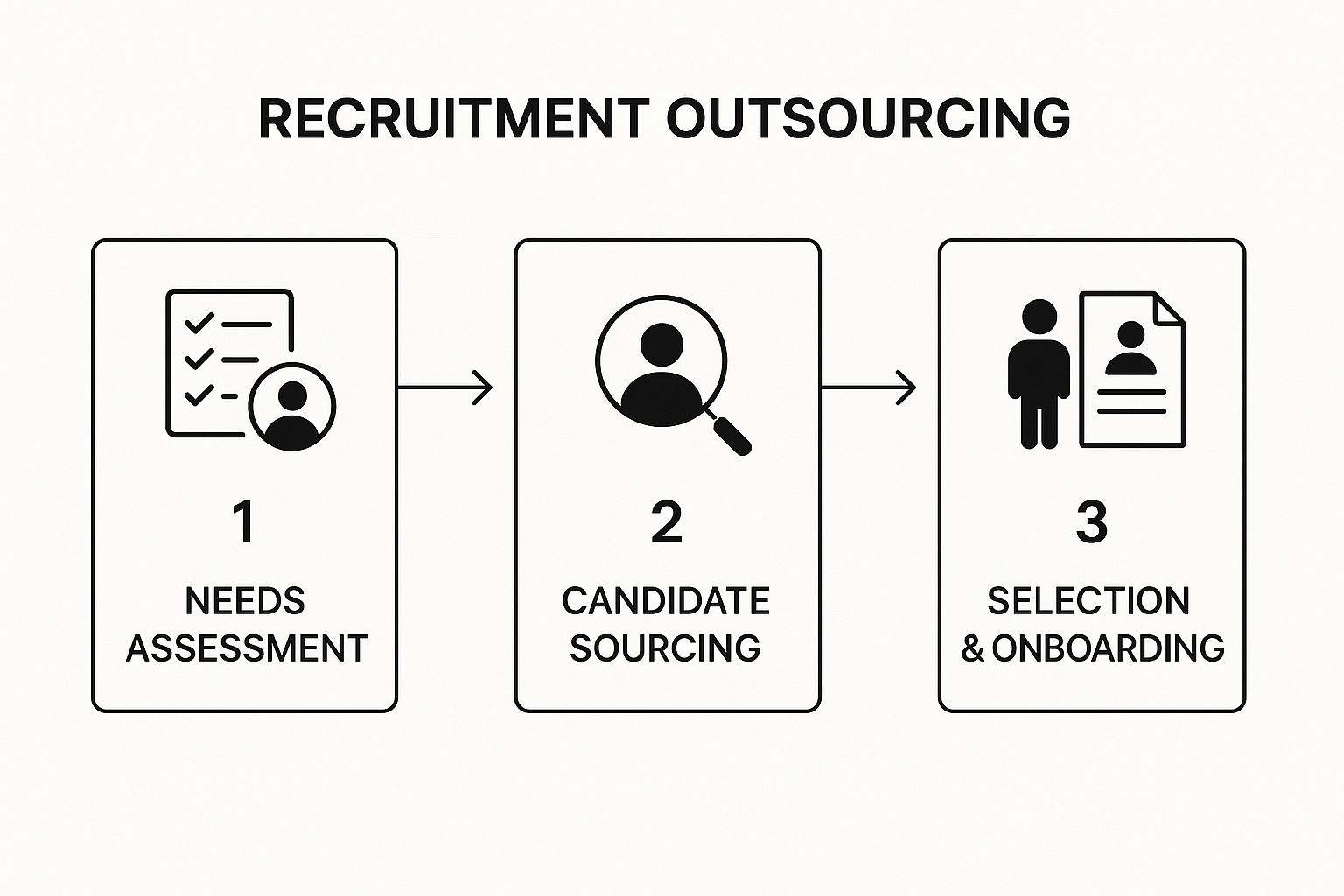
As you can see, it's a logical progression. Each step builds on the last, ensuring the candidates you meet are not just qualified on paper but are genuinely a great fit for your organisation's culture.
Get Your Communication Channels Right
Let's be honest: email chains and weekly catch-up calls just don't cut it. Effective communication is the lifeblood of a healthy RPO partnership. You need a system that feels collaborative and transparent, making your RPO partner feel like they're sitting in the next office, not in another county.
I’ve found that creating a shared Slack or Microsoft Teams channel is a game-changer. It allows for those quick-fire questions, instant feedback on a promising CV, and a constant, easy flow of information between your hiring managers and the outsourced recruiters. This simple step immediately breaks down the formal "client-vendor" wall and fosters a more collaborative "one team" spirit.
Imagine a project manager in Manchester needs to hire for a niche engineering role in Namibia. They can instantly ping a technical question to the RPO sourcer, who can use that specific detail to fine-tune their search. This kind of agile communication prevents delays and keeps everyone on the same page.
The goal here is to completely eliminate any feeling of "us vs. them." Your RPO provider should have the same access to information as your internal team. This builds the trust that empowers them to make better, faster decisions on your behalf.
Set Up Performance Dashboards That Actually Mean Something
Data is your best friend for managing the partnership effectively. While your RPO partner will track their own metrics, you need a shared dashboard that laser-focuses on the KPIs that matter most to your business. Forget "vanity metrics" like the number of CVs sent. Let's talk about what truly moves the needle.
Your dashboard should be simple, visual, and something you review together regularly. I always recommend clients include:
Time-to-Fill by Role/Department: Are we hitting the targets we agreed on?
Source of Hire: Where are our best people really coming from? This insight is gold for optimising sourcing spend.
Hiring Manager Satisfaction: A quick, regular survey can tell you how your internal stakeholders feel about the process and the quality of candidates.
Candidate Experience Score: What are candidates saying about the process? This is invaluable feedback on how your brand is being represented in the market.
This isn’t about micromanaging. It’s about having a shared, objective view of performance. When you and your partner are looking at the same data, conversations become far more productive and are squarely focused on continuous improvement.
Manage Internal Change and Expectations
One of the biggest, and often unforeseen, hurdles is internal resistance. Your hiring managers or existing HR team might see the new RPO provider as a threat, or just another layer of complexity. Getting out ahead of this with proactive change management is non-negotiable.
You have to clearly and consistently communicate the "why" behind this decision. Explain that the RPO partner is here to augment their capabilities, not replace them. I always frame it as a strategic move to free up their time, giving them access to specialist sourcing firepower so they can focus on the high-value work they love, like interviewing and building their teams.
It's also worth noting that the role of recruitment outsourcing is changing. UK SMEs, in particular, are looking for strategic partnerships, not just someone to fill jobs. The trends for 2025 show a growing demand for partners who provide broader workforce insights—things like identifying talent gaps, tackling high turnover, and suggesting ways to improve workforce development. You can learn more by exploring these evolving HR outsourcing trends and how they shape business strategy.
Nail the Handover of Live Roles
A messy handover of active job requisitions is a common and completely avoidable point of failure. You can’t afford to lose momentum or, worse, alienate great candidates who are already in your pipeline.
To get everyone up and running smoothly, a clear checklist of key milestones is invaluable. It ensures both sides know exactly what's expected and when, preventing anything from falling through the cracks during those crucial first few weeks.
Key Implementation Milestones Checklist
Milestone | Key Action | Responsibility (Client/Provider) | Status |
|---|---|---|---|
Kick-off Meeting | Finalise goals, KPIs, and communication protocols. | Both | ☐ |
Tech & Systems Access | Grant provider access to ATS, shared channels, and calendars. | Client | ☐ |
Hiring Manager Intros | Schedule intro meetings between the RPO team and key managers. | Client | ☐ |
Live Role Handover | Detailed briefing on all active roles and candidate pipelines. | Both | ☐ |
Process Finalisation | Agree on the final candidate submission and feedback process. | Both | ☐ |
First KPI Review | Schedule the first 30-day performance dashboard review. | Both | ☐ |
This simple checklist acts as your roadmap. Once it’s complete, you can be confident your new partner is fully equipped to start delivering value right from day one.
Right, so you’ve signed on the dotted line and your RPO partner is officially on board. That’s a huge step, but the real work starts now. Getting the most out of your recruitment outsourcing isn't a "set it and forget it" deal. The best results come from treating it like a true partnership—one that you actively manage and improve over time.
Think of it less as a service you've bought and more as a strategic alliance that needs to grow and adapt right alongside your business. When you get this part right, your RPO provider becomes more than just a recruiter; they become an essential part of your team, spotting challenges before they arise and helping you stay ahead of the curve.
Making Business Reviews Genuinely Useful
We’ve all sat through those Quarterly Business Reviews (QBRs) that feel like a data dump. A long list of metrics is read out, everyone nods, and you leave wondering what the point was. To make these sessions truly valuable, you need to shift the conversation from what happened to why it happened and, most importantly, what we do next.
So, you see your time-to-hire for tech roles in the UAE has dropped by 15%. Fantastic. But don't stop there. The crucial question is, why? Did your partner tap into a new sourcing channel? Did your own hiring managers suddenly get much faster with their feedback? Pinpointing the cause is what allows you to replicate that success across other departments or regions.
A productive QBR is a strategy session, not a report card. Use the data as a launchpad for conversations about the future. What’s the plan for that new project in Saudi Arabia? How are we going to tackle that skills shortage everyone is predicting?
This forward-thinking is critical, especially when the market is all over the place. Take the UK recruitment scene in 2025, for example. We saw permanent hiring dip for the eighth month straight back in May, while temporary roles exploded to make up about three-quarters of the market. Knowing this kind of detail is gold. It helps you and your partner make smart, informed decisions. If you're curious about the specifics, you can dig into these UK recruitment sector trends to see just how market intelligence can shape your strategy.
Giving Feedback That Actually Works
Feedback is the lifeblood of any good partnership, but it has to be the right kind. Vague gripes like "the candidate quality isn't good enough" just don't help anyone. They’re frustrating for you and impossible for your partner to act on. You need to get specific.
Instead of just stating the problem, try framing your feedback this way:
Be Specific: "The last three candidates you sent for the Project Manager role didn't have experience managing budgets over £1 million. That's a deal-breaker for us, as we covered in the initial briefing."
Be Collaborative: "How about we set up a quick calibration call? We can get the hiring manager and your lead sourcer together to go through a 'perfect fit' CV and a 'near miss' one. That should clear things up."
Focus on the Process: "I've noticed it's taking us about two days to get interview feedback logged. Let's brainstorm how we can tighten that up on our end to stop good candidates from dropping out."
This approach completely changes the dynamic. It’s no longer about pointing fingers; it’s about rolling up your sleeves together to solve a problem. It shows your provider you see them as a partner, not just a vendor to blame when things get tricky.
Evolving the Partnership as Your Business Changes
Your business doesn’t stand still, so your RPO relationship can't either. The real test of a great partnership is how it flexes when your priorities change.
Let’s look at a few real-world situations:
Scaling Up for Growth: Your company suddenly decides to launch a new renewable energy division. You need 30 specialists hired in the next six months. A top-tier RPO partner will immediately start scaling their team, mapping out a sourcing strategy for that specific talent pool, and helping you craft a story that will attract them.
Moving into a New Market: You're expanding into Namibia for the first time. Your provider should be your go-to source for market intelligence. What are the local salary benchmarks? Are there cultural quirks in the hiring process? What are the best job boards or networks to use there?
Bringing in New Tech: You're about to roll out a new Applicant Tracking System (ATS). Your RPO partner shouldn’t just know how to use it. They should be able to integrate with it flawlessly and even suggest ways to configure it to make your entire recruitment process smoother.
By keeping the lines of communication wide open and treating your RPO provider like the strategic advisor they can be, you build a relationship that does more than just fill today's empty seats. You build a partnership that helps you win the talent you'll need for whatever comes next.
Solving Common Recruitment Outsourcing Challenges

Let's be realistic. Even with the best partner and a bulletproof plan, outsourcing your recruitment won't always be a perfectly smooth ride. You’re going to hit a few bumps. The real test is knowing how to handle them without letting the whole partnership go off the rails.
Instead of hitting the panic button when things go wrong, I’ve learned to see these moments as a chance to fine-tune our approach and actually strengthen the relationship. A sudden drop in candidate quality or a communication breakdown isn’t a sign of total failure; it's a flare gun, signalling that something needs a quick adjustment.
What to Do When Candidate Quality Dips
This is probably the most frequent headache I see. One week, the CVs hitting your inbox are spot-on; the next, they feel like they’re for a completely different job. The culprit is almost always a gap between what your hiring manager actually wants and what your RPO partner thinks they want.
The fix? A calibration session.
Get your hiring manager and the lead sourcer from your partner in the same room (virtual or otherwise). Don't just re-read the job description. That’s not where the magic happens. Instead, get practical and review specific CVs together:
The "Gold Standard": Pull up the CV of a top performer already in that role. Point out the exact skills and experiences that make them so great. This gives your partner a real-world benchmark.
The "So Close": Look at a candidate who was good but didn't make the cut. Be specific about what was missing. Was it a particular soft skill? A certain type of project experience?
The "Hard No": Go through a CV that was a clear mismatch. This helps solidify the absolute deal-breakers and non-negotiables.
This hands-on approach cuts through the jargon and gets everyone speaking the same language. It creates a much clearer, shared vision of the person you're looking for than any job spec ever could.
A common trap is treating the initial brief like it's carved in stone. Roles change, team dynamics shift, and priorities evolve. Regular calibration isn't just a fix for when things go wrong; it’s a proactive habit that keeps the quality of your talent pipeline high from start to finish.
Overcoming Internal Resistance
You could have the best RPO partner on the planet, but if your own hiring managers are digging their heels in, the process will grind to a halt. This resistance usually stems from a fear of losing control or a belief that "no one outside this company can possibly understand our niche roles."
The key is to bring them into the fold, not just send them updates. Frame the RPO partner as a specialist resource—an extension of their team designed to save them time and tap into a wider talent pool. You can also re-jig your weekly check-ins to be more collaborative. Make it a working session where the manager offers direct feedback and strategic input, not just a one-way status report.
Once managers see that the partnership is bringing in top-tier candidates they couldn't find themselves, you’ll find that resistance quickly melts away. This is especially true in hyper-competitive fields like IT and healthcare. By 2025, the UK staffing market is projected to see 4.3% growth, heavily driven by these sectors. With 57% of UK employees thinking about quitting because they feel undervalued, finding and keeping great people has never been more critical. You can explore more about these trends in the UK staffing report on qxglobalgroup.com.
Fixing Communication Breakdowns
When communication gets shaky, trust disappears fast. Vague updates and slow response times will leave you feeling completely in the dark and wondering what you're paying for. If your weekly call has become a lifeless, box-ticking exercise, it’s time to hit the reset button.
First, pinpoint the real problem. Is it the frequency, the format, or the content of the communication? A weekly email summary might be useless for a role you needed to fill yesterday. Or maybe the reports you're getting are filled with vanity metrics instead of the actionable data you actually care about.
A simple but incredibly effective fix is to redefine the rules of engagement. Agree on a clear, tight agenda for every meeting that focuses on blockers, potential solutions, and key decisions. This forces every conversation to have a purpose. It's also vital to connect your recruitment efforts to the bottom line. For a deeper dive on this, have a look at our guide on [how to calculate your cost-per-hire in the UK](https://www.talentpeople.co/post/how-to-calculate-cost-per-hire-uk-guide-to-recruitment-costs).
By tackling these common issues head-on with practical, straightforward solutions, you can build a resilient and productive partnership that consistently delivers the talent your business needs to grow.
Got Questions About RPO? We've Got Answers
Stepping into recruitment outsourcing is a big move, and it's totally normal to have a long list of questions. It’s a strategic decision, after all, and you need to feel confident before you sign on the dotted line.
Here, we'll tackle the most common questions we hear from companies just like yours. No jargon, just straight answers to help you figure out your next steps.
What’s the Real Cost of Recruitment Outsourcing?
This is usually the first thing people ask, and the honest answer is: it depends. RPO isn't a one-size-fits-all service with a simple price tag. The final cost really comes down to the model you choose and how much support you need.
You'll generally come across a few pricing models:
Cost-per-hire fee: Simple and direct. You pay an agreed-upon fee for every candidate who gets hired. This is great for clear-cut hiring projects where you know exactly how many people you need.
Monthly management fee: This is common for end-to-end RPO. You pay a set monthly fee that covers the management of your entire recruitment function, no matter how many people you hire that month.
Percentage of annual salary: Just like traditional recruitment agencies, the fee is a slice of the new hire's first-year salary.
So, which one is right for you? If your hiring is steady and predictable, a monthly fee can offer great value. If you hire in bursts for specific projects, a cost-per-hire model might make more sense. Always ask for a detailed breakdown so you know precisely what you're paying for.
Will We Lose Control Over Our Hiring?
This is a massive—and valid—concern. But a proper recruitment outsourcing process is built to give you more strategic control, not less. Think about it: you’re handing off the time-consuming tasks like sourcing, screening, and admin. That frees up your internal team to focus on what really matters—interviewing the best candidates and making that final call.
A good RPO provider becomes an extension of your own team, not a replacement. You always, always have the final say on who joins your company. They work to your standards and represent your brand.
The secret to keeping control is setting clear ground rules right from the start. You need to define how you'll communicate, how feedback will be given, and who has the final authority on decisions. When you do that, the provider just becomes a seamless part of your operation. You’re still the one in the driver's seat.
How Long Does It Take to Get an RPO Solution in Place?
The timeline can really vary depending on how complex your needs are. This isn’t something you can switch on overnight; a solid setup is absolutely vital for it to work long-term.
Here’s a realistic look at what to expect:
For a smaller, project-based RPO (say, hiring for a new team), you can often get going in just 2-4 weeks.
For a full, end-to-end RPO solution, you’ll need a bit more time. This involves a much deeper discovery phase, integrating tech (like your applicant tracking system), and managing the change internally. A smooth rollout for this kind of partnership usually takes around 6-12 weeks.
That initial time investment is well worth it. Rushing the setup almost always leads to mismatched expectations and poor results down the line. It pays to build a strong foundation.
Can an Outsider Really Understand Our Company Culture?
Yes, they absolutely can—but it takes a real commitment from both of you. Getting the culture fit right is probably the most important part of the whole deal. A provider who doesn't "get" you will never find people who stick around and do great work.
When you’re vetting potential partners, you need to dig into how they plan to learn your culture. A great provider won’t just scan the "Our Values" page on your website. They should want to:
Spend time with your teams and chat with key leaders.
Get a feel for the unwritten rules and the day-to-day vibe of the office.
Learn the story behind your company and what makes people want to work there.
This "cultural immersion" is a non-negotiable part of the process. It’s what helps the provider go from just matching CV keywords to finding people who are a genuine fit for your team.
Navigating complex projects in the energy and tech sectors requires more than just filling seats—it demands a strategic talent partner who understands your world. Talent People designs agile, project-based hiring solutions that build high-performing teams for high-growth companies. Discover how our embedded approach can accelerate your most critical projects at https://talentpeople.co.

Comments