UK Oil and Gas Recruitment Guide
- Talent People

- Aug 11, 2025
- 16 min read
Let's be honest, the old ways of recruiting in oil and gas just don't cut it anymore. What worked five or ten years ago is now a fast track to frustration. The entire sector is shifting under our feet, caught between the unstoppable drive towards cleaner energy and the rollercoaster of market prices.
To win in this environment, you have to move beyond just posting a job ad and hoping for the best. Success today means actively hunting for talent with a fresh set of skills—people who are digitally savvy, adaptable, and ready for an industry in transition.
Navigating the New Energy Recruitment Landscape
Recruiting for oil and gas roles in the UK used to be fairly straightforward. You knew the skills you needed, where to find the candidates, and what it took to get them on board. Those days are gone. We're now operating in a completely different world, one shaped by profound, long-term change.
This new reality presents a tricky balancing act. You still need to keep your core operations running like a well-oiled machine. But at the same time, you have to find people who can steer the company through the energy transition, embrace new technologies, and manage complex projects with a firm focus on sustainability. It's a tall order, and a passive recruitment strategy is destined to fall short.
The Shrinking Talent Pool
One of the biggest hurdles we face is a rapidly shrinking talent pool. The industry is staring down a demographic cliff edge; a huge number of seasoned experts are heading towards retirement, and not enough young talent is stepping up to fill their boots.
The numbers are genuinely concerning. A recent report from Robert Gordon University (RGU) paints a stark picture, projecting that the UK's dedicated oil and gas workforce could plummet from around 115,000 to as low as 57,000 by the early 2030s. That’s a potential 50% reduction, making every single hire more critical than ever before.
To stay ahead, you need to start thinking more like a marketer and less like a traditional recruiter. This means building an employer brand that stands out and speaks to the priorities of a new generation of professionals.
The core task of modern oil and gas recruitment is no longer just filling vacancies. It’s about building a resilient, adaptable workforce that can thrive amidst uncertainty and lead the charge into a new energy era.
So, where do the best people actually come from? The data might surprise you.
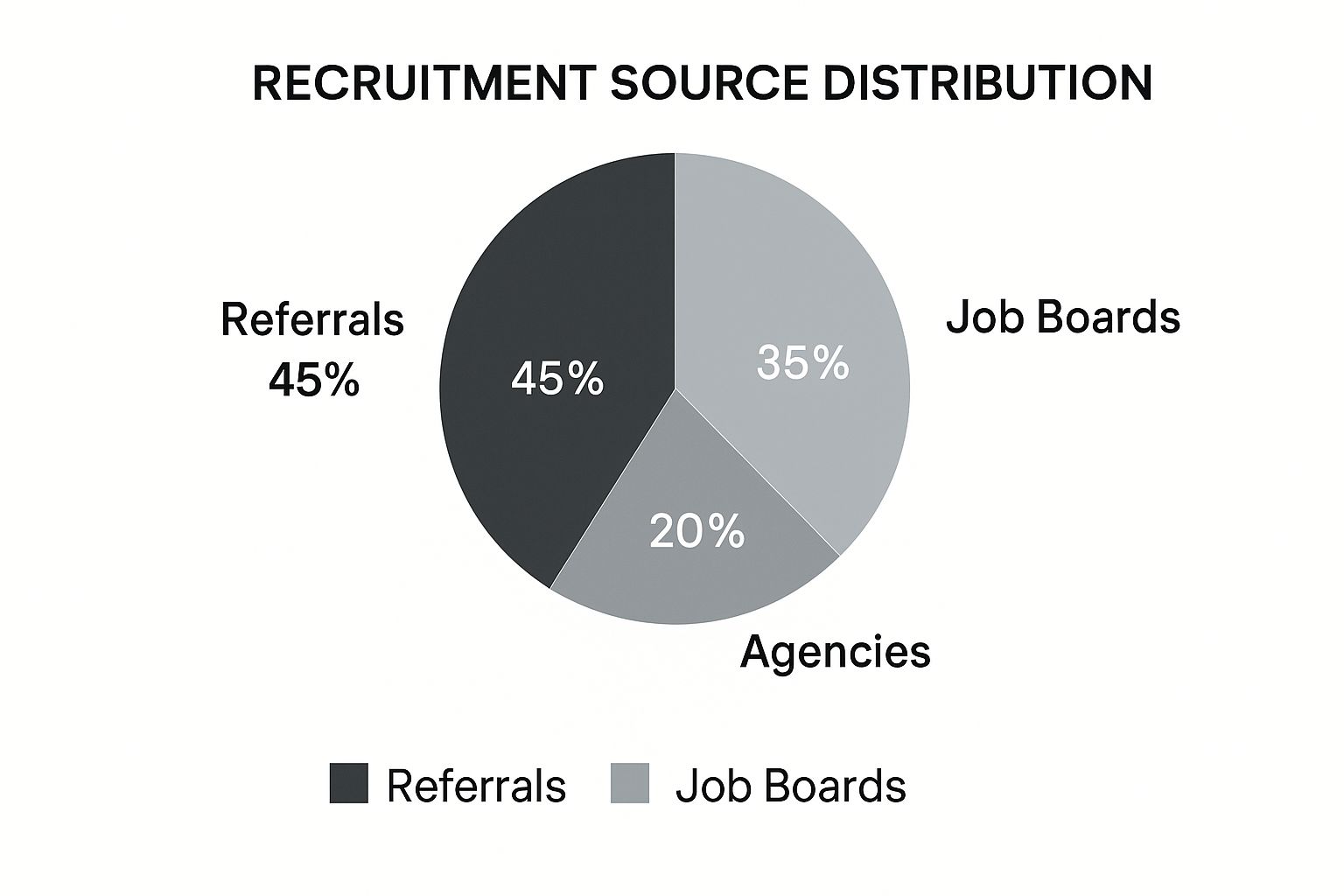
This breakdown shows that a massive 45% of successful hires often come from internal referrals. It’s a powerful reminder that your greatest recruitment tool might just be your current team.
To succeed, it's vital to shift your mindset. Here’s a look at the key strategic shifts needed for effective hiring in today's energy sector.
Rethinking Your Recruitment Approach
Strategic Pillar | Traditional Approach | Modern Approach |
|---|---|---|
Candidate Sourcing | Post job ads on major boards and wait for applications. | Actively hunt for talent across niche platforms, professional networks, and industry events. Build talent pipelines before you have a vacancy. |
Employer Branding | Assume candidates know who you are and what you do. | Proactively build a brand that highlights innovation, sustainability, and career growth. Showcase your company culture. |
Skill Focus | Prioritise legacy technical skills and years of experience. | Seek a blend of core expertise with digital literacy, adaptability, and problem-solving skills for the energy transition. |
Candidate Experience | A long, formal, and often slow application process. | A streamlined, transparent, and engaging process that respects the candidate's time and keeps them informed at every stage. |
Embracing this modern approach isn't just about tweaking your process; it's about fundamentally changing how you view and attract talent. It's the difference between merely surviving and actively thriving in this new landscape.
Building a Recruitment Strategy That Weathers Market Storms
Recruiting in the energy sector isn't for the faint of heart. To succeed, you need a plan that’s as resilient as it is flexible. It’s no longer about just filling an empty seat. You have to build a workforce that can ride out market volatility and embrace the massive shifts of the energy transition.
This means your strategy has to be proactive and forward-thinking, grounded in a real understanding of where your organisation is heading. It starts with asking bigger questions. Instead of just replacing a project manager who's left, you should be thinking: what skills will this role demand in three to five years? Will they need to be an expert in carbon capture, hydrogen infrastructure, or complex data modelling?
This kind of foresight is what separates the leaders from the laggards in oil and gas recruitment. You're not just hiring; you're anticipating skill gaps before they turn into critical operational problems.
Pinpoint Your Future Skill Requirements
Before you start building your team, you need to know what you’re working with. A skills audit is more than just a dusty list of employee qualifications. Think of it as a detailed map of your organisation's collective talent, which you can then overlay onto your long-term business goals.
Let's say your company is planning a major push into geothermal energy. Your audit needs to uncover a few key things:
Your Current Bench Strength: Which of your existing geologists or engineers have skills that could transfer over?
The Gaping Holes: What specific expertise, like geothermal reservoir modelling, are you missing completely?
The Hidden Potential: Can you upskill promising people you already have to fill some of these gaps?
This exercise gives you a crystal-clear picture of your next move: hire, train, or a bit of both. It shifts recruitment from being a simple cost centre to a strategic investment in your company’s future. For more on crafting this foundational plan, our talent acquisition strategy template for success can provide a solid starting point.
Craft an Employer Brand That Actually Attracts People
Once you know who you need, you have to convince them to join you. In a market this competitive, a good salary isn’t enough. You need a compelling Employer Value Proposition (EVP)—the unique promise you make to employees in exchange for their talent and hard work.
Your EVP is your recruitment calling card. It has to be authentic and speak directly to the professionals you want to hire, especially the next generation of engineers and data scientists who care deeply about purpose-driven work and innovation.
In today's energy sector, your EVP must answer one critical question for any top candidate: "Why should I build my career here, in an industry going through such a fundamental transformation?"
This is particularly crucial when the sector faces uncertainty. You only have to look at recent events, like Harbour Energy cutting UK onshore jobs, to see the pressures. Despite layoffs, industry leaders continue to stress the need for a strong domestic workforce, which depends more on smart investment and policy than just market whims.
Set Budgets and KPIs That Matter
Finally, a strategy without clear metrics is just wishful thinking. It’s time to move beyond tired old KPIs like "time-to-fill". You need to track things that actually tell you about the quality and long-term impact of your hiring.
Consider focusing on more meaningful measures:
Quality of Hire: How are your new recruits performing at 90 days, six months, and one year?
First-Year Attrition Rate: This is a direct reflection of how well you're hiring and onboarding.
Source Effectiveness: Which channels consistently deliver the candidates who become your top performers?
Setting a realistic budget is just as critical. This isn't just about paying recruiter fees or for job ads. You need to account for investments in new tech, employer branding campaigns, and training for your hiring managers. When it's properly funded and measured, your recruitment function becomes a powerful engine for growth, ensuring your oil and gas recruitment efforts deliver real, lasting value.
Sourcing Talent Where Your Competitors Aren’t Looking

If your whole oil and gas recruitment strategy is waiting for candidates to come to you, you’re already falling behind. It’s a hard truth. The best people—those reservoir engineers with rare expertise or the project directors known for delivering on time and under budget—are almost never scrolling through job boards. They’re what we call passive candidates, deeply invested in their work and not looking for a move.
To get in front of this top-tier talent, you have to become a proactive talent hunter. This is a big shift. It means moving away from the old ‘post and pray’ method to strategically finding professionals where they are, both online and in the real world. It takes more creativity and a targeted approach, but the payoff is huge: you’ll hire exceptional people your competitors can’t even find.
Beyond the Job Board Horizon
Let's be honest, the standard job boards are saturated. They often bring in a high volume of applicants, but the quality can be disappointingly low. The first real move is to explore the specialised digital and physical spaces where industry experts gather. This is your chance to build genuine connections and spot high-calibre individuals before they even think about changing roles.
Think about professional associations. Groups like the Society of Petroleum Engineers (SPE) or the Energy Institute are absolute goldmines. Their conferences, membership lists, and local chapter meetings are packed with the very professionals you need to hire. Show up to these events not just as a recruiter, but as someone genuinely engaged. You'll build credibility and start spotting the real rising stars.
The same goes for niche online forums and specialised LinkedIn groups covering topics like subsea engineering or drilling optimisation. By participating in these discussions, you can identify true experts and start building relationships organically. If you want to explore more modern sourcing methods, you might find our guide on effective candidate sourcing strategies useful.
Forging Strategic Talent Partnerships
A truly solid sourcing strategy isn’t about one-off searches; it’s built on long-term relationships. By proactively partnering with universities and training organisations, you can create a sustainable pipeline of new talent that’s perfectly suited to your future needs.
Think about teaming up with universities known for their petroleum engineering or geoscience programmes. This can look like:
Sponsoring final-year projects that tackle your company's real-world challenges.
Arranging guest lectures from your senior technical experts to build your employer brand on campus.
Creating structured internship and apprenticeship programmes that work as an extended interview process.
These kinds of initiatives make you an employer of choice long before graduation. You get early access to the brightest students and can even help shape the skills of the next generation of energy professionals.
Your goal should be to move from a reactive hiring model to a continuous talent-farming model. By cultivating these partnerships, you ensure a steady flow of qualified individuals who are already familiar with and invested in your company’s vision.
This broad approach is critical. In the UK, while direct employment in oil and gas extraction sits at around 27,500 people, the industry supports a much larger indirect workforce of over 120,000 through its supply chain. This means your recruitment challenges go far beyond your direct competitors, making a creative and wide-reaching sourcing strategy essential. You can explore these workforce dynamics further with the UK EITI.
The Art of the Approach
So, you’ve found a promising passive candidate on LinkedIn. What now? Your outreach message is your one and only shot to make a good impression. A generic, copy-and-pasted message will get you nowhere. The key is to make it personal, professional, and all about them.
Start by showing you’ve done your homework. Reference a specific project they worked on, a paper they published, or even a thoughtful comment they made in a forum. It shows you have a genuine interest.
Then, pivot to the opportunity, but frame it around career impact, not just a job spec. Instead of saying, “We have an opening for a Senior Geologist,” try something more compelling. For instance: “I was impressed by your work on the XYZ field development. We're working on a project with similar geological challenges where I believe your expertise could make a significant impact.”
This approach respects their experience and appeals to their professional ambition, dramatically increasing your chances of starting a real conversation.
Designing an Interview Process That Reveals True Potential
A polished CV and an impressive career history are good starting points, but they only tell part of the story. In the high-stakes world of oil and gas, you need to be absolutely certain a candidate can handle the technical complexity and intense pressure of the job. That means your interview process needs to dig much deeper than surface-level questions to test for the right skills and mindset.
The trick is to design a multi-stage assessment that's both thorough and respectful of everyone's time. Let's be honest, a drawn-out, disorganised process will send the very top-tier talent you're trying to attract running for the hills. A well-structured approach, on the other hand, doesn't just help you make better hires; it makes your company look professional and committed. This is a non-negotiable part of any successful oil and gas recruitment framework.
Moving Beyond Standard Questions
To really find out what someone is capable of, you have to move beyond generic questions like, "Tell me about a time you faced a challenge." The key is to use competency-based questions tailored specifically to the realities of the energy sector. These questions force candidates to give you concrete examples from their past, showing you their expertise, judgement, and problem-solving skills in situations they'll genuinely face on the job.
Let’s take interviewing a potential Drilling Supervisor, for example. You could shift from a vague question to a much more pointed one.
The Vague Question: "How do you handle safety on a project?"
The Specific Competency Question: "Describe a situation where you had to make a critical decision on the rig floor that balanced immediate operational targets with strict safety protocols. What was the issue, what data did you use, and how did you communicate your decision to the crew?"
See the difference? This approach doesn't leave room for rehearsed, textbook answers. It forces the candidate to dig into their experience and articulate how they think and act under pressure.
Integrating Technical Case Studies
For many specialist roles in oil and gas, a standard interview just won't cut it when it comes to judging technical ability. This is where practical, role-specific case studies are worth their weight in gold. These aren't abstract puzzles; they are condensed, real-world tasks that let you see a candidate's mind at work.
A well-designed case study gives you a direct window into how a candidate analyses information, weighs up different factors, and puts together a plan.
Examples of Technical Case Studies:
For a Reservoir Engineer: Give them a simplified dataset from a well and ask them to perform a preliminary production forecast. You’re not looking for a perfect answer, but you want to see their methodology and the assumptions they make.
For a Geoscientist: Show them a piece of seismic data and ask for an interpretation of the key geological features and potential drilling hazards. This tests their real-world interpretive skills and risk awareness.
For a Project Manager: Hand them a brief for a challenging brownfield modification project with a tight deadline and budget. Ask them to outline an initial plan, pinpointing key risks and how they’d manage stakeholder communication.
These assessments are incredibly revealing. They show you not just what a candidate knows, but how they think—a far more critical indicator of whether they'll succeed with you.
The ultimate goal of the interview process is to simulate the job as closely as possible. By creating scenarios that mirror the daily challenges of the role, you move from assessing a candidate’s past performance to predicting their future impact.
Involving Your Technical Experts
One of the most powerful things you can do to improve your hiring is to get your technical leads involved in the interview process. Your best engineers, project managers, and geologists have a gut feeling for what it takes to succeed in their teams. They know the right questions to ask—the nuanced, technical ones that an HR manager or recruiter might miss.
Bringing them into the fold has two huge benefits. First, they provide an expert-level assessment of a candidate’s technical skills, so you don't end up hiring someone who looks great on paper but can't deliver in practice.
Second, it builds a sense of ownership and team buy-in. When your lead engineers have a voice in who joins their team, they are far more invested in helping that new person succeed. This collaboration creates stronger teams, smoother onboarding, and, ultimately, better project outcomes. Getting this right is a hallmark of truly strategic oil and gas recruitment.
Making the Offer and Mastering Onboarding
You've put in the hard graft, sifting through candidates and running a tight assessment process. Now for the make-or-break moment. This is where you turn a promising candidate into your next great hire. The offer and onboarding stages are where all your good oil and gas recruitment work pays off—or falls apart at the last hurdle.
Frankly, a clumsy offer can sour the entire experience and undo months of relationship-building. Likewise, a weak onboarding process just sets your new starter up to fail, sending early turnover rates through the roof. It’s not over when they sign the contract; it’s over when they're settled, productive, and feel like part of the team.
Crafting an Offer They Can’t Refuse
In a market this competitive, a decent salary is just the starting point. The best people, especially those with hot skills in digitalisation or the energy transition, expect more. They’re looking at the whole picture. Your offer can't just be a number on a page; it needs to be a clear signal of how much you value them and their future with your company.
Think beyond the basic paycheque. What really motivates top energy professionals today? You need to build a compelling package that might include:
Performance Bonuses: Link these to clear, achievable project goals or company-wide targets. Make it tangible.
Long-Term Incentives: Things like share options or long-term incentive plans (LTIPs) show you’re serious about their long-term contribution.
Professional Development: A dedicated budget for certifications, courses, or industry conferences shows you're investing in them, not just hiring a pair of hands.
A Clear Path Forward: During the offer call, sketch out what their career could look like in the next three to five years. Show them the opportunity.
And please, make the initial offer over the phone. That personal touch is huge. It lets you share your excitement and handle any immediate questions or hesitations on the spot. It keeps the process human and builds on the rapport you’ve already established.
The First 90 Days: A Blueprint for Success
The moment they accept, the clock starts on making a fantastic first impression. A structured onboarding programme isn't a "nice to have"; it's essential. It's your best tool for getting new hires integrated smoothly, up to speed quickly, and feeling good about their decision to join you. A chaotic start just screams disorganisation.
A great onboarding experience is the bridge between a successful recruitment campaign and long-term employee retention. It's where you transform a promising new hire into a committed, high-performing team member.
Your plan for the first 90 days needs to be sharp. This period is everything for setting expectations and helping them build crucial relationships. A solid 90-day plan should map out key milestones, learning goals, and who they need to meet. This goes way beyond HR paperwork and getting their laptop sorted; it's a strategic roadmap for their first chapter with you. For a brilliant framework to build upon, check out our guide on creating an [onboarding checklist for new employees](https://www.talentpeople.co/post/onboarding-checklist-for-new-employees-7-essential-steps).
The Power of a Buddy System
One of the most powerful—and surprisingly overlooked—parts of world-class onboarding is a dedicated mentor or 'buddy'. Partnering a new hire with a seasoned team member for their first few months can make all the difference. This isn't about management; it's about support.
A buddy helps them learn the unwritten rules, answers the "silly" questions they might not want to bother their manager with, and makes introductions around the business. It’s a simple gesture that helps someone feel like they belong far faster than any employee handbook ever could.
The mentor provides context, builds confidence, and ensures your new talent doesn't just survive their first few months—they thrive. It's this final touch that cements your oil and gas recruitment efforts, ensuring every hire is truly set up for success from day one.
Answering Your Top Recruitment Questions
In oil and gas recruitment, some questions come up time and time again. This is a tough industry—defined by technical complexity, market swings, and a major generational shift—so getting clear, practical answers is essential. I've gathered some of the most common queries I hear from hiring managers and HR leaders to give you some straightforward advice.
From grabbing the attention of younger professionals to navigating the choppy waters of UK policy, these insights come from real-world experience. Let’s get into it.
How Can We Attract Younger Talent to a Traditional Industry?
First things first: you have to change the story you’re telling. The oil and gas sector has a reputation for being old-school, but the reality on the ground is far different. It’s rapidly becoming a high-tech, data-first industry, and your recruitment messaging needs to shout about it.
Stop focusing on tradition and start highlighting innovation. Show them the exciting work happening right now in:
Digitalisation and Automation: Talk about the roles that involve AI-powered reservoir modelling, drone-based inspections, and advanced robotics. This is the kind of work that gets tech-savvy graduates interested.
Energy Transition Projects: Frame the work as being central to solving the world’s energy problems. Emphasise your company's role in carbon capture, hydrogen, and geothermal energy. This speaks to their desire for purpose-driven careers.
Real Career Growth: Young professionals are hungry for development. Don't just mention it; show it. Detail your mentorship programmes and lay out clear, structured career paths that prove you’re ready to invest in their future.
Where you look for them matters, too. Ditch the over-reliance on traditional job boards and meet them where they are. Targeted social media campaigns and genuine partnerships with universities allow you to connect with them on their terms and show them an energy future that's both meaningful and cutting-edge.
What Are the Most Critical Transferable Skills?
As the industry changes, you can't afford to fish in the same old talent pond. Looking outside the sector isn't just a "nice-to-have"; it's a strategic move. Certain skills honed in other high-stakes industries are a perfect match for the demands of oil and gas.
Keep an eye out for professionals with a solid track record in:
Complex Project Management: People from aerospace, defence, or major civil engineering projects know what it’s like to juggle massive budgets, unforgiving deadlines, and intricate supply chains.
Data Analytics and Systems Engineering: Talent from the tech or finance worlds can bring a level of data modelling and systems-thinking that is becoming absolutely essential.
Rigorous Risk Assessment: Anyone coming from heavy manufacturing or the nuclear industry lives and breathes a non-negotiable safety culture. They understand how to manage risk in tightly regulated environments.
When you're interviewing someone from a different sector, don't get hung up on whether they know a specific piece of industry software—that can be taught. Focus on their problem-solving process. Their ability to apply their expertise to a new, highly complex field is the real indicator of their potential.
How Does UK Government Policy Affect Recruitment?
Let's be honest: government policy, especially around taxes and green targets, throws a lot of uncertainty into the mix. Things like the Energy Profits Levy (EPL) can make companies hit pause on major investments, and that has a direct knock-on effect on hiring for new projects.
The key is to be upfront with candidates about this. Acknowledging the volatility actually builds trust. A smart move is to strategically prioritise roles that are more insulated from these political winds. These often include positions essential for:
Operational Efficiency and Maintenance: No matter what, you need people to keep current assets running safely and efficiently. These roles are always critical.
Decommissioning Projects: This is a long-term, legally mandated growth area that isn’t going away.
Energy Transition Initiatives: Roles focused on decarbonisation often align with government goals, making them less likely to face tax-related budget cuts.
By doing this, you show candidates that you have a stable, forward-thinking plan, even when the political landscape is anything but.
What Is the Best Way to Retain Top Talent?
Getting great people through the door is only half the job. Keeping them is what makes the real difference. In today's energy sector, retention boils down to creating a place where skilled professionals feel valued and can actually see a future for themselves.
It’s about more than just a competitive salary. You need to build a strong retention strategy with a few key pillars. Provide clear and tangible career paths so your best people don't feel like they have to leave to move up. Invest properly in continuous training, especially on new technologies, so their skills stay sharp.
Finally, you need a culture that actively recognises great work and trains managers to be supportive leaders, not just supervisors. When you combine that with strong benefits, you create a workplace where your top talent will choose to stay, grow, and help drive your success for years to come.
Ready to build a high-performing team that can navigate the complexities of the modern energy market? Talent People specialises in project-based hiring for the oil & gas, renewables, and technology sectors. We embed with your team to deliver agile recruitment solutions that accelerate project delivery and secure the right talent, faster.
Discover how our deep industry expertise can help you meet your hiring goals at https://talentpeople.co.

Comments