What Is Contingency Recruiting? A Guide to Hiring
- Talent People

- Aug 17, 2025
- 13 min read
Ever heard of a ‘no win, no fee’ approach to hiring? That’s contingency recruiting in a nutshell. It’s a hiring model where you only pay a recruitment agency after they’ve successfully found and placed a candidate in your open role. This completely removes the upfront financial risk, because the fee is entirely dependent—or contingent—on getting the result you want.
Understanding the Core Idea of Contingency Recruiting

Think of it like hiring a specialist problem-solver who only gets paid once they’ve delivered the perfect solution. That’s the real spirit of contingency recruiting. It's a performance-based approach that creates a very clear dynamic: the recruitment agency’s success is directly tied to your own.
Unlike other models that ask for retainers or upfront payments, contingency recruiting is all about the success fee. This makes it a really appealing option for businesses that need to fill roles quickly but don't want to commit to a big financial outlay before seeing any candidates. The recruiter takes on all the initial risk, putting their own time and resources into sourcing, vetting, and presenting people who are a great fit.
The Key Players and Their Roles
This model is built on a simple but powerful partnership between your company and the recruiter. Each side has a clear role and motivation, which creates a system geared for speed and results.
The Client (Your Company): Your job is to provide a detailed brief for the role and agree on the fee, which is usually a percentage of the new hire's first-year salary. After that, your main responsibility is to give prompt feedback on candidates and handle the interviews.
The Agency (The Recruiter): The agency taps into its network, databases, and expertise to find the right people. They are highly motivated to work fast because they’re often competing against other agencies—and sometimes even your own internal hiring team.
This setup naturally creates a competitive environment where speed is everything. Recruiters know that the first one to find the perfect candidate is the one who will secure the placement and earn the fee.
Key Takeaway: The whole model is built on shared risk. The recruiter covers the cost of the search, and you only pay for the tangible outcome—a new employee starting their job.
To make things even clearer, here’s a quick summary of the fundamental elements that define the contingency recruiting model.
Contingency Recruiting Core Concepts at a Glance
Concept | Description |
|---|---|
Payment Model | A 'success-only' fee is paid to the agency once a candidate is successfully placed. |
Financial Risk | The recruitment agency carries the initial financial risk of the search, not the client. |
Exclusivity | It's typically non-exclusive, meaning a company can work with multiple agencies on the same role. |
Best For | Junior to mid-level roles, positions with a large talent pool, and fast-paced hiring needs. |
As you can see, the core principles are straightforward and designed to get results without upfront investment from your side.
How the Contingency Recruiting Process Works
Working with a contingency recruiter kick-starts a very clear, performance-based process. The entire journey is built for speed and efficiency because, quite simply, the recruiter doesn't get paid until you make a successful hire.
Think of it like working with an estate agent to find your perfect home. They put in all the time, effort, and resources upfront, knowing they only earn their commission once the keys are in your hand.
The moment you hand over a detailed job description, the race is on. The recruiter won't just stick an ad on a job board. They'll immediately tap into their network, scour their private candidate databases, and start reaching out to talented people who might not even be actively looking for a new job.
The Search and Sourcing Phase
Once the recruiter has a solid grasp of what you need, the hunt begins. This is where their deep industry knowledge really shines. They use specialised tools and connections built up over years to create a longlist of potential candidates far quicker than most in-house teams could manage.
Their main objective is to find people who not only tick all the boxes on skills but who will also fit into your company culture and contribute to your bigger goals. This initial sourcing stage is crucial—it sets the standard for the quality of candidates you’ll eventually meet.
Vetting and Submitting Candidates
From that initial longlist, the recruiter starts the screening and interviewing process. They dig into each person's qualifications, track record, and what truly motivates them, acting as your first filter against a flood of unsuitable applications. This saves your hiring managers a huge amount of time, ensuring they only speak to the most relevant and genuinely interested professionals.
After this thorough vetting, you'll receive a shortlist of the top contenders. This usually comes with detailed profiles and a summary explaining exactly why each person is a strong fit for the role and your business.
The Safeguard Clause: A great feature of most contingency agreements is the guarantee period, which is often between 30 and 90 days. If your new hire leaves for any reason within this window, the agency will typically find a replacement candidate at no extra cost or offer a partial refund.
The following infographic shows the typical stages involved in the process.
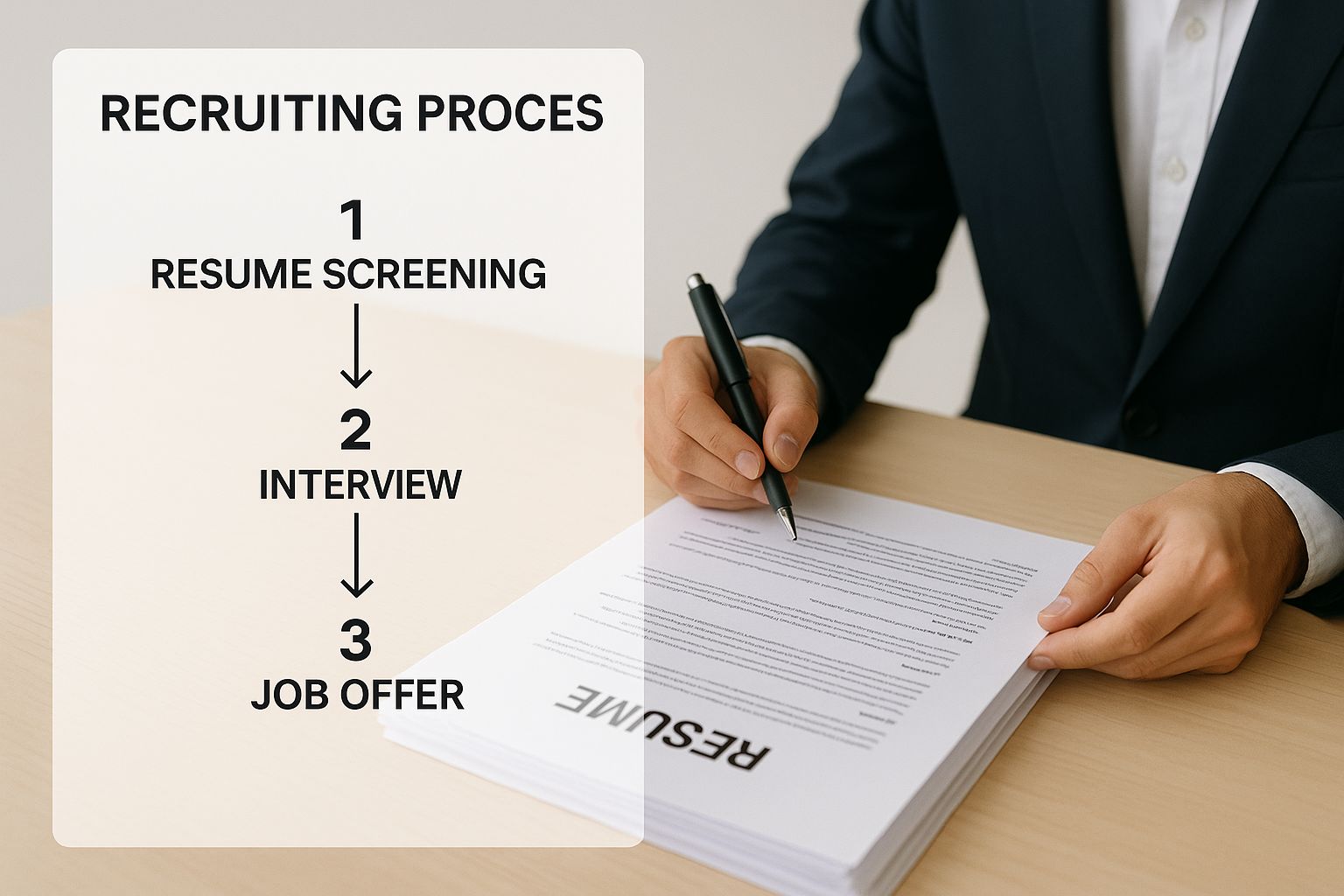
As you can see, a successful hire is the outcome of a well-defined and methodical approach.
Interview and Offer Stages
When you start interviewing the shortlisted candidates, the recruiter’s job changes to one of coordinator and go-between. They handle all the interview scheduling, gather feedback from you and the candidates, and keep the lines of communication wide open. This keeps everything moving along nicely and prevents top talent from losing interest.
If you're looking for more ways to fine-tune your hiring, you can find great tips in our guide on how to improve your recruitment process for success.
Once you've chosen your ideal candidate, the recruiter steps in to help with the offer. They can navigate salary negotiations, manage expectations on both sides, and help secure a high acceptance rate. After the candidate accepts the offer and begins their new role, the process is complete, and the recruiter invoices for their success fee.
Weighing Up the Pros and Cons of Contingency Recruiting

No hiring model is a perfect fit for every situation, and what works wonders for one company could be a complete mismatch for another. Contingency recruiting is certainly no exception. Its ‘no-win, no-fee’ structure creates a unique set of benefits and potential pitfalls you need to get your head around before diving in.
Let's start with the big one: there's practically zero upfront financial risk. You don't pay a penny until a candidate is successfully placed and has started their new job. This makes it a fantastic option for businesses keeping a close eye on cash flow or for anyone who’s hesitant to invest in recruitment before seeing actual results. It neatly shifts hiring from a fixed cost to a variable one that’s directly linked to your company’s growth.
This model also lights a fire under the hiring process. Contingency recruiters are often in a race against other agencies—and sometimes your own internal team—so they have every reason to find you great candidates, fast. This natural competition can seriously slash your time-to-hire, a huge win when a critical role needs filling yesterday.
The Key Advantages
The biggest draws of contingency recruiting really boil down to financial common sense and speed. When you bring a contingency agency on board, you get instant access to their little black book of candidates without putting any money down.
Pay-on-Placement: It's as simple as it sounds. No hire, no fee. This makes it a financially sound choice for filling junior to mid-level roles.
Speed and Urgency: The competitive model pushes recruiters to work quickly, often leading to a much faster hiring process from start to finish.
A Wider Net: You can work with several agencies at once, giving you access to multiple, distinct talent pools and increasing your chances of finding the right person.
Essentially, it’s a 'try before you buy' approach to recruitment. You can review candidates from different sources without any initial commitment.
The Potential Drawbacks
But it's not all sunshine and roses. The same factors that drive speed can also have a downside. Since these recruiters aren't working exclusively for you, their attention is likely split between you and a handful of other clients. This can sometimes mean they're not as deeply invested in your specific search as you might hope.
The focus on speed can also sometimes favour quantity over quality. A recruiter might be tempted to send over a pile of CVs, hoping one of them is a match, rather than taking the time to properly vet each person for skills and, just as importantly, cultural fit.
Contingency recruiting is a tough game. Success is never a given. With industry-wide fill rates in the UK hovering at around just 25%, recruiters are acutely aware that most of their work won't result in a fee. This reality only amplifies the high-stakes, performance-driven nature of the job. For more insights, you can find great business advice on making the contingency recruitment system work on Recruiter.co.uk.
At the end of the day, seeing both sides of the coin is the only way to make a smart decision that truly suits your company's immediate hiring needs.
Contingency Recruiting Pros vs Cons
To make things even clearer, here’s a straightforward comparison of the main advantages and disadvantages of using a contingency recruitment model.
Advantages | Disadvantages |
|---|---|
No upfront cost—you only pay for a successful hire. | Less recruiter commitment as their focus is split across multiple clients. |
Fast results due to the competitive nature of the model. | Quantity over quality can be an issue, with less rigorous vetting. |
Access to multiple talent pools if using several agencies at once. | Not ideal for senior or niche roles that require a dedicated search. |
Reduced financial risk, especially for startups or tight budgets. | Can damage your brand if multiple agencies contact the same candidates. |
This at-a-glance view helps highlight the trade-offs involved. While the model offers incredible flexibility and cost-efficiency, it may not provide the dedicated, in-depth search required for every role.
Contingency Versus Retained Recruiting Models
When you decide to partner with a recruitment agency, you’ll quickly find yourself at a fork in the road. The two main paths are contingency and retained search. Both will help you find great people, of course, but they work in fundamentally different ways when it comes to commitment, cost, and how the whole process unfolds. Getting this choice right is crucial for a successful hire.
Think of it like this: contingency recruiting is a bit like casting a wide net. It’s a performance-based model where you only pay if and when you hire a candidate they’ve found. You can even have several agencies working on the same role, which creates a real race to the finish line.
On the other hand, a retained search is an exclusive, dedicated partnership. You pay an upfront fee—the retainer—to secure a firm's undivided attention. This approach is usually reserved for those really tough-to-fill senior or specialist roles where you simply can't afford to get it wrong.
Commitment and Process Differences
The biggest gap between the two models really comes down to commitment. In a contingency search, a recruiter is often juggling multiple roles for multiple clients. Their main goal is to be the first one to present a winning candidate, which means speed is often the top priority, sometimes at the expense of a deeper, more exhaustive search.
A retained search flips that script entirely. That initial payment buys you the recruiter’s dedicated time and resources. They essentially become an extension of your own team, taking the time to truly get under the skin of your company culture, your long-term goals, and the specific leadership traits you need.
Retained recruiters offer a far more consultative experience. You're not just getting CVs; you're getting detailed market maps, analysis of your competitors, and incredibly thorough candidate assessments. It’s a strategic partnership, not just a fill-the-seat transaction.
Cost Structure and Ideal Roles
The way you pay reflects these different levels of service. Contingency fees are simple: you pay a percentage of the candidate's first-year salary, but only after they’ve signed the contract. This makes it a great, low-risk option for junior-to-mid-level roles where there are plenty of good candidates out there.
Retained fees are structured differently, usually paid in three parts:
First Payment: Paid right at the beginning to kick off the search and secure the agency's commitment.
Second Payment: Typically paid once a shortlist of qualified, vetted candidates is presented.
Final Payment: Due when your chosen candidate officially starts their new job.
This phased investment makes sense for those C-suite positions (like a Chief Financial Officer) or a highly specialised technical role where the perfect person is incredibly hard to find. While contingency is about filling a vacancy, retained is about finding the one person who will be a perfect strategic fit for your business.
If you’re curious about other hiring models that blend your internal team with outside help, you might want to explore our detailed guide on recruitment process outsourcing to see how it stacks up.
When Does Contingency Recruiting Make Sense?
Understanding the what is one thing, but knowing when to use contingency recruiting is where the real strategy comes in. This pay-on-success model isn't a magic bullet for every hiring need, but in the right situation, it's a powerful and incredibly cost-effective way to grow your team. It truly shines when speed and low financial risk are your top priorities.
Think of it as your go-to for roles that are important, but not so niche that you’re hunting for a unicorn. It's the perfect model for businesses that need to build out their teams quickly without committing to a big upfront search fee.
Ideal Scenarios for Contingency Hires
The contingency model works best for junior-to-mid-level positions where there’s a good-sized pool of qualified people out there. These are the roles where you know several strong candidates could do a great job, rather than needing to find that one-in-a-million "purple squirrel."
Here are a few classic examples where it just clicks:
Filling Junior to Mid-Level Roles: Perfect for hiring sales reps, marketing coordinators, or software developers with common, in-demand skill sets.
Scaling Teams Quickly: Imagine a startup that just closed a funding round and needs three account executives, fast. Contingency lets them get multiple agencies on the case at once, creating a race to find the best talent.
Backing Up Your In-House Team: When your own HR or talent team is at full capacity, contingency recruiters can provide a much-needed boost to get you through a hiring surge without adding permanent headcount.
The growing popularity of flexible work has made this model more relevant than ever. The contingent workforce is a huge and expanding part of the UK economy. In fact, it's estimated that by mid-2025, 20% of the UK workforce will be made up of contingent workers, a shift largely driven by the need for business agility. You can explore more insights about the UK's contingent workforce on CenturoGlobal.com.
Using It as a Smart Growth Tactic
Choosing a contingency search is a tactical move, especially when you need results without the long-term commitment of a retained search. It's a fantastic way to test the waters for a new type of role or in a new market where you don't yet have a strong presence or a deep feel for the local talent.
It also fits nicely into a more proactive hiring mindset. For companies that are always looking to connect with great people, building relationships with specialist contingency recruiters can pay off down the line. While great for filling today's vacancies, this relationship can also give you a real-time pulse on market trends and salary benchmarks.
Of course, for a more formal and long-term view, you might consider talent mapping to plan your future workforce needs. To learn more, check out our guide on what is talent mapping and why it is key to strategic workforce planning.
At the end of the day, it's all about matching the hiring method to the specific role and your business goals. When you use it for the right positions, contingency recruiting is a low-risk, high-speed solution for bringing brilliant people into your organisation.
How to Choose the Right Recruitment Partner
Let's be honest: not all contingency recruitment agencies are the same. Far from it. Finding the right one isn’t about hiring a CV-pushing service; it’s about finding a specialist who genuinely gets your world and can add real value to your hiring process.
Think of it this way: you wouldn't ask a plumber to fix your electrics. The same logic applies here. Look past the slick sales pitch and focus on their industry specialisation. A generalist agency might talk a good game, but a recruiter who lives and breathes your sector will have a network of high-quality, passive candidates you’ll never find on a job board. Don't be shy—ask for specific examples of similar roles they've filled recently.
Vetting Potential Agencies
Once you've got a shortlist, it's time to dig a little deeper. Asking the right questions will tell you everything you need to know about their process and how they operate. This isn't just about finding people; it’s about making sure the experience is smooth, professional, and protects your company’s reputation.
Here are the key areas to probe:
Their Vetting Process: How do they screen candidates beyond just matching keywords on a CV? Ask about their interview techniques and how they get a feel for cultural fit. A good recruiter goes way beyond the paper.
Communication Style: Will you have one dedicated person to talk to? How often can you expect updates? Clear, consistent communication is the bedrock of any successful partnership.
Proven Track Record: Ask for references or case studies. Nothing speaks louder than a history of successful placements in your industry.
Key Insight: A great recruitment partner is an extension of your brand. They take the time to understand your company's vision so they can share it compellingly and attract top talent who are genuinely excited about your mission.
Navigating the Current Market
Picking the right partner is even more critical in today's unpredictable hiring climate. The UK recruitment sector is currently grappling with economic uncertainty, which has caused a sharp drop in permanent placements. In this environment, temporary and flexible roles—often filled through contingency recruiting—have surged, now making up around 75% of the recruitment market's value.
A switched-on partner will understand these market shifts and help you adapt. You can get a better sense of the UK recruitment sector's challenges on Ryecroftglenton.com.
Ultimately, it all boils down to finding an agency that demonstrates deep expertise, works transparently, and shows a genuine commitment to understanding what makes your business tick.
Right, so you've got the basics of contingency recruiting down. But there are always a few practical questions that pop up when you're considering using this model for your next hire. Let's tackle the most common ones.
How Do Recruiters Work Out Their Fees?
In the UK, it’s almost always a straightforward percentage of the candidate's first-year annual salary. You can expect this to be somewhere between 15% and 25%.
The exact figure usually depends on how senior the role is and how difficult it is to find someone with the right skills. So, for a role with a £50,000 salary, a 20% fee would come out to £10,000, which you’d only pay once your new hire has actually started.
What Happens If a New Hire Leaves After a Few Weeks?
This is a big concern for many companies, and any reputable agency will have a plan for it. Most agreements include a 'rebate' or 'guarantee' period, which typically lasts between 30 and 90 days.
If the new employee leaves within this window (for any reason), the agency will usually find you a replacement for free or offer a partial refund.
This guarantee is your safety net. It ensures you're getting lasting value from the placement and makes sure the recruiter is just as invested in finding a long-term fit as you are. Think of it as built-in protection for your hiring investment.
Can We Work With More Than One Agency at a Time?
Absolutely. In fact, it’s a very common tactic. Using several agencies can cast a much wider net and get you a bigger pool of candidates, faster.
The only thing to watch out for is that it can create a bit of extra admin work on your end, like sifting through the same CV sent by different recruiters. It's all about finding the right balance for your specific search.
Talent People partners with high-growth companies to deliver agile, project-based hiring solutions in complex and competitive markets. Discover how we can help you build your high-performing team.

Comments