What is Contingent Labour? A Complete UK Business Guide
- Talent People

- Aug 9, 2025
- 13 min read
When you hear the term contingent labour, don't think of it as just "temp work." In simple terms, it refers to any non-permanent worker you bring on board for a specific job or a set period.
Think of it like a film production company. They don't keep a world-class special effects artist on the permanent payroll for years. Instead, they hire them for a few crucial scenes, get their incredible expertise, and then the engagement ends. That’s the essence of contingent labour—accessing specialised talent exactly when you need it.
What Is Contingent Labour Really?

At its core, using contingent workers marks a real shift away from the old, rigid ways of hiring. Instead of building a team composed entirely of permanent, salaried employees, businesses are tapping into a flexible talent pool to gain agility and fill critical skill gaps without the long-term overhead.
This approach gives companies the power to scale their teams up or down almost instantly, reacting smartly to new project demands or sudden market changes. This workforce is incredibly diverse, covering a huge spectrum of professionals—from freelance creatives and IT contractors to interim managers—who all bring focused expertise for a defined period.
A Growing Part of the UK Workforce
This move toward a more flexible workforce isn't just a fleeting trend; it's a major economic shift backed by solid numbers. Contingent workers have become a significant and undeniable part of the UK's labour market, showing just how much businesses have had to adapt their operations.
Right now, around 20% of the entire UK workforce is made up of contingent workers. This group includes everyone from temporary staff and freelancers to independent contractors and consultants.
To put that into perspective, this figure includes roughly 1.4 million temporary workers and a massive 4.38 million self-employed individuals. It's clear that businesses are strategically choosing to treat talent as a flexible, on-demand resource rather than a fixed cost. You can dive deeper into these figures and learn more about the UK's flexible workforce from industry reports.
Once you grasp what contingent labour truly is, you can start to see its huge potential. It’s a powerful way to build a more resilient and adaptable organisation—one that can respond quickly to whatever challenges and opportunities come its way.
Contingent vs. Permanent Labour at a Glance
To make the distinction crystal clear, it helps to see the two models side-by-side. The fundamental differences often come down to the nature of the contract, how they're paid, and the level of integration into the company.
This table breaks down the key characteristics.
Characteristic | Contingent Labour | Permanent Labour |
|---|---|---|
Employment Status | Self-employed or employed by an agency; not on company payroll. | Direct employee of the company. |
Contract Duration | Short-term, project-based, or for a fixed term. | Open-ended, indefinite contract. |
Compensation | Paid by the hour, day, or project milestone. No benefits. | Receives a regular salary and employee benefits (pension, holiday). |
Commitment | Low commitment from both parties beyond the specific task. | High level of mutual commitment and loyalty. |
Flexibility | High. Easy to scale the workforce up or down as needed. | Low. Hiring and termination processes are more complex. |
Integration | Often less integrated into the company culture and long-term goals. | Fully integrated into the team and company culture. |
Ultimately, choosing between these models isn't about one being "better" than the other. It’s about understanding which approach best fits your specific business needs at a given time. Many of the most successful companies today use a smart blend of both.
The Different Faces of Contingent Work
The term “contingent labour” isn't a one-size-fits-all label. It covers a whole host of different professionals, and knowing the difference between them is vital. After all, you wouldn't use a sledgehammer to hang a picture frame, would you? The same logic applies here—you don't hire a long-term contractor for a quick, one-off creative job.
It helps to think of these roles as different tools in your talent toolkit. Each one offers a specific solution for a particular business need. For instance, hiring a freelance developer to build a new app feature is worlds away from bringing in an agency worker to cover someone's parental leave. One requires a very specific technical skill for a defined project, while the other needs a reliable pair of hands to fill a temporary operational gap.
The Main Categories of Contingent Talent
To build a truly flexible workforce, you first need to know who’s who. Contingent workers generally fall into a few key categories, and each one is best suited for different situations.
Independent Contractors: These are your skilled specialists, often brought in for a specific project with clear goals and a defined timeline, like a six-month IT systems overhaul. They operate as their own business, handle their own taxes, and have a great deal of say in how they get the work done.
Freelancers: Often juggling multiple clients, freelancers are perfect for shorter, task-based assignments. Think of a graphic designer hired to create a new company logo or a copywriter brought on to produce a series of marketing emails.
Temporary Agency Staff: You get these workers through a staffing agency. While they work at your business, they're technically employees of the agency. This is a go-to solution for covering seasonal rushes, sick leave, or other short-term gaps in roles like admin or customer service.
Consultants: These are the big-picture thinkers. Consultants provide high-level strategic advice rather than getting stuck into the day-to-day tasks. You might hire one to help you map out a new market-entry strategy or analyse your company’s operational weak points.
This image helps to visualise how these different roles fit into the broader contingent workforce.
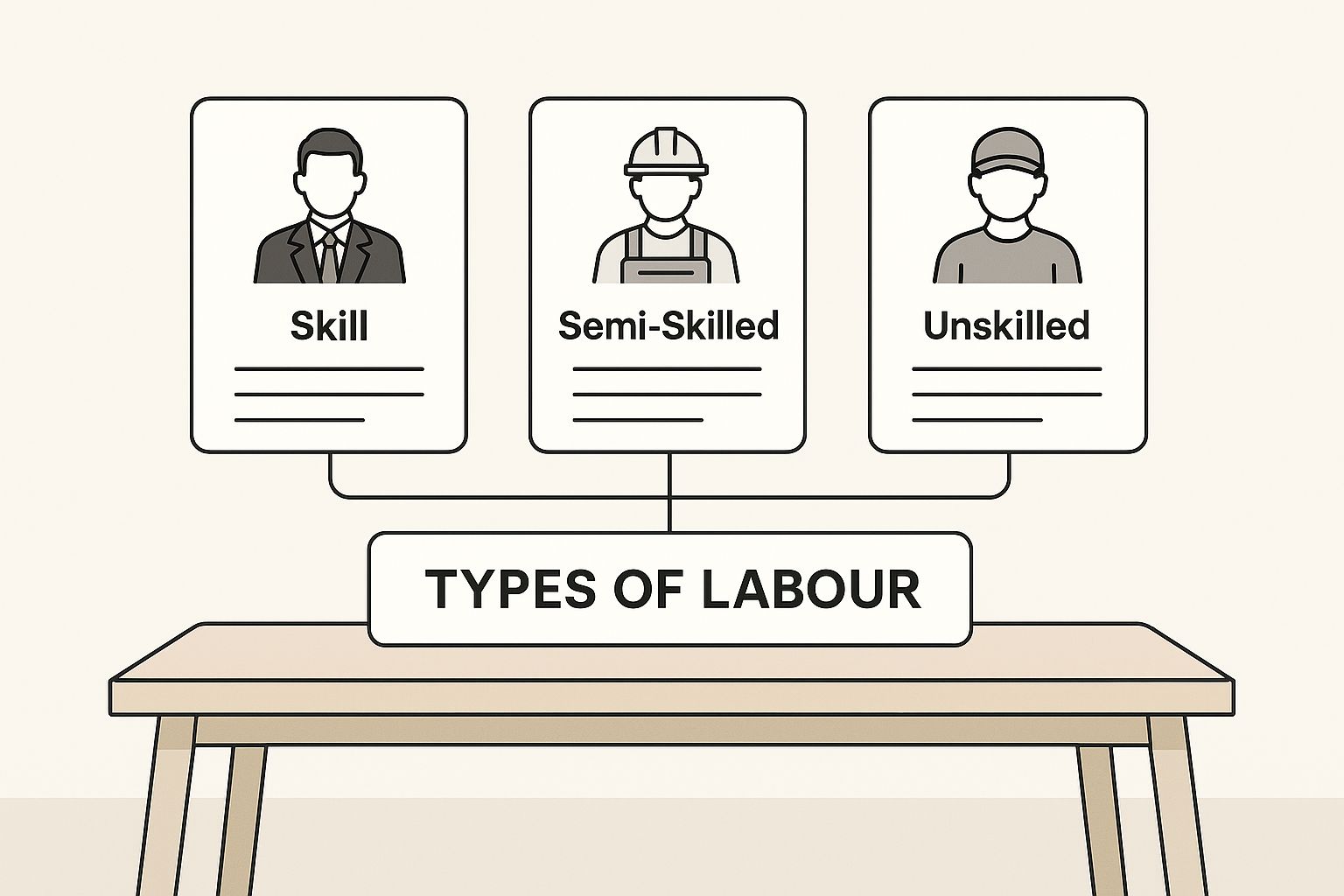
As you can see, even though they’re all temporary, their roles, responsibilities, and how you engage them can be very different.
Matching the Worker to the Work
Choosing the right type of contingent worker can make or break a project, not to mention your budget. Getting it wrong often leads to frustration, missed deadlines, and wasted resources.
One of the most common mistakes I see is businesses hiring a generalist temp when what they really need is a specialist contractor. A temp can fill a seat, sure, but a contractor brings deep expertise to solve a complex problem, giving you a much better return on investment for project-specific goals.
This distinction is crucial. Let's say your retail business needs extra help during the busy Christmas period—agency temps are the perfect fit. But if you’re trying to implement a new enterprise resource planning (ERP) system, you absolutely need an independent contractor who has a track record with that specific software.
Making the right choice from the get-go ensures you have the exact skills and support your business needs, right when you need them.
Why UK Businesses Use a Flexible Workforce

For UK businesses, mixing permanent and temporary staff is much more than just a passing trend—it's a smart, strategic move. Companies are deliberately building these blended workforces to get a real edge in a market that never stands still. This approach helps them react faster, work smarter, and be more innovative.
At its core, relying on contingent workers is all about agility. Think about it: what if your business lands a huge new project that needs double the development power for the next six months? Hiring permanent staff for a short-term surge is slow and leaves you with long-term payroll commitments. A flexible workforce lets you bring in skilled contractors almost overnight and then scale back down just as smoothly when the work is done.
Boosting Efficiency and Controlling Costs
Beyond just scaling up and down, one of the biggest draws of a contingent model is how it can control costs. A contractor's day rate might look high at first glance, but when you do the maths, it’s often the more economical choice. That's because you sidestep all the extra costs that come with a permanent employee.
These associated overheads usually include:
National Insurance contributions
Pension scheme payments
Paid holiday and sick leave
Training and development budgets
By using temporary workers, businesses turn a fixed labour cost into a variable one. It becomes an expense that’s directly linked to active projects and incoming revenue. This kind of financial nimbleness is a game-changer, especially for project-heavy sectors like tech or energy where the workload can be unpredictable. Managing this can be a job in itself, which is why some businesses look for expert partners. For anyone curious, a [UK guide to recruit process outsourcing](https://www.talentpeople.co/post/a-uk-guide-to-recruit-process-outsourcing) offers a closer look at handling the hiring process.
A crucial figure to keep in mind is the time-to-fill a role. Finding the right permanent candidate can take, on average, over 40 days. A well-organised pool of contingent talent can slash this time, getting an expert working on your project much, much faster.
Accessing Specialist Skills On-Demand
Perhaps the most valuable advantage is the power to tap into a worldwide pool of specialist talent at a moment's notice. Many of the most sought-after skills, from a specific type of software engineering to complex regulatory know-how in the renewables industry, belong to career contractors. These pros bring a wealth of experience from various projects, offering fresh ideas and making an immediate difference.
For instance, a UK tech company might need a cybersecurity specialist for a three-month audit. Instead of going through the long and expensive process of hiring a full-time expert, they can bring in a contractor who lives and breathes that exact specialism. This on-demand access to top-tier talent lets businesses solve tough problems and innovate more quickly, all without the baggage of a long-term hire. It’s a perfect example of how understanding what is contingent labour allows a company to stay sharp and competitive.
Navigating the Legal and Operational Hurdles
Tapping into the contingent workforce offers a fantastic amount of flexibility, but this freedom isn’t a free-for-all. While you gain agility, you also inherit some serious legal and operational responsibilities. Getting this wrong isn't an option, as it can lead to hefty penalties and major disruption, especially under the UK's watchful eye.
The single biggest landmine to avoid? Worker misclassification. This isn't just a simple admin slip-up; it's a mistake that can have significant financial consequences.
The Critical Importance of Worker Classification
In the UK, the line separating a true contractor from an employee can be surprisingly thin, and the penalties for getting it wrong are steep. The crucial task is to correctly determine a worker's employment status right from the very start. If you misclassify someone as a contractor when they function like an employee, you could be on the hook for back-dated tax and National Insurance contributions, not to mention interest and fines.
A key piece of UK legislation you absolutely need to get to grips with is IR35, often called the off-payroll working rules.
IR35 is designed to stop tax avoidance. It targets situations where a worker uses an intermediary, like their own limited company, but for all intents and purposes, works like a regular employee. The burden of figuring out their status? That often lands squarely on you, the client.
An incorrect IR35 assessment is a costly blunder. It’s vital to look at the real-life working relationship, not just what's written in the contract. You need to consider things like how much control you have over their work, if they have to do the work personally, and whether there's an ongoing obligation for you to offer work and for them to accept it.
Compliance Checks You Cannot Skip
Beyond getting the classification right, there are other essential checks that shield your business from legal hot water. The most fundamental of these is the Right to Work check.
Before anyone starts—whether they’re permanent or temporary—you are legally required to verify they have the right to work in the UK. Neglecting this simple step can lead to civil penalties of up to £60,000 per illegal worker. It’s a straightforward but absolutely critical part of your onboarding that you can’t afford to miss.
Managing Operational and Security Risks
Getting the legal side right is only half the battle. You also have to think about the practicalities of bringing temporary workers into your organisation.
Here are two key areas to keep on your radar:
Seamless Integration: How do you get a temporary worker up to speed and feeling like part of the team, without accidentally treating them like a permanent employee? A well-thought-out onboarding process is the answer. It should give them the tools and information they need to hit the ground running, but it must be clearly different from the process for your permanent staff.
Data Security: Contingent workers often need access to sensitive company information, from project details to client data. It's crucial to have clear policies and solid IT security measures in place. This means using non-disclosure agreements (NDAs) as standard practice and, just as importantly, ensuring their access to your systems is cut off the moment their contract ends.
The truth is, most of these challenges can be solved with clear, well-defined processes. By putting watertight contracts in place, carrying out your compliance checks diligently, and creating a robust onboarding plan, you can reap all the rewards of a flexible workforce without the headaches.
How to Manage Your Contingent Workers Effectively
Bringing contingent workers into your business isn't something you can just leave to chance. If you want to get the best out of your flexible workforce and sidestep potential risks, you need a proper, well-thought-out strategy. It’s about more than just filling a temporary gap; it’s about strategically managing a blended team.
This structured approach is more important than ever. UK businesses are relying on temporary talent in growing numbers, with around 1.54 million temporary workers reported in January this year. This isn't just a fleeting trend; it’s a fundamental shift in our labour market. You can dive deeper into the numbers with these UK temporary worker trends from Statista.
Create a Dedicated Onboarding Process
First impressions count, even for temporary staff. A slick, dedicated onboarding process for contingent workers is a must. Crucially, it needs to be different from the one your permanent staff go through to avoid any confusion or legal issues around worker classification.
The aim is to get them up and running—fast. Your process should cover the basics:
Essential Tools and Access: Make sure they have immediate access to all the software, systems, and communication platforms they'll need.
Key Contacts: Introduce them to their main point of contact and anyone else they'll be working with closely.
Project Goals and Deliverables: Be crystal clear from day one about the project's scope, what you'll be measuring (KPIs), and when things are due.
A solid onboarding means they feel ready to contribute from the get-go, instead of wasting their first few days just trying to figure out who's who and what's what.
Define Clear Expectations with a Statement of Work
Nothing sinks a project faster than vague instructions. Your best tool for avoiding misunderstandings and scope creep is a detailed Statement of Work (SOW). Think of it as the single source of truth for the entire engagement.
An effective SOW is much more than a job description. It’s a formal agreement that clearly lays out the project’s goals, what needs to be delivered, the timeline, and the payment schedule. This clarity protects both you and the contractor, making sure everyone agrees on what a successful outcome looks like.
Without a robust SOW, it's all too easy for projects to go off the rails, blowing the budget and missing deadlines. It really is the bedrock of any successful temporary engagement.
Use Technology to Streamline Management
Trying to manually manage contracts, timesheets, and invoices for several contingent workers can quickly become an administrative headache. Technology, like a Vendor Management System (VMS), brings all of these tasks under one roof.
A VMS can automate things like approvals, keep an eye on spending against project budgets, and make sure everyone gets paid accurately and on time. This not only frees up your HR and project managers but also gives you fantastic data on your contingent workforce spending and performance.
Foster an Inclusive and Collaborative Environment
Finally, never forget that contingent workers are part of the team, even if they aren't on the permanent payroll. Creating an inclusive culture where they feel genuinely welcomed and valued can make a huge difference to their engagement and the quality of their work.
Simple things, like inviting them to relevant team meetings and keeping them in the loop on project updates, go a long way. When you acknowledge their contributions, you help build a single, cohesive team where permanent and temporary staff work brilliantly together. This approach to building a positive environment is closely related to the ideas we explore in our guide on [how to improve employee retention with effective strategies in the UK](https://www.talentpeople.co/post/how-to-improve-employee-retention-effective-strategies-uk).
Answering Your Contingent Labour Questions
Even after you’ve grasped the basics of contingent workers, some practical questions always pop up when it's time to actually hire them. Nailing these details is the key to running a smooth, legal, and effective flexible workforce. This section gets right into those common queries.
Think of this as your go-to guide for the finer points. We'll give you clear, straightforward answers to help you make the right calls.
The move towards flexible hiring isn't just a hunch; you can see it in the wider job market trends. For instance, recent UK data shows the overall employment rate for people aged 16 to 64 was estimated at 75.2%. At the same time, the number of payrolled employees dipped slightly, while self-employed and temporary roles have been on the rise. This suggests businesses are deliberately opting for more adaptable hiring. You can discover more about the latest UK labour market statistics on the ONS website.
How Do I Correctly Classify a Contingent Worker in the UK?
Getting the classification right is probably the single most important legal step you’ll take. It all comes down to the real-life working relationship.
What really matters are factors like control (who decides how the work is done?), personal service (does the individual have to do the work themselves?), and mutual obligation (are you required to offer work, and are they required to accept it?). A true independent contractor controls how, when, and where they complete their projects.
If a worker operates more like an employee—following set hours, taking direct supervision, and having to accept the work you give them—you're heading into misclassification territory. This is what IR35 legislation is all about, and a mistake here can lead to serious tax liabilities and legal headaches. When in doubt, always get professional legal advice.
What Is the Difference Between a Contractor and a Freelancer?
People often use these terms as if they mean the same thing, but there are some subtle differences. Knowing what they are helps you find the right person for the job.
Contractors are typically brought in for a specific, longer-term project. They often work on-site and integrate with your team, almost like a temporary employee. A good example is hiring a contractor for a six-month IT system migration.
Freelancers usually handle shorter, task-based jobs for several clients at once, often remotely. Think of hiring a freelancer to design a logo, write a few blog posts, or create a marketing brochure.
Do I Need to Provide Benefits to Contingent Workers?
For genuinely self-employed workers like independent contractors and freelancers, the short answer is no. You generally aren't required to offer company benefits such as pensions, paid holidays, or sick pay. They are running their own business and are responsible for managing their own finances and provisions.
However, things get a bit more complex when you bring in temporary staff through an agency.
Under the Agency Workers Regulations (AWR), after working in the same role for 12 weeks, agency workers are entitled to the same basic employment and working conditions as your permanent staff. This includes things like pay and working hours.
This really shows why it's so vital to understand exactly which type of contingent worker you're dealing with, as each comes with its own set of rules. Making the right decision from the start, backed by good information, is crucial. You can learn more about [making smarter hiring choices with recruitment data analysis](https://www.talentpeople.co/post/smarter-hiring-with-recruitment-data-analysis) in our detailed guide.
At Talent People, we specialise in helping high-growth organisations in the energy and technology sectors build agile, high-performing teams with project-based hiring solutions. Find out how we can help you build your team.

Comments