What Is Contractor Management Explained Simply
- Talent People

- Sep 5, 2025
- 13 min read
Contractor Management Explained
Contractor management covers every step of working with external experts: finding, welcoming, guiding and paying them. Imagine a film director uniting lighting, sound and camera crews – each playing its part so the final scene comes together flawlessly.
This framework lets businesses tap into flexible talent while staying on the right side of regulations.
Unpacking Contractor Management

Across the UK and beyond, project teams depend on contractors, freelancers and consultants. They bring niche skills exactly when you need them, without the overhead of full-time hires.
But simply issuing a contract isn’t the full picture. Real impact comes from wrapping that relationship in clear policies and processes. Good contractor management transforms routine tasks into a strategic practice that guides projects, controls budgets and keeps compliance on track.
At its core, contractor management is about maximising the value of your flexible workforce while keeping potential risks in check. It turns a one-off hire into a smooth-running engine that drives results.
For high-growth sectors such as technology and energy, getting this right means scaling teams on demand. To explore practical tips and deeper insights, head over to our other [recruitment articles](https://www.talentpeople.co/articles).
The Contractor Lifecycle At A Glance
Before you dive in, let’s map out the core stages. This table highlights what happens at each step and the goals you’re aiming for.
Lifecycle Stage | Core Activities | Key Goal |
|---|---|---|
Sourcing & Vetting | Identifying needs, finding talent, screening candidates and verifying credentials. | Find the right specialist with proven skills for the task. |
Onboarding & Contracts | Drafting agreements, handling IR35 checks and integrating into teams. | Ensure legal compliance and set a solid foundation. |
Performance Management | Defining deliverables, tracking progress, providing feedback and managing tasks. | Keep projects on track with high-quality output and solid collaboration. |
Payment & Offboarding | Processing invoices, issuing timely payments and concluding contracts. | Wrap up smoothly and preserve positive relationships. |
With these stages in place, you can treat contractor management as a living process. That means every expert you bring on board hits the ground running and stays aligned from kick-off to sign-off.
The Pillars of a Strong Contractor Management System
Managing contractors effectively isn't about ticking a single box; it's about building a complete system from the ground up. Think of it like a well-built house. It needs strong pillars to stand, and a successful contractor strategy is no different. If you neglect these key components, you’ll quickly find your processes becoming chaotic, leading to project delays, compliance headaches, and missed goals.
When you understand these pillars, you can build a framework that’s both sturdy and flexible. This structure makes sure every contractor relationship, from the first hello to the final invoice, genuinely benefits your organisation. Each pillar covers a crucial part of the contractor's journey with you, creating a process that just works.
This image shows how core functions like selection, performance tracking, and compliance are the heart of a solid management system.
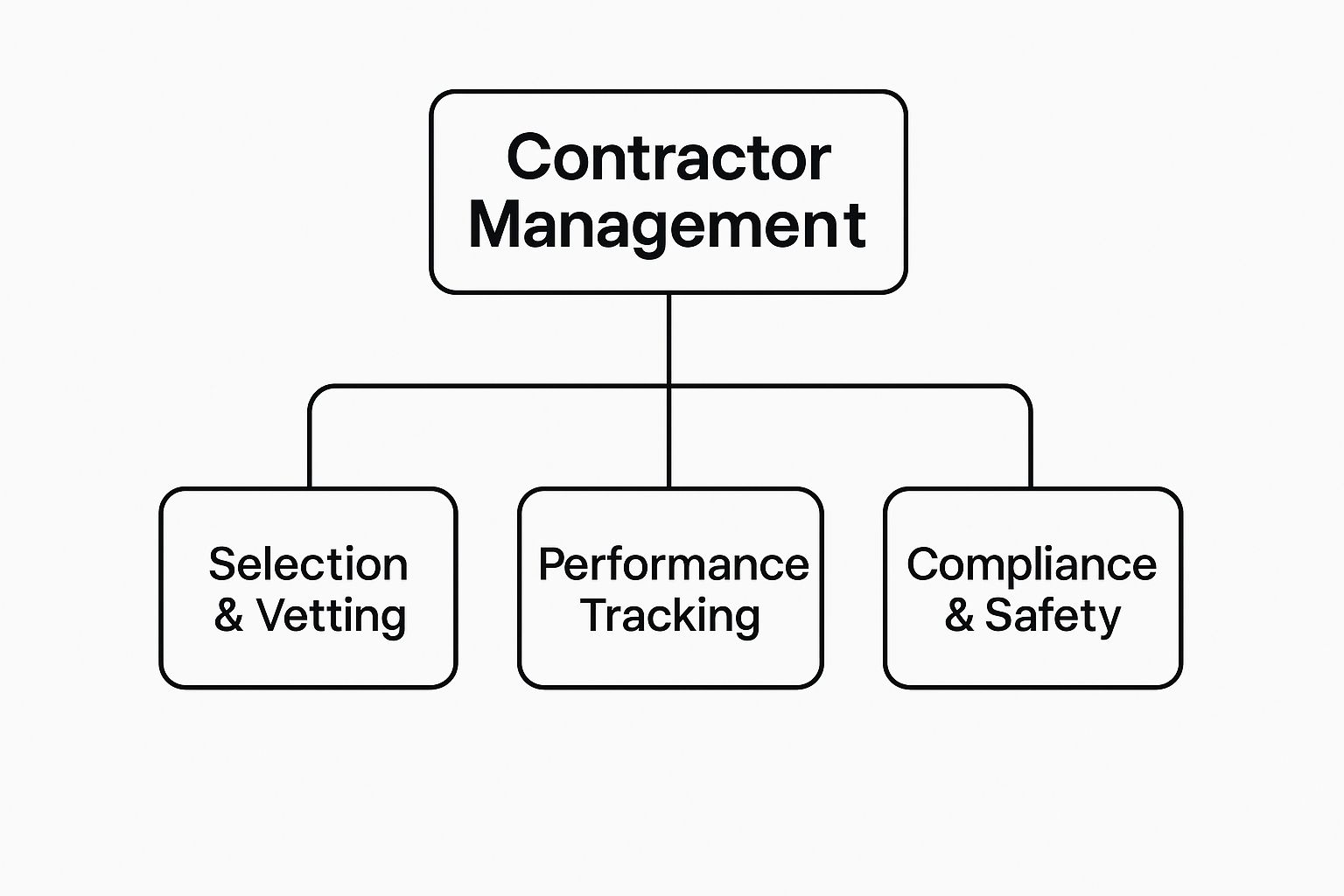
As you can see, while each pillar is distinct, they are all connected. They work together to help you stay in control and get the results you need.
Strategic Sourcing and Vetting
The real work starts long before anyone signs on the dotted line. Strategic sourcing is all about pinpointing the exact skills your project needs and then actively finding the right person for the job. It’s more than just chucking a job ad online; it's about seeking out specialists who have the proof to back up their expertise.
Once you’ve found some promising candidates, a thorough vetting process is non-negotiable. This means checking their credentials, speaking to references, and looking at their portfolio to make sure their work is up to scratch. For any UK business, this step must also include mandatory right-to-work checks to stay on the right side of the law from day one.
Airtight Contracts and Compliance
A well-written contract is the foundation of any professional relationship. It needs to clearly spell out the scope of work, key deliverables, timelines, and payment terms. Getting this right from the start prevents a world of misunderstanding down the road and protects both you and the contractor.
In the UK, compliance is a massive pillar. You absolutely have to get your head around regulations like IR35 to correctly determine a contractor's employment status for tax. Get it wrong, and you could be facing some hefty financial penalties, so this isn't something you can afford to gloss over.
A strong contract isn't just a legal formality; it's a communication tool that sets clear expectations and minimises risk for everyone involved.
Seamless Onboarding and Performance Tracking
How you welcome a contractor into your business sets the tone for the entire project. A seamless onboarding process is about getting them the tools, information, and access they need to hit the ground running. It should also include introductions to the team and a crystal-clear brief on the project’s aims.
Once the work is underway, transparent performance tracking is vital. Using project management tools to monitor progress against agreed milestones keeps everyone aligned with your business objectives. Regular catch-ups and providing useful feedback are the best ways to keep a project on track and ensure quality doesn't slip.
Timely Payments and Offboarding
Finally, you need a reliable process for payments and offboarding to close the loop professionally. Paying contractors accurately and on time is just basic decency, but it’s also fundamental to building a great reputation that attracts top talent.
When the project wraps up, a structured offboarding process is just as important as onboarding. This involves settling all final payments, revoking access to your systems to keep company data safe, and asking for their feedback on the whole experience. A smooth exit ensures a positive final impression and keeps the door open for working together again.
Here is the rewritten section, crafted to sound completely human-written and natural.
How to Navigate Common Contractor Management Hurdles

Bringing contractors on board gives you incredible flexibility and access to specialised skills. But let’s be honest, it’s not always a smooth ride. Knowing what bumps in the road to expect is the first step to creating a process that’s productive, straightforward, and legally watertight for everyone.
From navigating compliance minefields to managing inconsistent work, these issues can easily derail a project if you let them. The good news? With a bit of foresight, you can turn these potential headaches into opportunities to build a much stronger contractor management system.
Let’s get into the most common challenges and, more importantly, how to solve them.
Tackling Compliance and Misclassification Risks
In the UK, one of the biggest icebergs you can hit is worker misclassification. Mistakenly classifying an employee as a contractor, even accidentally, can lead to serious penalties from HMRC, especially with the complexities of IR35 regulations. This is one area where you simply can’t afford to get it wrong.
To keep your business safe, you need to be diligent about determining the correct status for every single contractor. This isn't just a box-ticking exercise at the start; it's an ongoing process to make sure the working relationship doesn’t creep into something that looks and feels like employment.
Here’s how to protect yourself:
Use Standardised Contracts: Get legal experts to help you draft clear, solid contract templates. These should spell out the scope of work and the independent nature of the relationship, leaving no room for ambiguity.
Conduct Regular Audits: Every so often, take a fresh look at your contractor agreements. Do they still hold up against current IR35 rules and employment laws?
Educate Your Managers: Make sure anyone who hires or manages contractors really understands the difference between an independent professional and a permanent employee.
Navigating compliance isn’t about putting up barriers. It’s about building a fair and sustainable foundation that protects your business and the talented people you rely on.
Ensuring Consistent Quality and Performance
When you’re juggling a team of freelancers, keeping the quality of work consistent can be tough. Everyone has their own way of doing things, and sometimes those methods don't quite sync with your project’s needs or your team's workflow.
If you don't set clear benchmarks from the beginning, you risk getting work that just isn't up to scratch. That means project delays, extra costs, and a lot of frustration. This is especially critical in industries like construction, where poor oversight can be financially catastrophic. In fact, recent data shows a 58% rise in financial distress among UK construction firms, where project overruns can be the final straw. You can read more about it in this UK construction sector's challenges report.
The answer is simple: clear communication and structured oversight. Define what success looks like right from the start with specific Key Performance Indicators (KPIs) and detailed project briefs. Regular check-ins and a single place for feedback keep everyone on the same page, making sure quality is always a priority, not an afterthought. This builds a real partnership where everyone is pulling in the same direction, aiming for the same high standard.
Best Practices for Managing Contractors Successfully
It’s one thing to avoid the common pitfalls of contractor management, but it’s another to actively build a system that gets the absolute best out of your flexible talent. This isn't just about preventing problems; it's about turning your contractors into a genuine strategic advantage. By putting a few solid practices in place, you can ensure every engagement is productive, compliant, and perfectly aligned with your business goals right from the start.
Think of these best practices as the foundational rules of engagement for your contingent workforce. They create a consistent, reliable framework that helps you get maximum value from specialist skills while cutting down on the administrative headaches.
Establish Crystal-Clear Communication Channels
Good communication is the glue that holds any project together. This is even more critical for contractors, who aren't part of the day-to-day office chatter and can't just pop their head over a desk to ask a question. Any hint of ambiguity is a fast track to missed deadlines, scope creep, or work that just isn't what you expected.
So, from day one, make it incredibly clear how, when, and where you'll communicate. Set up a single source of truth—whether that’s a dedicated Slack channel, an Asana board, or a weekly email digest. Regular, brief check-ins are also a must. They eliminate guesswork and make sure everyone is on the same page, which is the secret to a smooth and collaborative project.
Create a Standardised Onboarding Process
The way you welcome a contractor sets the tone for the entire project. If it’s rushed and chaotic, you’ll likely end up with a disengaged contractor who struggles to find their footing. A standardised onboarding process is your secret weapon, ensuring everyone gets the information, tools, and introductions they need to hit the ground running.
A solid onboarding checklist should cover the basics:
Essential Paperwork: Get contracts, NDAs, and payment details sorted out immediately.
System Access: Provide logins for all the necessary software, project tools, and communication apps.
Clear Briefing: Give a thorough walkthrough of the project goals, what needs to be delivered, who they'll be reporting to, and key deadlines.
Team Introductions: Make sure they meet the core team members they'll be working alongside.
This isn’t just admin work; it’s about making your contractors feel like a valued part of the team, empowering them to deliver their best work from day one.
Define Precise Deliverables and Milestones
Vague goals are the enemy of successful projects. Instructions like "improve website traffic" are practically useless because they leave too much room for interpretation. The key is to break down big objectives into precise, measurable deliverables with firm deadlines. This kills scope creep before it starts and gives everyone a shared definition of what "done" really means.
For example, instead of a fuzzy goal, map out specific milestones:
Week 1: Complete wireframes for the user dashboard.
Week 2: Deliver a functional front-end prototype.
Week 4: Finalise back-end integration and run initial tests.
By defining success in concrete terms, you create a shared understanding of expectations. This structure keeps projects on track, simplifies performance tracking, and ensures the final output aligns perfectly with your business needs.
This level of detail is exactly what powers the project-based hiring that helps companies win in competitive markets. If building high-performing teams is on your radar, exploring our [recruitment expertise](https://www.talentpeople.co/expertise) will give you a deeper look at crafting effective talent strategies.
Use Technology to Automate and Streamline
Still trying to manage contractors with a maze of spreadsheets and manual email follow-ups? That’s not just inefficient—it’s an open invitation for errors. Today's technology offers fantastic tools designed to automate the grunt work, freeing you up to focus on what really matters: strategic oversight.
Using a dedicated Contractor Management System (CMS) or similar platform can bring everything into one place. These systems can handle compliance checks, track time against milestones, and make invoicing and payments a breeze. It’s not just about reducing mistakes; it’s about giving you a clear, real-time view of your entire contingent workforce, making the whole process smarter and more secure.
Why Your Business Needs a Flexible Workforce

Contractor management isn’t just ticking boxes—it's a strategic lever that injects real agility into your organisation. In a fast-paced economy, the ability to pivot quickly can be the difference between leading the pack and playing catch-up.
A flexible workforce made up of skilled contractors lets you scale your team up or down as projects demand, without the overhead of long-term hires.
Picture a tech startup racing to launch a new app. Instead of spending months recruiting in-house developers, they bring in freelance specialists for exactly as long as they’re needed.
This tactic delivers speed, niche expertise and tighter budget control in one neat package.
Unlocking Specialised Skills On Demand
One of the biggest perks of contractors is on-tap access to rare skills exactly when you need them. Many short-term projects call for expertise you won’t use year-round.
• A marketing agency can bring in a freelance SEO expert for a pivotal three-month campaign.• A construction firm can hire a project-specific structural engineer to oversee a complex build.• A growing e-commerce business can engage a cybersecurity consultant for a one-off security audit.
This approach ensures top-tier know-how lines up perfectly with your project calendar—without bloating your permanent payroll.
Effective contractor management is the mechanism that transforms this flexibility from a concept into a tangible business asset. It’s the difference between chaotic ad-hoc hiring and a structured, strategic approach to talent.
Gaining A Competitive Edge In Key Sectors
In UK industries such as technology, that edge is essential. The IT contracting market has shown signs of revival, with the Recruitment & Employment Confederation’s jobs index climbing from 38.9 to 46.6.
Strong contractor management means you can meet surges in demand head-on, plugging skill gaps exactly when they arise. For more insight, explore the latest trends in the UK IT contractor market.
Embracing a flexible workforce isn’t a stop-gap. It’s a deliberate strategy to build a resilient, dynamic organisation ready for whatever comes next.
Using Technology to Simplify Contractor Management
Trying to manage a growing team of contractors with spreadsheets and a messy inbox is asking for trouble. It's not just inefficient; it’s a direct path to costly mistakes, compliance headaches, and a complete lack of visibility over who’s doing what.
The right technology changes this entire picture. Modern software isn't just a nice-to-have—it’s built to do the heavy lifting, turning contractor management from a chaotic admin task into a smooth, strategic part of your business.
Centralise and Automate Your Workflow
The biggest win you get from technology is having everything in one place. Instead of crucial information being lost in different spreadsheets or departmental folders, a Contractor Management System (CMS) or Vendor Management System (VMS) acts as your single source of truth.
These platforms automate the most time-consuming parts of the contractor lifecycle:
Onboarding: Getting new contractors set up with digital paperwork and automated compliance checks.
Time Tracking: Contractors log their hours directly in the system, making approvals straightforward.
Invoicing and Payments: The system can automatically generate invoices and handle payments on time.
Compliance Verification: It keeps an eye on things like certifications and insurance, flagging anything that's about to expire.
This level of automation frees up your team from drowning in paperwork so they can focus on what actually matters—the project itself. It's the same principle we apply when [designing a recruitment process](https://www.talentpeople.co/process): create efficiency and clarity right from the start.
Leverage Data for Better Decisions
Beyond simply making life easier, these systems give you access to incredibly useful data. You can see your total contractor spend at a glance, check how projects are tracking against their milestones, and quickly identify who your best external partners are. This data is gold for making smarter decisions about your workforce.
This is especially critical in industries like construction, where keeping projects and people coordinated is everything. The need for skilled oversight has boomed, with the number of UK construction project managers and related professionals recently hitting an estimated 102,100. You can find more details in this report about the growth in UK construction project management.
Investing in the right technology is no longer a luxury; it's a fundamental requirement for any business that wants to scale its flexible workforce securely and efficiently.
And it’s only getting better. AI is starting to play a bigger role, with tools emerging that can help you find the perfect contractor faster than ever. By analysing skills, project history, and performance, they can match your exact needs with the right specialist in no time, giving you a serious edge.
Your Contractor Management Questions Answered
To wrap things up, let's tackle a few common questions that pop up when businesses start bringing contractors on board. Getting these basics right will give you a solid foundation to build from.
What's the Real Difference Between a Contractor and an Employee in the UK?
It all comes down to the nature of your working relationship. Think of it this way: an employee works under a contract *of* service, which means you have control over how, when, and where they do their job. They're part of your team's structure.
A contractor, on the other hand, operates under a contract *for* services. They're brought in to deliver a specific outcome, but they have the autonomy to decide how they achieve it.
This isn't just semantics; it's a critical distinction for UK tax laws, especially IR35. Getting the classification wrong can lead to some hefty penalties from HMRC, so it's vital to get this sorted before any work kicks off.
What Software Can Actually Help Manage Contractors?
There’s a whole range of tools out there, depending on what you need. For a comprehensive solution, you have dedicated platforms like Contractor Management Systems (CMS) or Vendor Management Systems (VMS). These centralise everything in one place—from onboarding and compliance checks to tracking time and handling payments.
But if your needs are simpler, you don't have to go all-in on a massive system. Many businesses get by just fine using project management tools like Asana or Trello to track work, paired with good accounting software to manage the invoices.
I'm a Small Business. How Do I Even Start Managing Contractors?
You don't need a complex, bureaucratic process to get started. Just focus on a few simple, high-impact steps to get yourself organised.
Get a Standard Contract: This is non-negotiable. Work with a legal professional to create a clear, reusable contract template. It will save you countless headaches down the line.
Create an Onboarding Checklist: Make sure every contractor gets the same core information, system access, and project briefing. Consistency is key.
Keep Your Records in One Place: Whether it's a secure shared folder or a simple spreadsheet, have a central spot for all contracts, invoices, and important documents.
Ready to build high-performing project teams without getting bogged down in admin? Talent People designs agile, project-based hiring solutions that help you scale faster. Learn how we can support your growth.

Comments