A Guide to the Outsourced Recruitment Process
- Talent People

- Aug 15, 2025
- 14 min read
When you hand over your recruitment to a specialist partner, you're not just buying a list of candidates. You're bringing in a dedicated team to manage the entire process, from finding talent to getting them settled in. Think of it like hiring a master builder for your team—they handle the blueprints, the materials, and the construction, so you can focus on running your business. This is a far deeper partnership than simply calling a temp agency; it's about embedding an expert to fundamentally improve how you hire.
What Is an Outsourced Recruitment Process?

Let's be honest, most in-house teams are already juggling a dozen priorities. Trying to find someone with a very specific, niche skill set on top of everything else can feel impossible. This is exactly where an outsourced recruitment process—often known as Recruitment Process Outsourcing (RPO)—comes into play. The provider becomes a true extension of your own company, working under your brand and collaborating directly with your hiring managers to take the entire challenge off your plate.
But it’s not just about filling empty seats as they appear. A genuine RPO partner gets under the skin of your business goals to build a talent pipeline for the future. They manage the complete hiring journey, which usually covers:
Strategic Workforce Planning: Looking ahead to figure out who you'll need to hire long before a role becomes an urgent problem.
Candidate Sourcing and Engagement: Using sophisticated tools and their vast networks to connect with top talent, including those who aren't even actively job-hunting.
Screening and Assessment: Handling the initial interviews and skills tests, so your managers only meet the most suitable people.
Interview Coordination and Management: Taking care of all the scheduling headaches and making sure everyone is prepared and in the right place at the right time.
Offer Management and Onboarding Support: Guiding you through salary negotiations and helping ensure a new hire’s first days are smooth and welcoming.
A Strategic Model for UK Businesses
Here in the UK, this approach has become a key strategy for businesses that want to grow without the usual hiring pains. The UK's recruitment sector is a staggering £141 billion industry, and with around 59% of businesses already working with agencies, it’s clear that companies value external expertise.
The numbers speak for themselves. The average cost to bring a single new employee on board is £6,125, and it takes an average of 42 days to fill a vacant position. Outsourcing helps slash these costs and shrink those timelines by bringing in market specialists who live and breathe recruitment. You can learn more about how this works in our UK guide to Recruitment Process Outsourcing.
By entrusting the entire hiring function to a specialist, companies gain not just a service, but a strategic ally focused on building a high-performing and resilient workforce. It transforms recruitment from a reactive necessity into a strategic advantage.
Why Businesses Outsource Their Hiring

Sooner or later, many businesses hit a wall with their hiring. The internal HR team, already juggling a dozen other responsibilities, just can't give recruitment the focus it needs to find top-tier talent. This is especially true for niche or highly specialised roles. At this point, bringing in an outsourced recruitment process isn't just a nice idea; it becomes a genuine strategic need.
The decision to outsource is rarely down to a single issue. It’s usually a chain reaction of several nagging problems. Think about it: a role sits empty for months, productivity slumps, the existing team gets overloaded, and morale takes a hit.
The real reason businesses turn to outsourcing is to change recruitment from a frantic, reactive scramble into a proactive, strategic part of the business. It’s about getting expert help and resources so you can compete for the best people without derailing everything else.
Navigating Skills Shortages and Market Complexity
One of the biggest headaches for any hiring manager today is the persistent skills shortage. Finding people with the right blend of technical know-how and cultural fit feels harder than ever. The numbers back this up, with 33% of UK employers admitting they struggle to fill vacancies. A huge 36% of hiring professionals point the finger at a straightforward lack of skilled candidates.
To get by, almost half of businesses are trying to upskill their current staff, while 43% are simply throwing more money at the problem by increasing pay. If you want to dive deeper into these figures, you can explore some more detailed HR statistics.
This is where an outsourced partner really shines. They live and breathe the talent market every single day. They build vast networks and keep tabs on passive candidates—those talented people who aren't actively job hunting but would move for the perfect opportunity. An in-house team, no matter how good, rarely has the time or the specialist tools to unearth these hidden gems.
Reducing Costs and Improving Hiring Quality
Let’s not forget the eye-watering cost of a bad hire. When someone leaves within their first year, it can cost a business up to three times their annual salary once you factor in recruitment fees, lost output, and training time. It's a huge financial drain, but it also damages team morale and can stall important projects.
An outsourced recruitment process helps you dodge that bullet. These providers bring a level of rigour and data-driven insight that’s hard to replicate internally. They focus on finding people who are a great long-term fit, not just a quick fix. They boost the quality of your hires by:
Using structured interviews to get past unconscious bias and focus on what really matters.
Running thorough background and reference checks to make sure candidates are who they say they are.
Using real market data to put together job offers that are both competitive and attractive.
Ultimately, outsourcing isn't just about filling roles more quickly. It’s about filling them with the right people—the ones who will stick around, make a real contribution, and help your business grow. It turns hiring from an unpredictable headache into a reliable, scalable function that genuinely supports your goals.
The Key Stages of an Outsourced Hiring Lifecycle
Bringing in an outsourced recruitment partner isn't a single transaction; it's a journey. Think of it less like placing a one-off job ad and more like a carefully managed project, where each stage builds on the last to land that perfect hire. Understanding this lifecycle helps to demystify how a recruitment partner turns your hiring needs into a real, high-performing team member.
The whole process kicks off long before any job description sees the light of day and continues well after the offer letter is signed. It's a structured workflow designed to deliver quality candidates, speed up the hiring time, and give everyone involved a genuinely positive experience.
This visual gives you a great bird's-eye view of how the outsourced recruitment process flows, from the initial strategy session right through to the final placement.
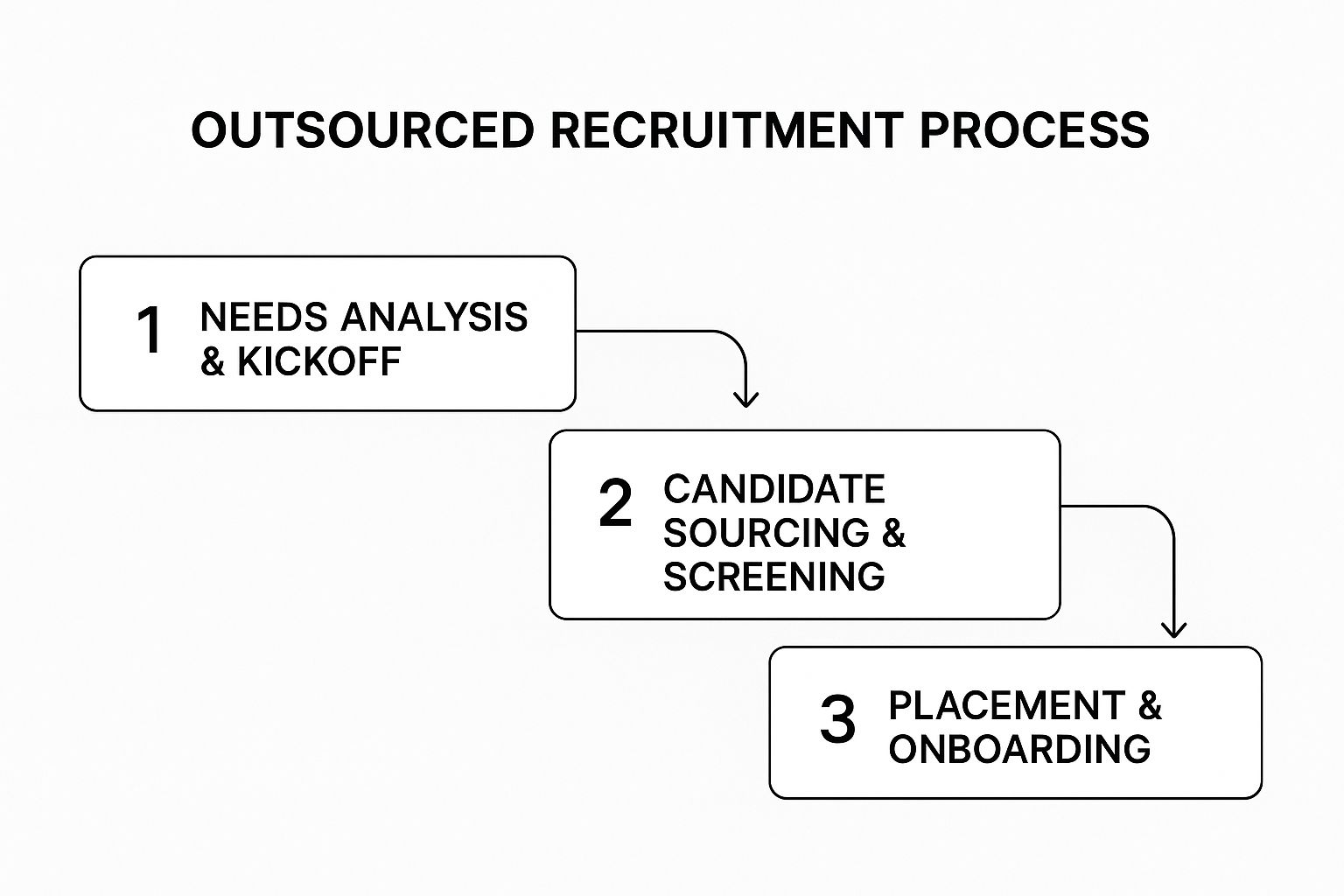
As you can see, each phase logically feeds into the next. This creates a repeatable system that ensures you get consistency and quality with every single hire.
Strategic Planning and Kickoff
This is the bedrock of the entire process. Before a single CV is reviewed, a good outsourced partner will invest time to properly get under the skin of your business. They want to understand your culture, your team dynamics, and exactly what success looks like in the role you're hiring for.
This means in-depth chats with your hiring managers to nail down not just the essential skills but also the personality traits and attitudes that will make someone thrive. For instance, they might research what your competitors are offering to make sure your salary is competitive, or help sharpen a vague job description into a compelling advert that attracts the best people. It's all about making sure everyone is on the same page from the get-go.
Candidate Sourcing and Engagement
With a solid plan in place, the real hunt begins. This is where Recruitment Process Outsourcing (RPO) partners really show their value. They don't just post an ad and hope for the best. Instead, they dive into their extensive networks, use powerful sourcing tools, and actively approach passive candidates.
These are the talented professionals who aren't necessarily looking for a new job but would be open to the perfect opportunity. This proactive approach is a game-changer. While your in-house team might be waiting for applications to land in their inbox, an outsourced partner is out there marketing your role to a hand-picked audience, dramatically widening the talent pool and boosting the quality of potential hires.
Think of your outsourced partner as a brand ambassador. They represent your company in the talent market, and their expertise ensures that every single interaction—from the first message to the final interview—paints your employer brand in the best possible light.
Screening and Assessment
Once a strong pool of potential candidates has been built, the filtering process starts. This stage is all about saving your hiring managers precious time by making sure they only speak to the most suitable people.
This isn't just a quick look at a CV. The process usually involves several layers:
Initial CV Screens: Using a combination of smart technology and human expertise to spot the best matches.
Preliminary Interviews: Quick phone or video calls to get a feel for a candidate's communication skills, motivation, and cultural fit.
Skills Assessments: Using technical or behavioural tests to check that a candidate really knows their stuff.
This thorough, multi-stage approach means that by the time a candidate gets to you, they’ve already been carefully vetted. If you want more ideas on sharpening your own hiring workflow, check out our top tips on how to improve your recruitment process.
In-House vs Outsourced Recruitment Activities
To see the difference in action, it helps to compare how specific tasks are handled. An internal HR team often juggles recruitment alongside many other responsibilities, while an outsourced partner is a dedicated specialist.
Recruitment Activity | In-House HR Team Approach | Outsourced Provider Approach |
|---|---|---|
Candidate Sourcing | Primarily relies on inbound applications from job boards and careers page. | Proactively hunts for talent using multi-channel sourcing, headhunting, and talent pooling. |
Screening | Screens CVs against the job description, often with limited time for deep vetting. | Conducts multi-stage screening including behavioural interviews and technical assessments. |
Technology | Uses a standard Applicant Tracking System (ATS), often with basic functionality. | Leverages a specialist tech stack with advanced sourcing tools, AI, and analytics platforms. |
Market Insight | Has a good understanding of the company but may have limited external market data. | Provides real-time salary benchmarking, competitor analysis, and talent market intelligence. |
Candidate Engagement | Manages communication alongside other HR duties, which can lead to delays. | Provides a dedicated resource to ensure constant, high-touch communication with all candidates. |
This table highlights the specialised focus an outsourced partner brings. They don't just do the same tasks; they approach them with a different level of depth, technology, and market awareness.
Interview Management and Onboarding
The final stages are all about creating a smooth and professional experience. Your RPO partner takes care of all the fiddly logistics, from scheduling interviews across different time zones to chasing up feedback from your interview panel. They become the central hub for communication, keeping candidates in the loop and feeling positive about the process.
And it doesn’t stop when you’ve found your person. They’ll manage the offer, handle any negotiations, and even support the onboarding to make sure your new starter gets settled in and ready to make an impact from day one. This end-to-end support turns what can be a messy administrative headache into a completely seamless journey for everyone.
How to Choose the Right Recruitment Partner

Picking a partner for your outsourced recruitment process is one of the biggest calls you'll make. This isn't just about finding another supplier. It's about bringing a strategic ally into the fold—someone who will become a true extension of your own team. The right partner gets under the skin of your business and represents your brand out in the talent market.
Get this decision wrong, and you could end up with a string of mismatched hires and a lot of wasted money. To sidestep that, you need to dig deeper than slick presentations. It’s about getting to grips with their real-world capabilities, their track record, and whether they’re a good cultural fit for your organisation.
Evaluate Their Industry Specialisation
A one-size-fits-all approach to recruitment just doesn't cut it, especially in specialised fields. Does a potential partner really know your sector inside and out, whether that's technology, energy, or renewables? A firm with genuine industry experience will already have a ready-made network of the right people.
You need to ask some direct questions to really test their knowledge:
Proven Track Record: Can they show you specific case studies or share testimonials from businesses like yours?
Market Knowledge: How do they keep their finger on the pulse of salary benchmarks and skills trends in your corner of the market?
Talent Networks: Can they prove they have existing relationships with the kind of professionals you’re trying to attract?
A partner who speaks your industry's language will find better candidates, and they'll do it faster. They'll grasp the nuances of the roles you're hiring for and can have far more credible conversations with top talent. That kind of expertise makes all the difference.
Choosing a recruitment partner is like hiring a key leader for your company. You need someone who not only has the right skills but also shares your vision and can integrate seamlessly with your existing team to achieve shared goals.
Assess Their Technological Capabilities and Process
Today’s recruitment is powered by technology. A top-tier provider will have a seriously impressive tech stack that’s much more than just a basic Applicant Tracking System (ATS). Their tools should be making everything more efficient and giving you insights backed by solid data.
When you’re vetting them, ask for a demo. Get them to show you their tech in action. You’ll want to know how they handle candidate sourcing, automated screening, and reporting analytics. A partner who’s clearly invested in advanced recruiting platforms is showing you they’re serious about delivering quality and results.
Ultimately, you’re looking for a partner who clicks with your long-term vision. They shouldn’t just be a plaster for your immediate hiring headaches; they should offer the strategic support you need to build a resilient, high-performing team for years to come.
How to Measure Your Hiring Success
Deciding to outsource your recruitment is a big step. But how do you actually know if it's working? You can't just go on a gut feeling; you need cold, hard data to see if your investment is paying off.
Setting the right Key Performance Indicators (KPIs) from the start is crucial. It’s how you hold your partner accountable and prove the real-world value of your decision to the rest of the business. These aren't just numbers for a spreadsheet; they tell the story of how efficient, cost-effective, and successful your hiring has become.
Without solid metrics, you're essentially flying blind.
Key Metrics to Track
To get a complete picture of your hiring success, you need a balanced set of KPIs. Each one gives you a different view of your recruitment performance, from speed and cost to the long-term impact on your company. Think of it as a dashboard for your talent pipeline.
Here are the essential metrics to keep an eye on:
Time-to-Fill: This is the classic. It's the number of days from when a job requisition is opened to the moment a candidate accepts the offer. A shorter Time-to-Fill means your teams aren't left waiting, and you lose less productivity.
Cost-per-Hire: This tracks the total investment in recruitment (agency fees, job board costs, etc.) divided by the number of people hired. It gives you a crystal-clear look at the financial efficiency of the process.
Quality of Hire: This is arguably the most important metric of them all. It measures how much a new employee contributes to the business. You can track this through performance review scores after six or twelve months, retention rates, and simple feedback from their hiring manager.
Candidate Satisfaction: Don't forget this one. It measures the experience of everyone who applies, not just the people you hire. Positive feedback, often gathered through short surveys, protects and even boosts your employer brand.
Measuring success isn't just about counting hires. It’s about ensuring every new employee strengthens your organisation, proving that your outsourced partnership is a powerful driver of long-term growth and stability.
Tracking these KPIs provides the concrete evidence you need to justify the investment. It allows you to have honest, data-driven conversations with your recruitment partner, celebrate the wins, and work together on areas that need a little fine-tuning.
For a deeper dive into the numbers that matter, check out our guide on smarter hiring with UK recruitment metrics. This disciplined approach ensures your recruitment partnership remains a genuine strategic asset.
Future-Proofing Your Talent Strategy
The world of work never sits still. We're seeing huge economic shifts, the explosion of flexible working, and technology that seems to change by the day. What this means is that the skills you need right now probably won't be the ones you need next year. This is where an outsourced recruitment process steps in, moving from a nice-to-have for filling roles quickly to an essential part of a modern, resilient talent strategy.
Think of it this way: instead of scrambling to hire when a new project lands, a strategic partner helps you look around the corner and see what's coming. They become your eyes and ears in the talent market, giving you the flexibility to quickly scale your team up or down. This shifts recruitment from being a reactive cost into a proactive driver of business growth.
Adapting to a Flexible and Tech-Driven Market
The talent market today is far more complex than it used to be. The best Recruitment Process Outsourcing (RPO) providers are more than just recruiters; they're talent advisors armed with powerful tech and a deep understanding of market trends.
They use this combination to build a stronger, more adaptable workforce for you. Here’s how:
Data Analytics for Forecasting: They crunch market data to predict future skills gaps, allowing them to start building talent pipelines before you even have an open role.
AI-Powered Candidate Matching: Smart algorithms sift through thousands of profiles to pinpoint the best-fit candidates with a speed and accuracy that’s hard to match internally.
Building Flexible Talent Pools: They create curated communities of pre-vetted freelance, contract, and permanent candidates, all ready to go when your needs change.
This tech-focused approach is what keeps your business competitive. In the UK, for instance, economic uncertainty has made temporary roles a huge part of the hiring landscape, making up around three-quarters of the recruitment market’s value. This trend means agencies offering an outsourced recruitment process have to bring advanced tech to the table, often using AI to get ahead. You can get a closer look at how financial and tech leadership is shaping the UK recruitment sector for more on this.
An outsourced partnership gives you the ability to adapt instantly. It's the difference between having a fixed, rigid structure and a dynamic one that can bend without breaking, ensuring you always have the right people to achieve your goals.
At the end of the day, outsourcing your hiring is a strategic move to future-proof your organisation. It brings the expertise, technology, and agility you need to handle whatever the market throws at you, securing the top talent required to not just survive, but thrive.
Frequently Asked Questions
It's natural to have questions when you're thinking about outsourcing your recruitment. Let's tackle some of the most common ones to give you a clearer picture of how it all works.
What’s the Difference Between RPO and a Recruitment Agency?
This is a great question, and the distinction is key. A traditional recruitment agency typically works on a transactional basis – you have an open role, they find candidates to fill it. It’s a bit like calling a plumber to fix a single leaky tap.
Recruitment Process Outsourcing (RPO), on the other hand, is a true partnership. When you work with an RPO provider, you're essentially handing over a whole slice (or even all) of your recruitment function. They don't just fill seats; they become an extension of your company, managing everything from planning your future hiring needs to getting new starters settled in. They’re there to fix your entire plumbing system for the long haul, not just one tap.
Is Recruitment Outsourcing a Good Idea for Small Businesses?
Absolutely. It’s a common myth that outsourcing is only for big corporations. Many RPO providers have flexible models designed specifically for small and medium-sized businesses that might not have the resources for a dedicated, in-house recruitment team.
For a smaller business, outsourcing instantly levels the playing field. It gives you access to:
Seasoned recruiters who know your industry inside and out.
Powerful sourcing tools and technology you wouldn't otherwise afford.
A much broader pool of talent to choose from.
This means you can go head-to-head with larger competitors for the best people, all without the hefty cost of building your own recruitment department from scratch.
How Much Does Outsourced Recruitment Cost?
There's no single price tag, as the cost really depends on the model you go for. Some providers charge a fixed monthly fee, others work on a cost-per-hire basis, and some might charge a flat fee for a specific project. While it is an investment, it's often more financially savvy than keeping recruitment in-house.
Think about the hidden costs you’re already facing: the financial hit of a bad hire, the productivity lost from a role sitting empty for months, and the salaries for an internal team. When you weigh all that up, the value of a quality RPO partnership quickly becomes obvious. A good partner will be transparent and work with you to find a pricing structure that makes sense for your budget.
Ready to build a high-performing team without the hiring headaches? At Talent People, we embed our expertise directly into your business to deliver agile, project-based hiring solutions for complex industries. Discover how our specialists can accelerate your growth.

Comments