A UK Guide to Recruit Process Outsourcing
- Talent People

- Aug 1, 2025
- 17 min read
Imagine you could hand over the entire, often tricky, puzzle of recruitment to a team of experts who operate as if they were part of your own company. That, in a nutshell, is Recruitment Process Outsourcing (RPO). This isn't just about bringing in a temp agency to plug a few gaps; it's a genuine strategic partnership where an external provider takes complete ownership of finding your permanent talent.
What Is Recruitment Process Outsourcing?

Recruitment Process Outsourcing is where a business transfers all, or even just part, of its permanent hiring function to an external specialist. Think of your RPO partner as a supercharged version of an in-house recruitment team. They come equipped with specialised tools, a much wider reach into the talent market, and deep industry knowledge.
The relationship is so close that they become fully integrated with your business. For the candidates, the experience is seamless—they often feel like they're talking directly to your company, not a third party.
This kind of partnership is about much more than just filling empty seats. A great RPO provider gets under the skin of your business. They learn your company culture, champion your employer brand, and represent you authentically throughout the entire hiring journey. From writing job descriptions and sourcing candidates to managing interviews and finalising offers, they handle it all.
RPO vs. Traditional Recruitment
The main difference comes down to strategy versus transaction. A traditional recruitment agency is usually brought in on a role-by-role basis. Their job is to fill that specific position, get paid, and move on. They're not typically involved in your company's bigger picture.
An RPO partnership, on the other hand, is a long-term game. The provider is deeply invested in your success. Their focus is on building a robust, sustainable talent pipeline that will support your business now and in the future. This strategic alignment is what makes RPO so different. If you're keen to explore this further, you can find out more about mastering the recruitment outsourcing process in our detailed guide.
To better understand the distinction, let’s quickly compare the two approaches.
Recruit Process Outsourcing at a Glance
Aspect | In-House Recruitment | Recruit Process Outsourcing (RPO) |
|---|---|---|
Focus | Managing day-to-day hiring needs within the organisation. | Strategic, long-term talent acquisition aligned with business goals. |
Relationship | Internal department with a limited external network. | Deeply integrated external partner acting as an extension of the business. |
Scope | Often limited to filling current vacancies as they arise. | Manages the entire recruitment lifecycle, from planning to onboarding. |
Cost Model | Fixed overheads (salaries, tools, etc.) regardless of hiring volume. | Flexible and scalable, often based on hiring volume or project scope. |
Expertise | Generalist HR knowledge, often covering many functions. | Specialist recruitment expertise with deep market insights and tools. |
As you can see, RPO offers a fundamentally different way of thinking about how you find and hire people.
An RPO provider will act as an entity that is virtually part of the client’s organisation. They are proactive, focused on learning about the organisation's climate, and developing human resource policies for future use.
This deep integration means they don't just find people—they find the right people. They find individuals who will genuinely fit in and thrive within your specific company culture, which ultimately helps reduce staff turnover and boost productivity across the board.
What Does an RPO Provider Actually Do?
A full RPO solution covers the A-to-Z of the recruitment lifecycle. This typically includes:
Talent Sourcing & Attraction: Using sophisticated tools and vast networks to uncover both active job seekers and passive candidates who aren't even looking.
Screening & Assessment: Carrying out initial interviews and skills tests to make sure only the best-fit individuals move forward.
Interview Coordination: Taking care of the often-complicated logistics of scheduling interviews between candidates and your hiring managers.
Offer Management: Handling salary negotiations and formally extending job offers on your company’s behalf.
Employer Branding: Actively promoting your company as a fantastic place to work to attract the highest-calibre talent.
By handing these responsibilities over to a specialist, you free up your internal team to focus on their core roles and other strategic HR initiatives, confident that your talent acquisition is in expert hands.
The Real Pay-Offs of Bringing in an RPO Partner

While the idea of outsourcing your hiring sounds good on paper, what does it actually mean for your business day-to-day? Many companies first look at recruitment process outsourcing as a way to cut costs, but the real value is much deeper than just saving money. It’s about building a smarter, more powerful way to find and hire the people you need.
A top RPO provider brings specialist tools and vast talent networks that most internal teams simply can't access. They’re brilliant at finding those hidden gems—the high-quality candidates who aren't actively job-hunting but are perfect for your role. This immediately widens your talent pool beyond the usual suspects.
This improved reach gets results, fast. One of the biggest benefits is a dramatic drop in hiring time. Studies show a well-run RPO programme can slash the time-to-hire by as much as 55%. That means critical roles get filled sooner, projects stay on track, and you don't lose momentum because of an empty desk.
Better Hires and a Sharper Focus
A huge advantage of recruitment process outsourcing is the clear improvement in the quality of people you bring on board. RPO providers are specialists; this is all they do. They live and breathe talent, using proven methods and data to find candidates who not only have the skills but who will also thrive in your company culture.
This focus on quality and fit pays off in the long run. Take, for example, a global tech firm that was struggling with high turnover in its software engineering team. By partnering with an RPO provider, they fine-tuned their screening process to better assess cultural fit. The result? They cut new hire turnover by 30% within just 18 months.
An RPO partner does more than just fill jobs; they help you get smarter about how you hire. They bring the data and insights you need to build a long-term talent strategy.
This frees up your internal HR team from the endless, time-consuming grind of daily recruiting. Instead of sifting through hundreds of CVs, they can focus their expertise on bigger-picture initiatives that truly move the needle, such as:
Employee Retention: Creating programmes to keep your best people happy and engaged.
Leadership Development: Spotting and nurturing your company's future leaders.
Workforce Planning: Looking ahead to figure out what skills your business will need next year and beyond.
A Stronger Employer Brand and True Flexibility
In a crowded market, your reputation as an employer is everything. RPO providers are experts at crafting and showcasing your employer brand. They make sure every touchpoint—from the first email to the final offer—is professional and positive, giving candidates a great impression of your company.
This consistent, high-quality experience doesn't just attract better people; it builds your reputation as a great place to work. Imagine a renewable energy company launching in a new country. They used an RPO to build their brand from the ground up, quickly becoming known as a top employer in that region.
Perhaps most importantly, an RPO partner gives you incredible flexibility. Business is unpredictable, and hiring needs can swing wildly.
Ramping Up: Suddenly need to hire 50 new people for a major project? An RPO can instantly scale up their team to meet the demand, saving you the headache of hiring temporary recruiters.
Slowing Down: If there’s a hiring freeze, you simply scale back the service. This avoids the cost and pain of having a large, under-utilised internal team.
This ability to adapt is a massive operational advantage. By working with a recruitment process outsourcing partner, you gain an expert ally dedicated to making your hiring faster, smarter, and more strategic, giving your business the talent it needs to succeed.
Finding Your Fit with RPO Models
Recruitment process outsourcing isn't a rigid, one-size-fits-all service. It’s a flexible solution, with different models designed to meet your company’s specific hiring needs, whether you're a fast-growing startup or a large, established enterprise. Think of it less like buying a suit off the rack and more like visiting a bespoke tailor. They'll measure your organisation’s unique shape and goals to create the perfect fit.
Choosing the right model is the most important first step. It ensures you get the exact level of support you need, without paying for services you don’t. The main models—End-to-End, Project-Based, and On-Demand—each have their own strengths. Getting to grips with how they work is key to building a powerful and efficient talent acquisition strategy for your business.
This kind of flexibility is a big reason why RPO has taken off across the UK. The global market, which includes a major UK segment, was valued at roughly USD 8.14 billion in early 2025. It’s expected to shoot up to around USD 14.74 billion by 2029. That reflects a compound annual growth rate of 16%, with particularly strong demand in UK sectors like banking, IT, and healthcare, where finding specialised talent is a constant challenge. You can learn more about this growth in the full Recruitment Process Outsourcing market report.
Full-Scale Support with End-to-End RPO
End-to-End RPO, sometimes called Enterprise RPO, is the most comprehensive option on the table. In this model, your RPO provider essentially becomes your entire, outsourced recruitment department. They handle every single step of the hiring process for all your permanent roles, right across the business.
This is a true long-term, strategic partnership. The provider gets deeply embedded in your company culture, acts as a champion for your employer brand, and takes complete ownership of delivering a consistent flow of high-quality candidates.
An End-to-End RPO partnership is like a subscription service for your entire talent acquisition function. It's built for organisations that need continuous, high-volume hiring and want to standardise processes for maximum efficiency and quality.
This model is a fantastic fit for larger organisations or businesses that are in a steady, predictable growth phase. By handing over the entire recruitment function, you free up your internal HR team to focus on bigger-picture initiatives like employee development, engagement, and retention.
Targeted Solutions with Project-Based RPO
But what if you don't need to outsource everything? Maybe you’re launching a new division, opening an office in a new city, or need to staff up quickly for one specific, large-scale project. This is where Project-Based RPO really comes into its own.
With this model, you get a dedicated recruitment team for a defined period to hit a specific hiring goal. It's a focused, results-driven solution that gives you access to specialist expertise precisely when you need it, all without locking you into a long-term commitment.
Business Use Case: Imagine a UK-based renewable energy firm wins a major contract to build a new wind farm. They suddenly need to hire 40 specialist engineers and project managers within six months.
Solution: They bring in a Project-Based RPO provider that knows the energy sector inside and out. The provider deploys a dedicated team to run the entire recruitment drive—from sourcing candidates with niche skills to coordinating interviews and finalising offers. Once the project is fully staffed, the RPO team disbands.
This targeted approach gives you the horsepower of a full recruitment team for a single, critical mission.
The infographic below shows the key steps that go into a successful RPO solution.
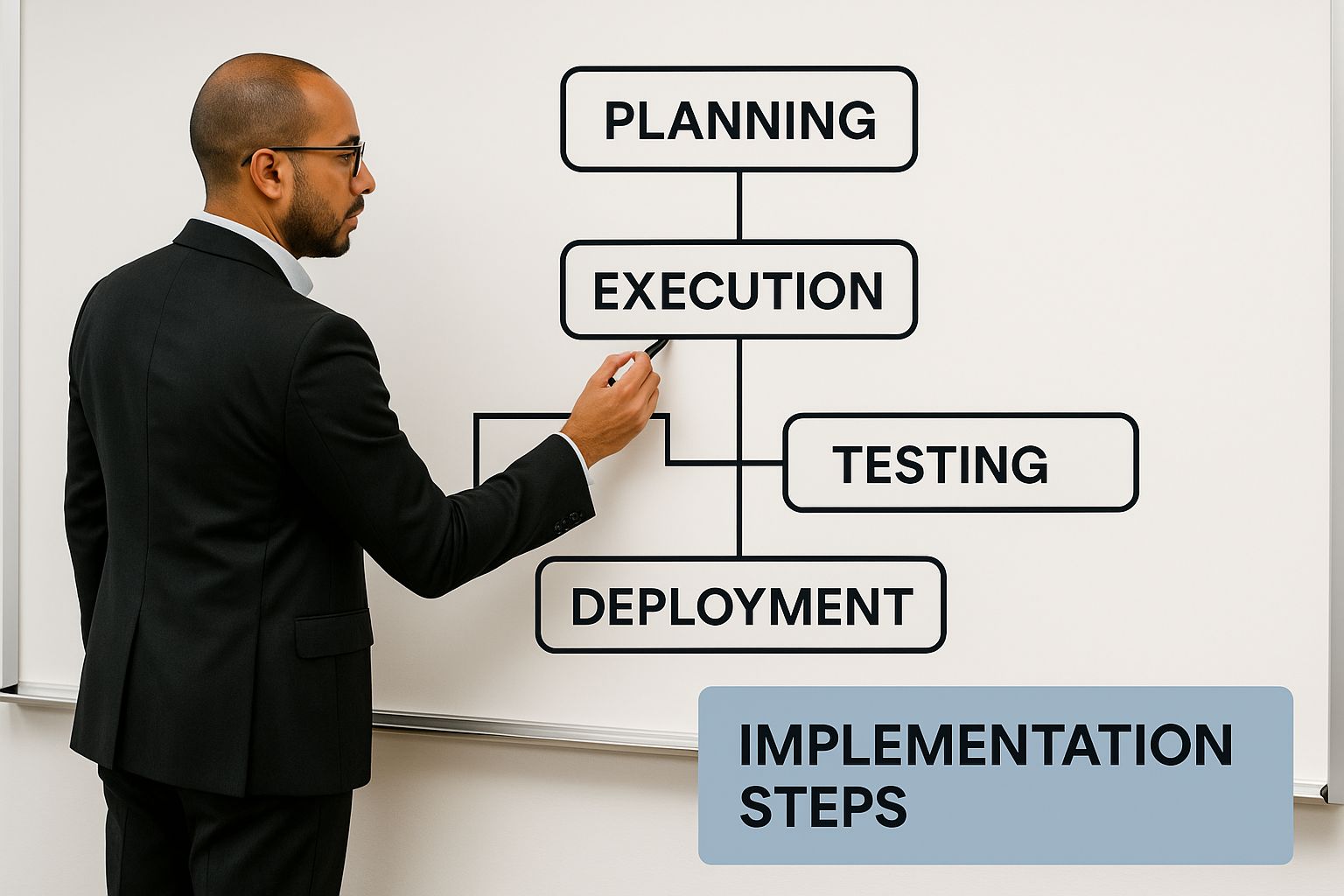
As you can see, a successful RPO partnership isn't just a transaction; it's a structured, collaborative process, from the initial assessment right through to ongoing optimisation.
Flexible Hiring with On-Demand RPO
Finally, we have On-Demand RPO, which is the most agile model of the three. Think of it as your "pay-as-you-go" recruitment service. It’s perfect for businesses that face sudden, unpredictable hiring spikes or just need to fill a handful of critical roles quickly but don't have the in-house capacity.
With this model, you bring in an experienced recruiter or a small team from the RPO provider to act as an extension of your own team for a short burst. They slot in seamlessly, using your existing systems and processes to manage the sudden workload.
This is an excellent choice for startups or SMEs that are experiencing unexpected growth spurts. It allows you to scale your recruitment muscle up or down at a moment's notice, ensuring you never miss out on top talent just because you're stretched thin.
How RPO Drives Success in UK Industries
Let's move past the theory. The real power of Recruitment Process Outsourcing comes alive when you see it working in the wild. RPO isn't some one-size-fits-all corporate service; it’s a specialist tool that adapts to solve the unique hiring puzzles different UK industries face. From the high-stakes world of healthcare to the fast-moving tech sector, the results speak for themselves.
When you look at it this way, an RPO partnership stops being just another service and becomes a genuine strategic advantage. It brings the focused expertise and scale needed to tackle specific talent challenges, making sure businesses have the right people to grow and run smoothly.
Tackling Compliance in UK Healthcare
The UK healthcare sector is under constant pressure. Staffing levels aren't just a number—they directly affect patient safety and the quality of care. Hiring here isn't simply about finding skilled people; it’s a high-volume, compliance-heavy minefield where every single credential has to be checked and double-checked. One gap in the workforce can have very serious consequences.
This is where a good RPO partner makes all the difference. One that specialises in healthcare already knows the complex compliance landscape inside out, from DBS checks to professional registrations. They build slick, efficient processes to handle large-scale recruitment for nurses, allied health professionals, and support staff, ensuring every candidate is fully compliant before their CV even lands on a hiring manager's desk.
By taking on the burden of rigorous vetting and high-volume sourcing, a healthcare RPO ensures patient care never suffers because of staff shortages. It turns a complex, high-risk recruitment function into a smooth, reliable pipeline of qualified professionals.
This strategic approach is becoming essential as the demand for flexible healthcare staff continues to rise. In fact, the UK staffing market is projected to grow by 4.3% by 2025, with temporary and contract hiring in healthcare and IT leading the charge. For example, one UK healthcare recruiter, using targeted support within its RPO framework, boosted its efficiency by 95% and got its compliance turnaround down to a rapid 24 hours, hitting 100% of its KPIs. These figures show just how vital RPO is for staying responsive in demanding public sectors. You can read more about these UK staffing trends and their impact.
Securing Scarce Talent in the Tech Sector
In the UK's buzzing tech scene, the biggest headache is the fierce competition for highly specialised talent. Roles like data scientists, cybersecurity experts, and AI engineers are always in high demand. The best candidates? They’re usually passive—already in a good job and not actively looking for a new one.
This is where traditional job ads and postings just don't cut it. An RPO provider with real tech expertise acts less like a standard recruiter and more like a talent agent. They use sophisticated sourcing tools and their deep industry networks to map the market, spot the top performers, and start building relationships long before a job opening even exists.
Proactive Sourcing: They don't just wait for applications. They're out there hunting for talent on platforms like GitHub, showing up at industry meetups, and nurturing a network of specialists.
Expert Engagement: They can actually "talk tech." They understand the difference between programming languages and technical stacks, which allows them to have credible conversations with top-tier candidates.
Employer Branding: The RPO partner also works to build their client's reputation as a top place to work in the tech community, showcasing exciting projects and a strong engineering culture.
This proactive, specialist approach means that when a critical tech role finally opens up, the RPO partner doesn’t start from scratch. They already have a shortlist of interested, pre-vetted candidates ready to talk, dramatically cutting down the time-to-hire for roles that could otherwise stay open for months.
Managing Fluctuations in Manufacturing
The manufacturing and industrial sectors live and die by their production cycles. Workforce needs can swing wildly depending on seasonal demand or big new project wins. One month a company might need to hire a hundred people to fulfil a large order, and the next, things quieten down. Trying to manage this boom-and-bust cycle with a fixed in-house recruitment team is just not efficient or cost-effective.
This is a classic problem that RPO is perfectly built to solve. An RPO partner gives a manufacturer the agility to handle these peaks and troughs without missing a beat. When a hiring surge is needed, they can deploy a dedicated team almost instantly to manage the recruitment drive. When things slow down, the service scales back with them.
This flexibility means the manufacturer isn't stuck paying for a large recruitment team during quiet periods. It makes sure production targets are always met because the right number of skilled workers are always on the factory floor, exactly when they're needed.
Choosing the Right RPO Partner
Picking a recruitment process outsourcing partner is a huge business decision, much more than just signing a contract. Think of it as choosing a business partner, not just a supplier. The right choice can become a massive strategic advantage, feeding your company with the talent it needs to grow.
The wrong one? That can lead to wasted time, money, and a damaged reputation in the talent market. Getting this selection process right is your first, and most important, step.
Define Your Destination Before You Start
Before you even think about talking to potential RPO providers, you need to look in the mirror. You can't hire a great partner if you don't know exactly what you need them to do. It’s like trying to build a house without a blueprint – you're setting yourself up for failure.
So, start by defining what success actually looks like for your business. Be specific about your goals and the Key Performance Indicators (KPIs) you'll use to track them.
Hiring Goals: Are you trying to slash the time it takes to hire critical tech roles? Do you need to build a brand-new sales team from the ground up? Or is your main aim to improve the quality of new hires to bring down staff turnover?
Key Metrics: Pinpoint the numbers that truly matter. This might be reducing your cost-per-hire, increasing the diversity of your candidate pipeline, or boosting your offer acceptance rate.
When you have these details sorted, you have a solid foundation for evaluating potential partners. It shifts the conversation from vague promises to measurable results. To help get your thoughts in order, you can find useful insights in our guide to creating [your talent acquisition strategy template for success](https://www.talentpeople.co/post/your-talent-acquisition-strategy-template-for-success).
Assessing Industry Expertise and Cultural Alignment
Once you know what you want, you can start vetting providers. One of the most critical factors here is industry-specific experience. An RPO provider that’s already found great people for other companies in your sector—whether that’s fintech or life sciences—will hit the ground running.
They’ll know where to look for niche talent, what a great candidate looks like for your specialised roles, and how to talk to them in a way that builds credibility. That existing knowledge saves a ton of time and dramatically improves the quality of candidates right from the start.
Just as important is the cultural fit. Your RPO partner will be the face of your company to potential hires. They have to genuinely understand and represent your company’s values and culture in every single conversation.
A great RPO partner doesn’t just fill jobs; they become a true ambassador for your employer brand. They should feel like a natural extension of your own team, championing your mission and values to every candidate.
When you're talking to them, ask how they get under the skin of a new client's culture. A good provider will have a clear plan for this, which should involve spending time with your team, running workshops, and digging deep into your company's vision.
Technology, Process, and The Essential Questions
Any modern RPO provider relies on technology. It’s essential you dig into their tech stack. Find out about their Applicant Tracking System (ATS) and the sourcing tools they use to find those hard-to-reach candidates. You need to be sure their systems can talk to yours, creating a smooth flow of information.
Finally, go into every meeting armed with a checklist of questions that get straight to the point.
How will you measure success and what KPIs will you report on? This ties directly back to the goals you defined at the beginning.
Can you describe your ideal candidate experience? This shows how much they care about protecting and even enhancing your employer brand.
What does your implementation and onboarding process look like? This will tell you how quickly they can start making a real impact.
Can you provide a case study of a client with challenges similar to ours? This is your chance to see real-world proof that they can deliver.
Choosing your RPO partner is a foundational move. Take your time, be strategic, and you’ll set up a partnership that delivers real, long-term value and helps you build the team you need to succeed.
The Future of RPO and Talent Acquisition
The world of hiring never stands still, and Recruitment Process Outsourcing is changing right along with it. We're seeing RPO move far beyond a simple transactional service. It's becoming a genuine strategic partnership.
For businesses in the UK, this shift means RPO is now a powerful tool for building an agile, skilled workforce that can hold its own on the global stage. It’s less about plugging today's gaps and more about anticipating tomorrow's needs.
This evolution is being powered by technology. Artificial intelligence and machine learning aren't just concepts anymore; they're practical tools being put to work in modern RPO. They're paving the way for predictive hiring analytics, allowing providers to sift through market data and internal trends to forecast future talent needs with surprising accuracy. Think of it as identifying skills gaps before they become real problems.
A More Strategic and Human-Centred Approach
But it’s not all about the tech. The future of RPO is also becoming more human. There's a much bigger emphasis on using RPO to build diverse, equitable, and inclusive (DEI) workforces. The right partner can introduce unbiased sourcing and screening methods, helping you attract talent from a much wider pool of backgrounds. This isn't just an HR initiative anymore; it's a core business goal.
At the same time, we're seeing a more holistic approach to talent strategy. Forward-thinking RPO providers are helping companies look inwards, blending internal mobility programmes with external hiring. Why spend time and money searching for a new hire when the perfect person might already be on your team, eager for a new challenge? This complete view helps you hold onto your best people while strategically filling any remaining gaps from the outside.
The biggest change in RPO is its journey from a 'do this for me' service to a 'plan with me' partnership. It's no longer just about outsourcing recruitment tasks; it's about embedding experts who help shape your entire talent ecosystem for long-term success.
The New Era of Integrated Partnerships
Looking ahead, RPO in the UK has left its transactional roots behind in favour of deep strategic integration. As of 2025, RPO is valued not just for saving money, but as a vital part of a company's overall talent plan. UK firms are now looking for partners who can manage the entire recruitment lifecycle, embedding their own teams to work alongside in-house HR and using sophisticated tech for smarter, data-led decisions. This reflects a broader need for speed and fresh thinking to meet business goals, with RPO partners becoming essential for hitting both hiring and diversity targets. You can read more about the future of recruitment outsourcing from ANSRPO.
Ultimately, this means the future of recruit process outsourcing is defined by its advisory role. These partners help you make sense of your talent data, understand what’s happening in the market, and build solid workforce plans. You can dive deeper into this with our guide on how to implement data-driven recruiting for modern hiring. A modern RPO partnership gives your business the foresight and agility it needs to not just compete, but to thrive.
Answering Your RPO Questions
If you're thinking about whether recruit process outsourcing could work for your business, you've probably got a few questions. That's completely normal. Getting straight answers is the best way to cut through the noise and figure out if an RPO model is genuinely the right move for you.
Let's tackle some of the most common queries we hear.
How Is RPO Different From a Staffing Agency?
This is easily the question we get asked most, and it's a vital one. The difference is massive. A traditional staffing agency is all about transactions. You have an open role, they find candidates to fill it, and you pay a fee. It's often for temporary or contract staff, and they act purely as an outside supplier.
An RPO provider, on the other hand, isn't just a supplier; they become a true partner. They step inside your organisation to manage a large chunk, or even all, of your permanent hiring. They’re not just filling a job for today; they’re thinking about your long-term hiring strategy, strengthening your employer brand, and making your entire recruitment process better from the ground up.
Here’s a simple way to think about it: A staffing agency gives you a fish when you're hungry. An RPO provider teaches you how to fish and helps you build a better fishing boat.
Is RPO Just for Big Companies?
Not at all. That might have been true years ago, but the RPO world has changed. While huge corporations still use large-scale, end-to-end RPO, the model is now incredibly flexible and works just as well for small and medium-sized businesses (SMBs).
For instance:
Project-Based RPO is perfect for an SMB that needs to staff a specific initiative, like building a new tech team or expanding into a new city.
On-Demand RPO gives you instant access to expert recruiters when you hit an unexpected hiring spike, all without locking you into a long-term contract.
This kind of flexibility means recruit process outsourcing is now a powerful option for businesses of any size.
What Does Recruit Process Outsourcing Actually Cost?
There's no one-size-fits-all price tag for RPO. The cost is completely shaped by what you need. The pricing models are flexible and reflect the specific services and scope of the partnership.
You'll typically see options like a set monthly management fee, a cost-per-hire fee, or a mix of both. What you end up paying depends on factors like how many people you need to hire, how complex the roles are, and which services are included in the package. When you're looking at the cost, don't just focus on the fee. A great RPO partnership delivers real value by hiring people faster, reducing costly staff turnover, and cutting what you spend on traditional agency fees. It’s an investment that should pay for itself.
Ready to build a high-performing team for your next big project? Talent People designs and delivers agile, project-based hiring solutions for complex and competitive markets. We embed seamlessly into your organisation to help you hire faster, reduce attrition, and accelerate project delivery. Learn more at https://talentpeople.co.

Comments