Data Driven Recruiting for Modern Hiring
- Talent People

- Jul 15, 2025
- 19 min read
For too long, recruiting has been more of an art than a science. We’ve all been there—relying on gut feelings, past experiences, and that hard-to-define "intuition" to find the right person for the job. But this approach often leads to long hiring cycles, inconsistent quality, and that nagging doubt that the perfect candidate slipped through the net.
Data-driven recruiting flips that script. It’s about swapping guesswork for evidence. By using performance data, pipeline metrics, and solid analytics, you can find, attract, and hire top talent far more effectively and with much less bias. This isn't just about filling roles; it's about turning recruitment into a strategic engine for your business.
Moving Beyond Gut-Feel Hiring

Let's be honest, traditional hiring can feel a bit like shooting in the dark. You're hoping your instincts are right, but hope isn't a strategy. Shifting to a data-first mindset is no longer just a trend; it's essential for staying competitive in today's talent market.
It's about asking better questions. Instead of just reacting to vacancies as they pop up, you can start proactively identifying what works and what doesn't. This is how you build a talent acquisition function that doesn't just fill seats but actually anticipates the needs of the business.
The impact is real and measurable. In the UK, data-driven approaches are already making a difference. One recent report highlighted that the average time to hire dropped from 5.1 weeks to 4.6 weeks in a single quarter, thanks to better use of analytics. Even more telling, 58% of UK business leaders now feel more confident in their talent strategies, directly crediting data for that assurance. You can explore the complete data-driven recruitment findings on seemehired.com to see the full picture.
To see just how different these two approaches are, let's compare them side-by-side.
Traditional vs Data-Driven Recruiting At a Glance
Aspect | Traditional Recruiting (Intuition-Based) | Data-Driven Recruiting (Evidence-Based) |
|---|---|---|
Decision-Making | Based on "gut feel," personal judgment, and subjective impressions from interviews. | Based on objective metrics, historical performance data, and predictive analytics. |
Sourcing Strategy | Relies on familiar channels (e.g., one or two job boards) with little analysis of ROI. | Continuously optimises sourcing channels based on cost-per-hire and quality-of-hire data. |
Candidate Evaluation | Prone to unconscious bias; often focuses on CV pedigree and interview "chemistry." | Uses structured interviews and skills assessments to ensure fair and consistent evaluation. |
Success Metrics | Primarily focused on time-to-fill and cost-per-hire, often missing the quality aspect. | Measures quality of hire, sourcing channel effectiveness, and impact on business goals. |
Outcome | Inconsistent hiring quality, longer hiring cycles, and a reactive, fire-fighting approach. | Improved hiring quality, faster time-to-hire, reduced bias, and strategic talent planning. |
This table makes it clear: moving to a data-driven model isn't just a minor tweak—it's a fundamental change in how you think about and execute hiring.
The Core Pillars of a Data Strategy
So, how do you get started? Building a solid data-driven recruiting programme doesn't mean you need to become a data scientist overnight. It’s about methodically weaving evidence into your existing workflow.
It all boils down to a few key pillars:
Setting clear goals: Your recruiting metrics should directly support wider business objectives. What does success really look like?
Choosing the right metrics: Forget vanity numbers. Focus on KPIs that truly matter, like quality of hire and sourcing channel effectiveness.
Using your tech wisely: Your Applicant Tracking System (ATS) is a goldmine. Use it and other tools to gather and analyse data without adding manual work.
Turning insights into action: This is the most crucial part. Create a feedback loop where you analyse results, make smart adjustments, and constantly improve your process.
The essence of data-driven recruiting is simple: replace assumptions with answers. Instead of asking, "Who feels right for this role?" you start asking, "Which sourcing channel consistently delivers candidates who become top performers?"
This shift empowers your team to make decisions that are more objective, effective, and fair. It’s the difference between just filling a job and strategically building a high-performing team that will drive your organisation forward for years to come.
Setting Meaningful Goals and KPIs

Before you ever think about pulling a report or building a dashboard, every great data-driven recruiting effort I’ve seen starts with one simple question: “What are we actually trying to achieve here?”
It’s an easy step to skip, but without a clear destination, you’ll find yourself drowning in a sea of numbers that might look impressive but don't actually tell you anything useful. You have to give your data a purpose, and that starts with setting meaningful goals.
These goals can't just be plucked from thin air, either. They need to be tied directly to what the wider business is trying to do. For instance, if the company’s big push is to expand into a new European market, the recruitment goal isn't just "hire more people." It's about hiring individuals in that specific region who have the right language skills and market know-how.
This is where we move beyond the usual, surface-level metrics. Everyone tracks time to fill, and it’s a good measure of efficiency, but it doesn't paint the whole picture. Let's be honest: filling a role quickly with the wrong person is a costly mistake, not a success. A truly data-driven approach zeroes in on more powerful Key Performance Indicators (KPIs) that show real business value.
Defining Your Core Recruitment KPIs
The truth is, the right KPIs are different for every organisation. Your priorities and challenges are unique. A rapidly growing tech start-up desperate for scarce developer talent will care about very different things than a large retailer looking to get a handle on high turnover in its customer service centres.
Let’s look at some of the more insightful KPIs that really get to the heart of the matter:
Quality of Hire: This is the holy grail. It’s all about measuring the value a new employee actually brings to the company. It can feel a bit tricky to quantify, but you can get a solid picture by blending data points like performance review scores, manager satisfaction surveys, and 90-day retention rates.
Sourcing Channel Effectiveness: This tells you where your best people are really coming from. It’s not about which channel sends you the most CVs; it's about which one delivers candidates who actually get hired and go on to excel. Are your stars coming from LinkedIn, employee referrals, or that niche industry job board you tried?
Candidate Experience Score: In a tight talent market, a bad candidate experience can seriously damage your employer brand and cost you top people. You can measure this with simple post-interview surveys, asking candidates to rate their experience on a scale of 1-10.
Offer Acceptance Rate: A low acceptance rate is a massive red flag. It can signal problems with your compensation, your company culture, or the interview process itself. Digging into this metric helps you find and fix the issues that are putting great candidates off at the final hurdle.
Your goal isn't to track every metric under the sun. It's to choose a handful of KPIs that directly reflect what success looks like for your business. Start simple and you can always build from there.
For instance, if you look at the UK market, the data tells a complex story. One recent report highlighted a 25% month-over-month jump in job postings—a clear sign of employer demand. At the same time, applications per role dropped by 2% and actual placements fell by 10%. This points to a clear gap between the jobs available and the supply of engaged, suitable candidates. This is the kind of insight that tells you exactly where to focus your energy.
From Goals to a Measurement Framework
Once you’ve settled on your KPIs, you need a straightforward way to measure them. This doesn’t have to involve complex statistical models. Often, it’s just about combining a few data points you probably already have access to.
Take Sourcing Channel Effectiveness. The formula could be as simple as:
(Number of Hires from a Channel / Total Number of Hires) x 100
But to get even more insight, you could layer in performance data. If you find that hires from employee referrals consistently become your top performers, that channel is far more valuable than a job board that brings in average employees, even if it delivers fewer CVs.
Putting this kind of framework in place gives you the clarity you need to take action. If your data shows your candidate experience score takes a nosedive after the second interview, you have a very clear place to start investigating. By adding structure to your data, you'll be much better positioned to improve the recruitment process with actionable tips and see real results.
This is how you shift recruiting from being a reactive, box-ticking function into a truly strategic one. You stop just filling vacancies and start building a talent pipeline that gives your organisation a genuine competitive advantage. Your data tells a story—your goals are what give it a plot.
Gathering and Analysing Your Talent Data
Once you've got your goals and KPIs locked down, it's time to get your hands dirty with the data itself. You can't be data-driven without the right raw materials, but the good news is you're probably already sitting on a goldmine of information.
Your own internal systems, particularly your Applicant Tracking System (ATS), are the first and best place to look. This is where your entire hiring history is stored—every candidate, every stage, every conversation, and every outcome. Tapping into this is the first real step in shifting your recruitment from being reactive to truly predictive.
But your internal data only tells half the story. To get the full picture, you need to enrich it with what’s happening in the wider world. External sources give you that crucial context about the talent market and how well your efforts are landing.
Job Board Analytics: Platforms like Indeed or LinkedIn are treasure troves of data on application rates, who's applying, and even what your competitors are up to.
Social Media Insights: Take a look at the engagement on your recruitment posts. What kind of content actually gets a reaction? Where are the people you want to hire spending their time online?
Performance Management Systems: This is the key to measuring Quality of Hire. By connecting pre-hire data with post-hire performance reviews, you can start to see what really makes a great employee tick.
Unlocking Your Internal Data Goldmine
Think of your ATS as more than just a digital filing cabinet for CVs. It’s your data command centre. To begin, just focus on the data points that link directly back to the KPIs you’ve already set. Don't try to boil the ocean; start small.
A great place to start is with sourcing channel effectiveness. Your ATS can tell you precisely how many applications came from LinkedIn, employee referrals, or your careers page. But you need to go a level deeper. Instead of just counting applications, track which source delivered the candidates who actually reached the final interview or got an offer.
It’s a common scenario: you might discover one channel is responsible for 80% of your applications but only 10% of your hires. That’s a massive red flag for quality and a clear sign you’re wasting time and resources. This is where the real power of data-driven recruiting comes into play. It's about looking past the vanity metrics to find what truly delivers quality and efficiency.
The most powerful insights often come from connecting different data points. It’s not just about knowing where candidates came from; it’s about knowing where your best candidates came from.
This kind of analysis can have an immediate impact. If you learn that employee referrals have the highest interview-to-hire ratio, you can confidently double down on your referral programme. It’s a simple, evidence-based decision that optimises your budget and directly improves results. To explore this further, you can learn more about how to achieve **smarter hiring with recruitment data analysis** in our detailed guide.
Building a Predictive Hiring Profile
One of the most valuable things you can do with your data is to build a profile of your ideal candidate based on your current top performers. This isn't about creating a team of clones. It's about spotting the common skills, experiences, and attributes that correlate with success within your company's unique culture.
Start by analysing the performance data of your top 10% of employees in a given role. Dig into their backgrounds:
What did their previous experience look like?
What specific skills were listed on their CVs?
Where did you find them?
How did they fare in their initial skills tests?
By uncovering these patterns, you create a predictive model. As you screen new people, you can look for those who share these success-linked traits, which dramatically increases your odds of making a fantastic hire.
Tackling Bias with Data
Data can also be a powerful ally in promoting diversity and inclusion. When you track diversity metrics at every stage of the hiring funnel, you can spot and tackle potential unconscious bias head-on.
For example, do you see candidates from a particular demographic consistently dropping out at the same interview stage? That's a clear signal to investigate. Is the interview panel itself diverse? Could the questioning style be unintentionally favouring one group?
Data gives you the hard evidence you need to ask these tough questions. It allows you to implement meaningful changes, like structured interviews or bias awareness training, to ensure a fairer process for everyone. This is how your data-driven recruiting efforts can build a more equitable, and ultimately more effective, hiring system.
Choosing Your Recruitment Tech Stack
Technology is the engine that drives a modern data-driven recruiting strategy. Let's be honest, though: the market is flooded with platforms all promising to be the next big thing, and picking the right ones can feel like a mammoth task. The secret isn't to chase every shiny new tool. It’s about carefully building a cohesive tech stack where every piece has a clear job to do, starting with your central hub.
At the very heart of any data-driven setup is your Applicant Tracking System (ATS). It's time to stop thinking of it as just a digital filing cabinet for CVs. Your ATS is your recruitment command centre. This is where your most valuable data lives—candidate pipelines, communication logs, interview feedback, and hiring outcomes. A solid ATS isn't just nice to have; it’s non-negotiable. It provides the foundational data you need for everything else.
Once your ATS is in place, you can start layering on other tools to boost your capabilities. Think of these not as random add-ons, but as strategic investments that plug specific gaps in your hiring process.
The Core Components of Your Stack
Whether you're a small business or a large enterprise, your needs will differ in scale, but the fundamental tool categories are surprisingly similar.
AI Sourcing Platforms: These aren't your average keyword-search job boards. We're talking about smart tools that proactively scan the web, social media, and professional networks to find passive candidates—the ones who aren't even looking but are perfect for your role. This alone can save your team countless hours of manual searching.
Assessment Software: To get past "gut feelings" about candidates, skills-based assessments are crucial. These platforms provide objective, measurable data on a person's actual abilities, offering everything from coding challenges for developers to situational judgement tests for leadership roles.
Analytics and Reporting Dashboards: Your ATS has its own reports, but dedicated analytics tools take it to the next level. They can pull data from your ATS, HRIS, and even survey tools, giving you a single, unified view of your entire recruitment performance.
I’ve seen it time and again: a great tech stack isn't about having the most tools. It's about having the right tools that integrate seamlessly. If your systems can't talk to each other, you'll spend more time exporting spreadsheets than you will finding great talent.
Demystifying the Role of AI in Recruiting
Artificial intelligence isn't some far-off concept anymore; it's a practical tool that's already automating tedious work and uncovering insights you'd otherwise miss. In the UK, its adoption is gathering real momentum, as this infographic on key recruitment technologies shows.
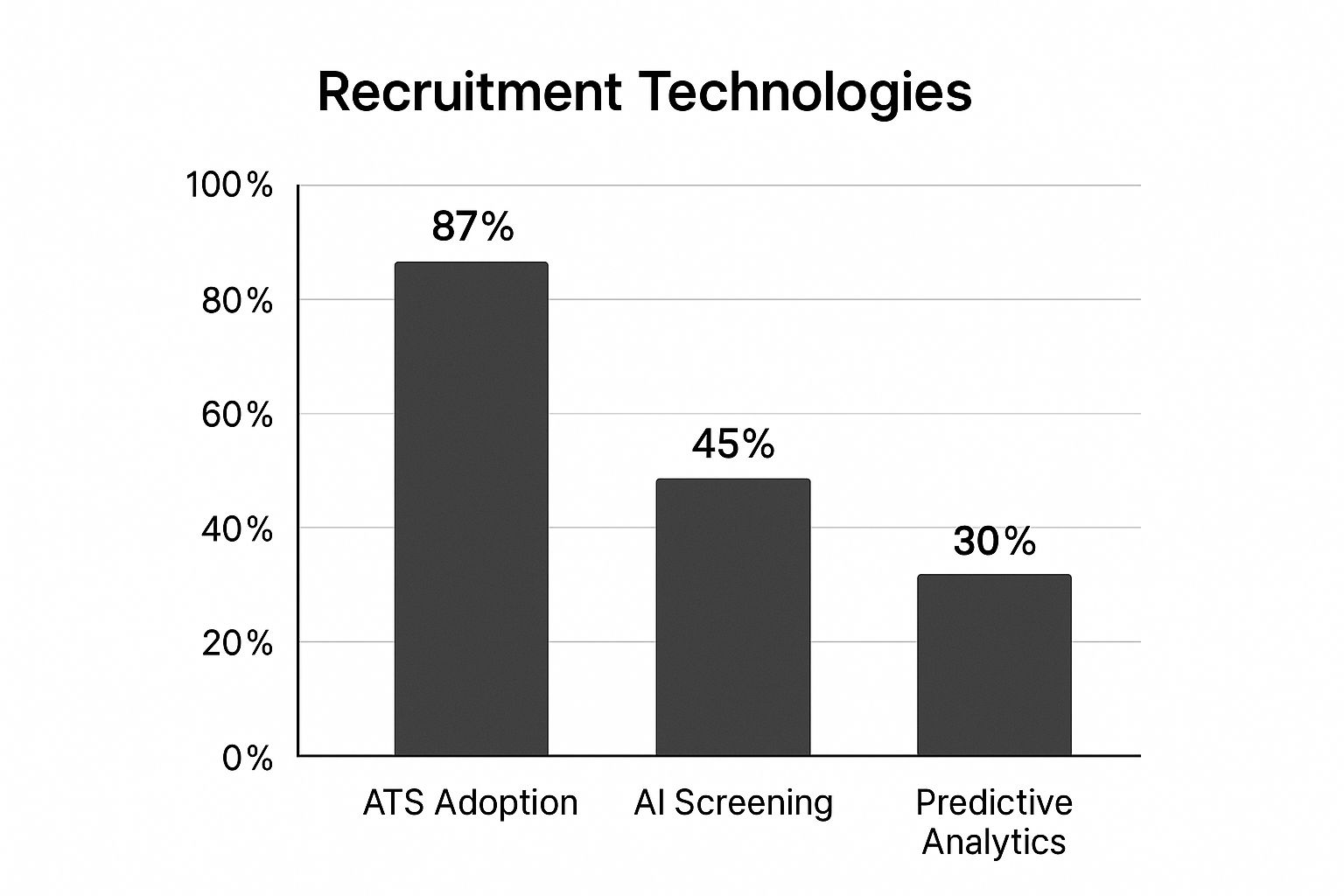
The data is clear. While most companies have an ATS, the uptake of more advanced AI and predictive analytics is still in its early stages. This presents a massive opportunity for forward-thinking teams to get ahead of the competition.
The results speak for themselves. Around 30% of UK employers are now using AI in their hiring, a figure that jumps to 43% for large companies using AI-driven interviews. Recruiters are seeing real benefits, with 70% reporting better hiring decisions and a 71% drop in average hiring costs. The time saved is also a huge win—recruiters are getting back an average of 4.5 hours per week. You can dig deeper into these findings on AI in recruitment from standout-cv.com.
By letting AI handle tasks like initial CV screening and candidate outreach, you free up your recruiters to do what humans do best: building meaningful relationships with top-tier candidates. It lets them switch from high-volume admin to high-impact strategy.
How to Evaluate Your Technology Choices
When you're looking at a new tool for your stack, it’s easy to get sidetracked by a long list of flashy features. Instead, I always advise my clients to focus on three critical areas that determine its real value to your data-driven recruiting efforts.
Evaluating Key Recruitment Technology
Choosing the right technology is about more than just features; it's about strategic fit. This table breaks down how to assess different tools based on what truly matters for building a data-driven recruitment function.
Tool Category | Primary Function | Key Evaluation Criteria | Impact on Data-Driven Recruiting |
|---|---|---|---|
Applicant Tracking System (ATS) | Centralises all candidate data and manages the entire hiring workflow from application to offer. | Integration capabilities, user experience (UX) for recruiters and candidates, customisable reporting. | Forms the "single source of truth" for all hiring data, making measurement and analysis possible. |
AI Sourcing Platforms | Proactively identifies and engages passive candidates from across the web. | Quality of candidate matching, size and scope of talent pool, ease of integration with ATS. | Expands the talent pool beyond active job seekers and provides data on sourcing channel effectiveness. |
Skills Assessment Software | Provides objective, standardised tests to evaluate candidate competencies and skills. | Variety and validity of tests, candidate experience, reporting on skill gaps and performance benchmarks. | Replaces subjective "gut feel" with hard data, improving quality of hire and reducing bias. |
Analytics & Reporting Dashboards | Aggregates data from multiple systems (ATS, HRIS, etc.) to provide holistic insights. | Ability to connect to all your data sources, customisable dashboards, ease of data visualisation. | Unlocks high-level strategic insights by connecting recruitment metrics to broader business outcomes. |
Ultimately, a tool is only as good as the data it provides and how easily your team can use it. By focusing on integration, usability, and the quality of analytics, you can build a powerful, efficient, and genuinely data-driven recruitment machine that gives you a serious competitive advantage.
Turning Data Insights into Hiring Wins
Collecting data is one thing; actually using it is where the magic happens. A data-driven recruiting strategy truly comes alive when you translate those numbers into real, tangible actions. Data that just sits on a dashboard is nothing more than noise. This is the moment your team shifts from a support function to a genuine strategic partner for the business.
The aim is to build a constant feedback loop: look at the data, make a change, measure what happens, and then do it all over again. It’s about creating a culture of continuous improvement, where every hire makes you a little bit smarter.
Let's dive into how you can put those findings to work in the real world.
Optimise Your Sourcing Budget
One of the quickest wins you can get is figuring out where to spend your time and money for the best results. Your sourcing channel data is the key to unlocking this.
For example, you might see that your LinkedIn campaigns are pulling in 70% of your total applications. On the surface, that looks brilliant.
But when you dig into your ATS, you discover something interesting: only 5% of those LinkedIn candidates actually make it past the first screening. Meanwhile, employee referrals—which only account for 10% of your applications—boast an impressive 40% interview-to-hire rate.
Insight in Action: The data gives you a clear direction. You can now confidently pull back some of your budget from broad-stroke LinkedIn advertising and reinvest it in your employee referral programme. Maybe that means bigger referral bonuses, or perhaps running an internal marketing campaign to get the word out. The outcome? A much better return on your investment and a pipeline full of stronger candidates.
A/B Test Your Job Descriptions
Think of your job descriptions as your primary marketing tool. Too often, they’re just recycled templates based on old assumptions. Data lets you get scientific and test what actually grabs the attention of the people you want to hire.
Let's say you're looking for a Senior Software Engineer. You could set up a simple A/B test:
Version A: Your standard, formal job description. It’s all about the required skills and qualifications.
Version B: A more story-driven description. This one talks about the company culture, the impact the role will have, and the cool projects the engineer will get to work on.
Track the metrics for both. Look at the click-through rate, the application completion rate, and, most importantly, the calibre of candidates each version attracts. You’ll probably find that Version B brings in fewer applicants overall, but a much higher percentage of top-tier engineers who are genuinely excited about your company’s mission.
Refine Your Interview Process and Stop the Leaks
High candidate drop-off is a silent killer, especially when you lose great people late in the game. Your data can show you exactly where the leaks are in your pipeline.
Imagine your dashboard highlights that a lot of candidates are withdrawing their applications right after the second interview. That’s a massive red flag telling you something in that stage is broken. It could be a few things:
Poor communication: Are people left waiting too long for feedback?
A bad experience: Is one particular interviewer leaving a sour taste?
Mismatched expectations: Does the reality of the job not quite match the initial pitch?
With this information, you can start investigating. Maybe you need to set up automated feedback reminders, offer more training to your interviewers, or just be clearer about the role upfront. Fixing these drop-off points doesn’t just save you time; it dramatically improves how people see your company. For more on this, check out our guide on top strategies to improve the candidate experience and build a stronger employer brand.
Tell a Story with Your Data to Leadership
Getting buy-in from leadership is all about how you present your findings. Don't just dump raw data on them. Instead, you need to tell a story that connects what you're doing to what the business cares about.
Instead of just saying, "Our time-to-hire is down by 10%," try framing it like this:
"By focusing our budget on the sourcing channels that deliver high-quality candidates, we filled our critical engineering roles 12 days faster this quarter. That meant the product team could kick off their new project ahead of schedule."
Use clean, simple charts and focus on the few metrics that speak directly to efficiency, cost, and quality. This changes the conversation from a simple report on recruitment activity to a strategic discussion about how talent is fuelling the company's growth. When you consistently show that kind of value, your team becomes an essential part of the organisation's success.
Common Questions About Data-Driven Recruiting
Making the switch to data-driven recruiting is a big move, and it's completely normal to have questions and hit a few bumps in the road. You're shifting from gut feelings to hard evidence, and that’s a journey. Here, I'll tackle some of the most common practical concerns I see teams run into, offering clear answers to help you push forward with confidence.
Where Should a Small Business Without a Big Budget Start?
For a small business, the whole idea of "data-driven recruiting" can sound expensive and complicated, bringing to mind fancy software and dedicated data analysts. The good news is, you can make a massive difference with the tools you probably already use. The trick is to start small and focus on what really matters.
Your first port of call should be your Applicant Tracking System (ATS), even a basic one. Most systems track fundamental data points that hold powerful insights. To begin, just focus on one or two high-impact metrics that don't need complex spreadsheets to figure out.
A great place to start is sourcing channel effectiveness. It's as simple as tracking where your actual hires come from. Is it LinkedIn, a niche job board, or employee referrals? After a few months, you’ll see a clear picture of which channels deliver people you actually hire, not just a mountain of CVs. This alone lets you point your limited budget where it will make a real difference.
Another metric that's easy to get your hands on is time-to-hire. Just by tracking how long it takes to fill each role, you can spot bottlenecks in your process. Is the CV review stage dragging on for weeks? Are you losing great candidates because interview scheduling is too slow? Pinpointing these delays costs you nothing but can seriously speed things up.
The most crucial advice for a small team is this: don't try to track everything at once. Pick one or two real pain points—like roles costing too much or taking too long to fill—and find the simplest metric that shines a light on it. The goal is to build momentum with small, tangible wins.
How Do We Accurately Measure Quality of Hire?
Quality of hire often feels like the hardest metric to nail down, but honestly, it’s the most valuable one. It’s the ultimate report card for your hiring efforts, directly answering the question, "Are we actually hiring the right people?" While there's no single magic formula, you can build a really solid measure by blending a few different data points.
A reliable quality of hire score typically combines information from before and after the person starts. From my experience, the most effective approach uses three key ingredients:
New Hire Performance: This is the cornerstone. Use the data from an employee's first formal performance review, say at 90 or 180 days. A simple rating on a 1-5 scale gives you a solid, quantifiable number.
Hiring Manager Satisfaction: How happy is the manager with their new team member? A short, simple survey sent out a few months after the start date can capture this perfectly. Ask them to rate the new hire’s skills, how they’ve fitted in with the team, and their overall contribution.
Retention Rate: Did they stick around? Tracking whether a new employee is still with the company after their first year is a brutally honest, but clear, indicator of a successful match.
By combining these scores, you create a composite "Quality of Hire" rating for each new employee. Over time, this data becomes your North Star, showing you which sourcing channels, interview panels, or assessment methods consistently bring in top-notch people.
How Can We Ensure Our Data Strategy Reduces Bias?
This is a critical point. If you're not careful, a data strategy can end up just putting a shiny, objective-looking stamp on existing biases. The key is to use data not just to confirm what you think you know, but to actively challenge your assumptions and uncover where bias might be creeping in.
You have to start by tracking diversity metrics at every single stage of your hiring funnel. It's not enough to just look at the diversity of who you hire. You need to see the demographic breakdown of candidates who apply, who pass the initial screen, who get interviewed, and who receive offers.
For example, if you see that candidates from a particular demographic group apply in high numbers but rarely make it to the interview stage, that's a massive red flag. This data points you directly to a problem area. Is it a screening algorithm that’s filtering out qualified people with non-traditional CVs? Or is unconscious bias influencing how your recruiters review applications?
Here are some practical steps to put data to work against bias:
Implement Structured Interviews: Make sure every candidate for a given role is asked the same core questions, and score their answers against a pre-defined rubric. This moves the focus from "gut feeling" to skills and competence.
Anonymise CVs: Use technology or even just a manual process to strip out names, photos, and other identifying details from CVs before they are screened.
Analyse Interviewer Data: Look at the interview-to-offer ratios for each of your interviewers. This can help you spot if certain individuals are consistently favouring or rejecting specific types of candidates.
Data truly becomes a tool for equity when you use it to ask tough questions and hold your process accountable.
What Are the Most Common Mistakes to Avoid?
Starting out on a data-driven recruiting path is exciting, but I’ve seen a few common pitfalls trip up even the most enthusiastic teams. Knowing what they are from the outset can save you a world of frustration.
The biggest mistake is tracking vanity metrics. It’s so easy to get a buzz from seeing a high number of applications or clicks on a job advert. But if those clicks don’t lead to qualified candidates and, ultimately, successful hires, then the metric is worthless noise. Always connect your data back to tangible business outcomes, like quality of hire.
Another frequent error is getting stuck in analysis paralysis. With so much data potentially at your fingertips, teams can get lost trying to analyse everything. This means they never get around to actually doing anything with it. Start small, focus on answering one question at a time, and remember that imperfect action is far better than perfect inaction.
Finally, don't make the mistake of ignoring the human element. Data should inform your decisions, not make them for you. It tells you the "what," but it’s still your recruiters' job to uncover the "why" through conversations and building real relationships. A candidate's potential and how they'll contribute to your culture often come through in ways that data alone can never capture.
At Talent People, we specialise in helping high-growth organisations in complex sectors like energy and technology build the teams they need to succeed. Our project-based, data-led approach ensures that every hire is not just a filled seat, but a strategic asset. If you're ready to move beyond guesswork and build a truly effective hiring function, learn more about our agile solutions at https://talentpeople.co.

Comments