Effective Diversity and Inclusion Training Strategies
- Talent People

- Aug 26, 2025
- 17 min read
Let's be honest, diversity and inclusion training often gets a bad rap. For many, it feels like a tick-box exercise—something to endure rather than embrace. But what if we flipped that script? What if, instead of being about compliance, it was about building a stronger, more innovative, and more resilient business?
When done right, that’s exactly what happens. The goal is to create a culture where every single person feels safe, valued, and ready to bring their A-game to work every day.
Why Most D&I Training Fails (And How Yours Can Succeed)
You know the feeling. A mandatory D&I training invite appears in your calendar, and you can almost hear the collective eye-roll across the company. It’s often seen as a corporate formality, totally disconnected from the day-to-day reality of people's jobs. This isn't just cynicism; it's a reaction to years of generic, preachy programmes that felt more like a legal briefing than a genuine effort to change things.

Here's the hard truth: bad training is worse than no training at all. It can create resentment, accidentally reinforce the very stereotypes it's trying to dismantle, and it’s a colossal waste of time and money.
Successful programmes work because they reframe the entire conversation. They move the focus from obligation to opportunity. D&I stops being a "problem" to be fixed and becomes a strategic advantage that can be unlocked.
The Business Case for Genuine Inclusion
In hyper-competitive fields like technology and energy, standing still means falling behind. Innovation and agility are your lifeblood. The risk with a homogenous team isn't just optics; it's the danger of groupthink, of missing the varied perspectives needed to solve tough problems and see what's coming next.
A genuinely inclusive workplace, on the other hand, directly fuels better business outcomes. Think of it as a performance enhancer for your entire organisation.
When your people feel psychologically safe—when they know they can speak up, float a wild idea, or even admit a mistake without fear of being shut down—that’s when the magic happens. This is the foundation of every high-performing team I've ever worked with.
A great diversity and inclusion programme does more than just raise awareness. It gives your people practical, everyday skills to challenge their own biases, collaborate more effectively, and become active champions for a fairer workplace.
From Checkbox to Culture Change
The real win here isn't completing a workshop; it's weaving inclusive behaviours into the very fabric of your company culture until they become second nature. This takes a real, sustained commitment that reaches far beyond a single training session. It means looking at your core processes—from hiring to promotions—and making them better.
How does this translate into measurable results? The link is clearer than you might think.
Here's a quick look at how targeted D&I training initiatives can create real business value.
From Training Initiatives to Business Outcomes
Training Outcome | Business Impact |
|---|---|
Increased Psychological Safety | Teams are more willing to innovate, share bold ideas, and admit mistakes, speeding up problem-solving. |
Bias-Aware Recruitment | The talent pool widens, leading to better hires and a stronger employer brand that attracts top performers. |
Inclusive Leadership Skills | Managers become better at retaining their best people, significantly cutting down on turnover costs. |
Improved Cross-Team Collaboration | Diverse perspectives are actively sought and valued, leading to more creative and robust solutions. |
Ultimately, connecting your D&I training directly to tangible business goals is what turns it from a dreaded requirement into a celebrated part of your company's success story.
Consider the real-world impact in these key areas:
Talent Attraction: Top candidates aren't just looking for a job; they're looking for a culture. A reputation for inclusivity is a massive advantage in a tight talent market.
Employee Retention: People stay where they feel they belong and can see a future for themselves. An inclusive culture is one of the most powerful tools for reducing costly staff turnover.
Innovation: Diverse teams are proven to be better problem-solvers. They approach challenges from different angles, which is critical in fast-moving industries like tech and energy.
Fairer Hiring: Good training helps hiring managers recognise and sidestep the hidden biases that can sabotage your recruitment efforts. Our guide on https://www.talentpeople.co/post/unconscious-bias-recruitment-fair-hiring-strategies dives deeper into building these equitable processes.
Laying the Groundwork for Your Training Programme
Jumping into diversity and inclusion training without a solid plan is a bit like building a house with no blueprints. You might end up with four walls and a roof, but it probably won’t be the sturdy, functional structure you actually need. I've seen it happen time and again: the most effective D&I programmes are built long before the first workshop is ever scheduled. It all starts with a deep, honest look at your organisation's real-world challenges.
This prep work is non-negotiable. It’s what takes you from a vague desire for ‘better inclusion’ to a sharp, data-backed strategy with goals you can actually measure. If you skip this, you risk rolling out generic training that just doesn't connect with your teams and ends up treating symptoms instead of the root cause.
Start with a Thorough Needs Analysis
Before you can design training that makes a difference, you have to understand the specific problems you’re trying to solve. A proper needs analysis helps you uncover the real D&I hurdles in your company. Is it unconscious bias creeping into your hiring process? Or maybe communication breakdowns are causing friction between your globally distributed teams?
This isn’t about guesswork; it’s about gathering cold, hard data. I recommend a mix of methods to get a full picture:
Anonymous Employee Surveys: Ask pointed questions about belonging, psychological safety, and whether people feel processes like promotions are fair.
Confidential Focus Groups: Get small groups of employees from different departments and levels into a room where they feel safe to share their real experiences.
Data Review: Dig into your existing HR data. Look at hiring, retention, and promotion rates across different demographic groups to spot any glaring patterns or disparities.
For instance, a fast-growing tech firm I worked with discovered through surveys that their female engineers felt their ideas were consistently overlooked in technical meetings. This single insight was gold. It allowed us to design training focused specifically on inclusive meeting etiquette and practical allyship—a far cry from a generic "unconscious bias" module that would have missed the mark entirely.
Secure Genuine Leadership Buy-In
Let's be blunt: if your leadership team isn't truly on board, your D&I initiative is dead in the water. But getting their buy-in is about more than just asking them to sign off on a budget. You need to frame this training as a strategic investment that hits core business goals, not just another HR expense.
You have to present a compelling business case. Connect what you found in your needs analysis directly to the KPIs that your execs lose sleep over—things like innovation, employee retention, and attracting top talent.
When you can walk into a boardroom and show that certain teams have a 30% higher turnover rate among underrepresented staff, the conversation changes instantly. Suddenly, the training isn't just a "nice-to-have"; it's a direct solution to a very expensive business problem. Leaders need to see the 'why' before they’ll ever fully commit to the 'how'.
This image really drives home the link between doing the training right, listening to feedback, and seeing real business benefits.
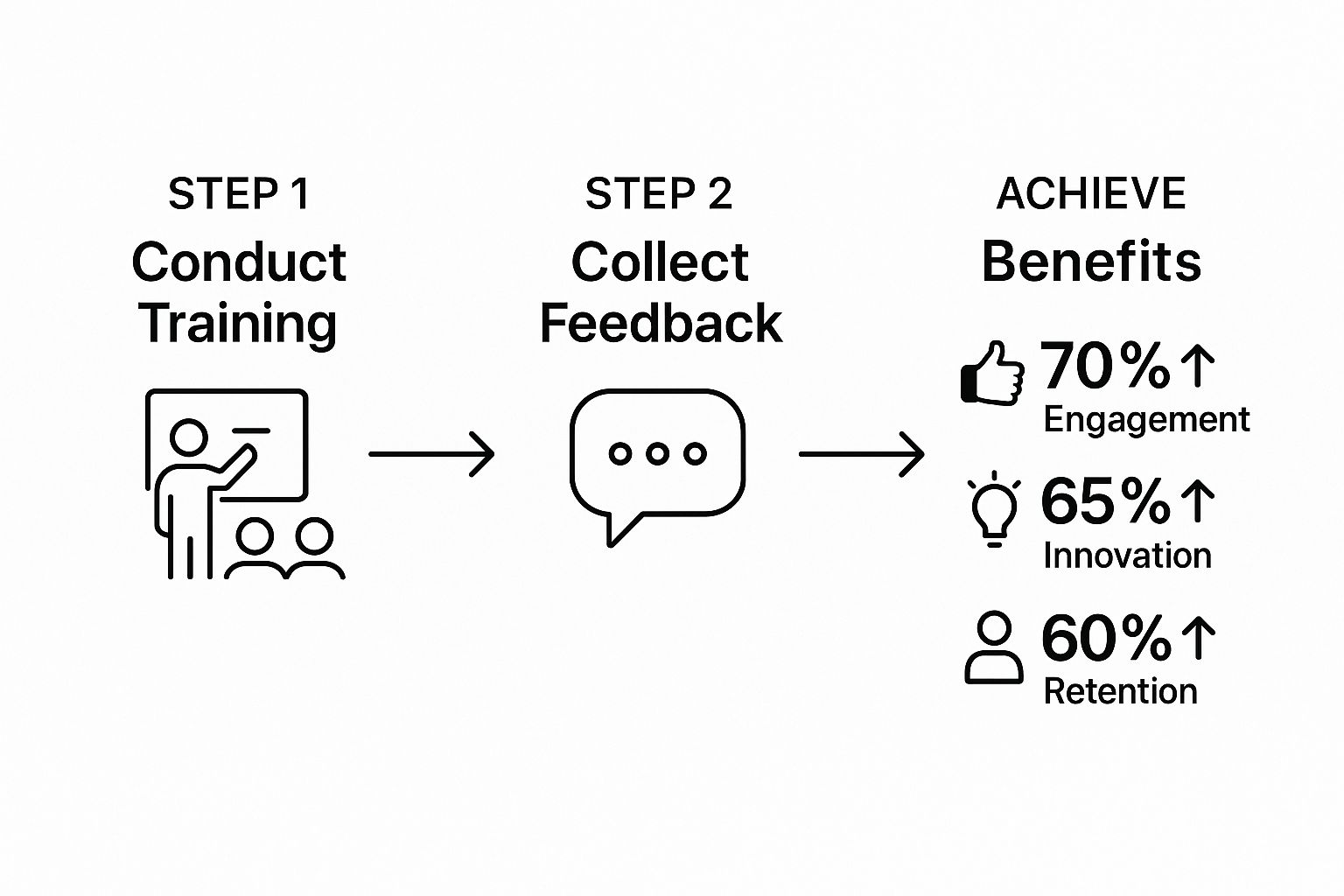
It clearly shows how a well-run programme leads straight to big wins in engagement, innovation, and retention, proving it’s worth every penny.
Assemble a Diverse D&I Committee
One person or one department can't change a company's culture. It’s a team sport. That's why putting together a dedicated D&I committee is such a powerful move for building momentum and making sure the initiative truly reflects the entire organisation.
And this can't just be a group of HR folks. You need a true cross-section of your company. Make sure your committee includes people from:
Different departments (think engineering, sales, and operations)
Various levels of seniority, from junior team members to senior leaders
A mix of backgrounds, tenures, and life experiences
This diversity is the committee's superpower. A project manager from your renewables division sees the world differently than a software developer in your city hub. Their combined insight is what will make your training programme relevant, practical, and championed by people their colleagues actually know and trust. This group will be your guide for everything from design and rollout to making sure the lessons stick long-term.
Designing Training Content That Resonates
Let's be honest: the fastest way to make your diversity and inclusion training completely useless is to pull some generic content off a shelf. Your team can spot a tick-box exercise from a mile away. Abstract theories about bias just don't stick, and they certainly don't change how people act day-to-day. If you want training that actually makes a difference, you need to build it from the ground up, with your company’s unique challenges front and centre.
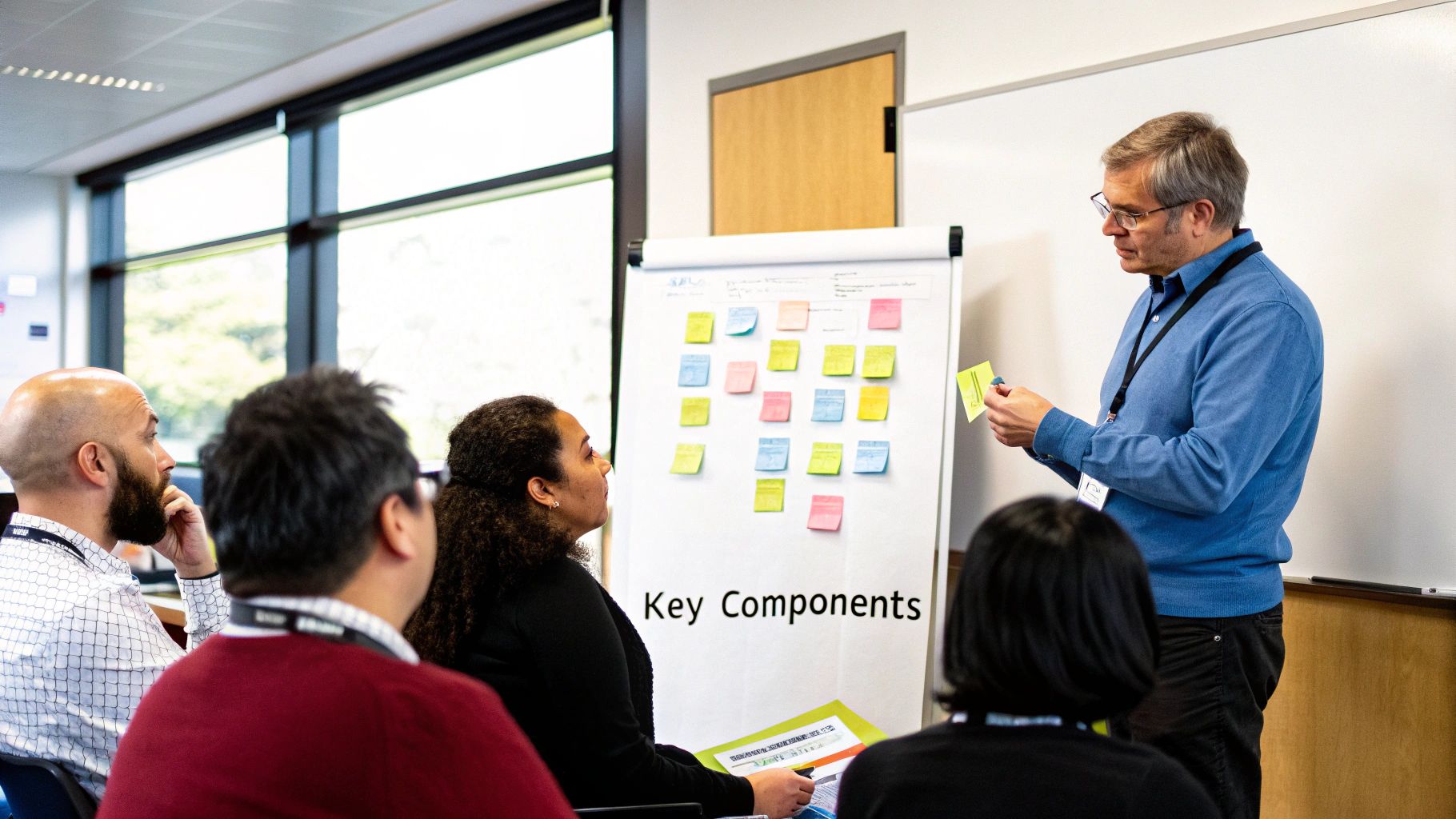
This means getting specific. Move beyond broad concepts and dig into the real situations your people face every single day. When you create customised content, you're showing respect for your team's time and intelligence. It sends a clear signal that this is a genuine effort to improve the workplace, not just another corporate mandate to get through.
Make it Real with Real-World Scenarios
The most powerful D&I training is built on a foundation of authenticity. Forget the theoretical lectures on microaggressions. Instead, craft a scenario based on something that could actually happen in your company.
For a fast-paced tech firm, this might mean exploring how feedback is delivered during a stressful code review. For an energy company, it could be a scenario about making sure every voice is heard during a critical on-site safety briefing.
When the learning is rooted in familiar contexts, it becomes immediately relevant. People shouldn't have to strain to figure out, "How does this apply to me?" The link to their daily work should be crystal clear.
Here’s how to make it happen:
Dig for Authentic Stories: Use the insights you gathered from your initial discovery—anonymous survey answers, focus group discussions—to build scenarios that feel genuine.
Focus on Building Skills: Every part of the training should give people practical tools they can use. For allyship, this means teaching specific phrases to use when interrupting a biased comment. For running inclusive meetings, it might be a simple checklist for facilitators to follow.
The goal isn't to make people feel guilty; it's to make them feel capable. Great training provides tools, not accusations. It helps people shift their thinking from "Am I part of the problem?" to "How can I be part of the solution?"
Tackle Sensitive Topics with Skill
Let’s face it, talking about things like unconscious bias, privilege, and microaggressions can be uncomfortable. The key is to create a space built on psychological safety, where people are encouraged to be curious and where mistakes are treated as moments for learning. If you take a preachy or accusatory tone, you'll just put people on the defensive and shut down any chance of progress.
Instead, frame these topics around shared understanding and collective improvement. It's about acknowledging a simple truth: we all have biases. It’s a natural function of how our brains work. The real work is learning practical strategies to stop those biases from affecting our decisions and how we treat each other.
Blend Different Formats for Maximum Engagement
Relying on a single training format, especially a standard slide deck presentation, is a surefire way to bore everyone. A blended learning approach, where you mix and match different methods, keeps the content fresh and appeals to different learning styles. This is especially vital in high-growth companies where teams are often spread out and time is a precious commodity.
Think about how different formats can serve different purposes:
Delivery Format | Best For | Why It Works |
|---|---|---|
Interactive Workshops | Deep dives on complex skills like allyship and inclusive leadership. | Encourages live discussion, role-playing, and immediate feedback, creating a powerful, shared experience. |
Self-Paced E-Learning | Foundational concepts, like defining D&I terms or reviewing company policies. | Offers total flexibility, letting people learn at their own pace and on their own schedule. |
VR/AR Simulations | Practising difficult conversations, such as addressing a microaggression. | Provides a safe, immersive space to build empathy and practice responses without real-world risk. |
Manager Toolkits | Reinforcing the learning and helping leaders continue the conversation with their teams. | Gives managers practical resources—like discussion prompts and checklists—to embed inclusive habits. |
By combining these formats, you create a much richer and more effective learning journey. You might start with a foundational e-learning module, follow it up with a live workshop for managers, and then equip those managers with a toolkit to lead discussions with their own teams. This multi-touch approach is essential for making change stick. In fact, research shows that organisations that continuously reinforce training see a much higher rate of actual behavioural change.
For any D&I training programme to truly connect, it must feel relevant, practical, and engaging. By customising your scenarios, handling sensitive topics with care, and blending your delivery formats, you create something far more meaningful than a corporate checkbox. You build a powerful learning experience that gives your people the skills and confidence to create a genuinely inclusive culture, one conversation at a time. The investment you make in a thoughtful programme like this pays off massively in employee trust, engagement, and innovation.
Rolling Out Your Training for Maximum Impact
You’ve put in the hard work and designed a brilliant diversity and inclusion programme. But here’s a truth I’ve learned over the years: the best content in the world can fall flat if the launch is clumsy or feels like just another corporate mandate. The rollout is where your careful planning meets reality, and getting it right is crucial.
How you introduce this training sets the entire tone. A generic, mandatory email makes it a chore. A thoughtful launch, on the other hand, frames it as a genuine opportunity for everyone to grow and contribute to a better, stronger company culture.
Building Your Communication Plan
First things first, you need to build a bit of a buzz and get people to understand the ‘why’. Don't just assume they'll get it. You need to connect the dots for them, showing how this training helps them, their teams, and the business as a whole.
Your messaging should be consistent and clear: this isn't about ticking a box or pointing fingers. It's about giving everyone the tools to work together more effectively and create a place where great ideas can truly thrive.
When you're crafting your pre-launch comms, make sure to hit these points:
A Clear 'Why': Connect the training directly to things everyone cares about, like innovation, keeping top talent, and hitting team goals.
What's In It for Them: Frame this as a chance to pick up modern leadership and collaboration skills that will genuinely help them in their careers.
A Word from Leadership: Get your CEO or another senior leader to kick off the announcement. This immediately shows that D&I is a core business priority, not just an HR side project.
The real aim of your communication is to shift the narrative from "you have to do this" to "we get to do this together." That subtle change in framing makes all the difference.
Nailing the Logistics
Let’s be honest, the practical details can make or break this. A poorly timed session creates stress and resentment before you’ve even started.
Think about the reality on the ground. For a tech firm in the middle of a crunch before a product launch, or an energy company with teams on rotating site schedules, timing is everything. Chat with managers and find a window that won’t throw a spanner in the works.
The environment you create is just as important as the content itself. You're going to be touching on some sensitive topics, so you absolutely must create a space of psychological safety. This means setting clear ground rules for respectful conversation and making sure people feel they can speak up without fear of judgement.
Choosing and Preparing Your Facilitators
The person leading the discussion is probably the single most important factor in a successful rollout. A great facilitator knows how to navigate tricky questions with empathy, manage group dynamics, and turn moments of discomfort into real learning. A bad one can, unfortunately, do more harm than good.
You’ve really got two paths here:
Internal Champions: These are people within the company who are already respected and passionate about D&I. They have priceless internal knowledge and existing trust. The key is ensuring they get proper training in facilitation so they can handle the tough stuff.
External Experts: A seasoned external facilitator brings a neutral perspective and specialist skills. They are often masters at creating a safe space for dialogue, simply because they aren't part of the day-to-day company politics.
Whichever route you take, preparation is non-negotiable. Your facilitators need to be completely up to speed on your company culture and what you’re trying to achieve. Their job is to guide a conversation, not just click through a PowerPoint deck.
Start the Rollout from the Top
If you want to show this is a real commitment, the training has to start with your leadership team. When people see the execs and senior managers fully engaged, it sends a powerful message: this matters.
This top-down approach does a few things. It gives leaders the language and confidence to champion inclusivity in their own teams. It also gives them a proper feel for the training, making them much better advocates for the whole programme. This cascade model builds momentum and shows that creating inclusive, high-performing teams is a responsibility everyone shares, starting right at the top. For more on this, have a look at our guide on proven strategies for building high-performing teams.
Measuring Success and Ensuring Lasting Change
A diversity and inclusion training programme isn't a one-and-done event. The real work actually starts once the final session is over. The goal isn't just to share information; it's to spark real, lasting changes in behaviour that become part of your company's DNA. This means you need a solid plan for measuring the impact and reinforcing what everyone has learned.

Without measurement, you're just guessing. You won't know what worked, what didn't, or if you've got a genuine return on your investment. It’s the difference between a feel-good initiative and a strategic business driver, giving you the hard data needed to refine your approach and show clear progress to leadership.
Combining Quantitative and Qualitative Metrics
To really get the full picture, you need to look beyond simple satisfaction scores. A smart measurement strategy blends the hard data with the human stories, giving you both the "what" and the "why" behind any cultural shifts.
Start with clear, quantifiable metrics—the numbers that track tangible changes.
Pre- and Post-Training Surveys: Use these to measure shifts in employee knowledge, attitudes, and confidence. A 15-20% jump in understanding key D&I concepts is a strong sign that the core messages landed.
HR Data Analysis: Keep an eye on key metrics over time. You’re looking for positive trends in the promotion and retention rates of people from underrepresented groups. Digging into this can also uncover broader insights to help you improve employee retention for everyone.
Recruitment Funnel Data: Is your candidate pipeline getting more diverse at every stage? An increase in applicants from different backgrounds is a great indicator that your employer brand is becoming more inclusive.
But numbers don't tell the whole story. Qualitative data adds the rich context you need to understand the human impact of your efforts.
Often, the most powerful insights come simply from listening to your people. Anonymous feedback, focus groups, and one-on-one chats can reveal subtle but vital shifts in team dynamics and psychological safety that you’d never see in a spreadsheet.
Responsible Data Collection and Analysis
Gathering diversity data is essential, but it has to be handled with incredible care and transparency. Your employees must trust that their information is secure and will be used constructively.
This is especially true as legal frameworks evolve. For instance, upcoming UK requirements around mandatory ethnicity and disability pay gap reporting for companies with over 250 employees are pushing organisations to get much better at collecting and using this data. You can't build that trust without being completely clear about why you're collecting the data and how it will inform your next steps.
Embedding the Learning for Long-Term Impact
Training provides the initial spark, but reinforcement is what keeps the fire going. To make sure the lessons stick, you have to weave them into the daily rhythms of your business. This is how you move from a one-off initiative to a genuine cultural transformation.
Integrate into Performance Management: Make inclusive behaviours a core part of your performance review criteria. When managers are evaluated on how well they foster inclusive teams, it stops being a "nice-to-have" and becomes a non-negotiable part of their role.
Empower Employee Resource Groups (ERGs): Your ERGs are some of your most valuable allies. Give them the resources and visibility to keep the conversation going with events, workshops, and peer-to-peer mentoring. They are the grassroots champions who maintain momentum.
Provide Ongoing Resources: Don't let the learning end with the course. Create an easily accessible resource hub with articles, toolkits, and discussion guides for managers and teams. Sometimes, small, regular touchpoints are far more effective than a single big event.
By thoughtfully measuring your progress and actively reinforcing the lessons, your D&I training can become a powerful catalyst for a more innovative, equitable, and high-performing workplace.
Got Questions About D&I Training? Let's Tackle Them.
Whenever you start planning diversity and inclusion training, a few common (and tricky) questions always come up. It's totally normal. Getting ahead of these concerns is the best way to build a programme that your teams actually get behind, rather than just sit through.
Let's walk through some of the big ones I hear all the time.
How Do We Handle People Who Are Resistant or Cynical?
This is probably the number one concern, and it's a fair one. Look, resistance doesn't usually come from a bad place. It’s often born from sitting through past "check-the-box" training that felt pointless, or simply not understanding what you’re trying to achieve.
The trick is to completely reframe it from day one.
Stop calling it a mandatory HR session. Start positioning it as a genuine professional development opportunity. This isn't about blame; it's about giving everyone the skills to build a workplace that's more respectful, innovative, and frankly, better to work in. You need to show them what’s in it for them.
Senior leadership has to be in the room and fully bought in. I can't stress this enough. If leaders are actively participating, it sends a crystal-clear message that this is a core business priority, not just another HR initiative.
A great practical step is to use anonymous pre-training surveys to take the temperature of the room. When you know what people are worried about, you can address it head-on. Most importantly, the training itself needs to feel practical and engaging, led by someone who can create a safe space for real talk, not just a lecture from a PowerPoint slide.
What's the Real Difference Between Diversity, Equity, and Inclusion?
People throw these terms around a lot, often using them to mean the same thing. But they are distinct, and knowing the difference is fundamental to creating a programme with any real substance.
Here’s a simple way I like to think about it:
Diversity is the "who." It’s the mix of people you have in your organisation—different backgrounds, experiences, identities, and ways of thinking. It's about getting all the different ingredients for the recipe.
Inclusion is the "how." It's about making sure every single one of those people feels valued, heard, and able to do their best work. It's that feeling of belonging that makes great people stay. It’s ensuring every ingredient can actually contribute its unique flavour to the dish.
Equity is the "what." It's the systemic piece. This is about taking a hard look at your internal processes—hiring, pay, promotions—and actively dismantling the barriers that create unfair advantages for some. It's about making sure the recipe itself is fair.
A truly successful diversity and inclusion training programme has to hit all three. You can spend a fortune hiring a diverse team, but if you don't have an inclusive culture and equitable systems, you'll watch that talent walk right out the door.
How Often Should We Be Doing This?
Thinking of D&I training as a one-and-done event is a classic mistake. You can't change ingrained behaviours with a single two-hour workshop. It might create a spark of awareness, but it won't build new habits.
You need to treat it like an ongoing conversation. A big, foundational session is a great starting point, especially for new hires, to get everyone on the same page. But that's all it is—a start.
To make it stick, you need a steady rhythm of learning. This could look like:
Annual Refreshers: A chance to revisit the core ideas and introduce new, timely topics.
Manager-Specific Training: Give your leaders more advanced skills, like how to spot bias in performance reviews or run truly inclusive meetings.
Regular Micro-Learning: Keep the conversation alive with smaller, frequent nudges. This could be anything from a "lunch and learn" session, an interesting article in the team newsletter, or a discussion prompt for weekly stand-ups.
This is how you turn a memorable training day into a living, breathing part of your culture.
Should This Training Be Mandatory?
Ah, the mandatory vs. optional debate. It’s a big one.
Here’s my take: making your foundational D&I training mandatory sends a clear, powerful message. It says, "This is a core competency here, just like health and safety." It establishes a shared language and a baseline of understanding that everyone is expected to have.
But—and this is a huge but—how you frame it is everything. If it feels like a punishment or a box-ticking exercise, you’ll get pushback and people will tune out.
The goal is to present it as a shared learning journey, one that’s vital for the company’s success and for everyone's personal growth. When people get the why, they're much more likely to show up with an open mind. For more advanced or niche topics, making them optional can be a smart move, letting those who are most passionate dive deeper and become champions for the cause.
At Talent People, we know that building high-performing, inclusive teams is what separates good companies from great ones, especially in today’s market. Our project-based hiring solutions are built to find people who don't just have the right skills, but who will actively strengthen your culture.
Discover how we can help you build the diverse and talented teams you need to thrive. Learn more at talentpeople.co.

Comments