How to Build High Performing Teams in the UK
- Talent People

- Jul 21, 2025
- 17 min read
High-performing teams don't just happen by accident. They're built on a solid foundation, starting with a crystal-clear purpose that everyone on the team can rally behind. It's about getting past those generic mission statements you see on office walls and defining what success really looks like for your team. When you set tangible goals and establish core values that actually mean something, you create a powerful sense of alignment and motivation.
Defining Your Team’s Purpose and Vision
Before you can even think about putting together a team of top performers, you have to know where you're going. A compelling vision is more than just a nice idea; it's a practical tool that guides everyday decisions, sparks action, and, crucially, helps attract the right kind of people. Without that clarity, even the most talented individuals can end up pulling in different directions, which is a recipe for frustration and poor performance.
This first step is all about answering one simple question for every person on the team: "Why does my work matter?" When people see a clear line connecting their daily tasks to the team's bigger goals, their engagement and sense of ownership go through the roof. Honestly, this is the most important, non-negotiable step in building a team that consistently delivers.
Moving Beyond the Mission Statement
Let's be real: a vague mission statement rarely inspires anyone. A powerful team purpose, on the other hand, is specific, measurable, and has a bit of an emotional pull. It needs to be short and sharp enough for everyone to remember and repeat. Think of it as your team’s unique reason for being.
For instance, a goal like "Achieve market leadership" is far too vague. A much better purpose might be, "To become the UK's most trusted solar energy provider by delivering flawless installations and unmatched customer support to 1,000 new homes this year." See the difference? It's specific, ambitious, and connects directly to what the team does day-in, day-out.
This image shows just how central goal-setting is to the whole strategic process.
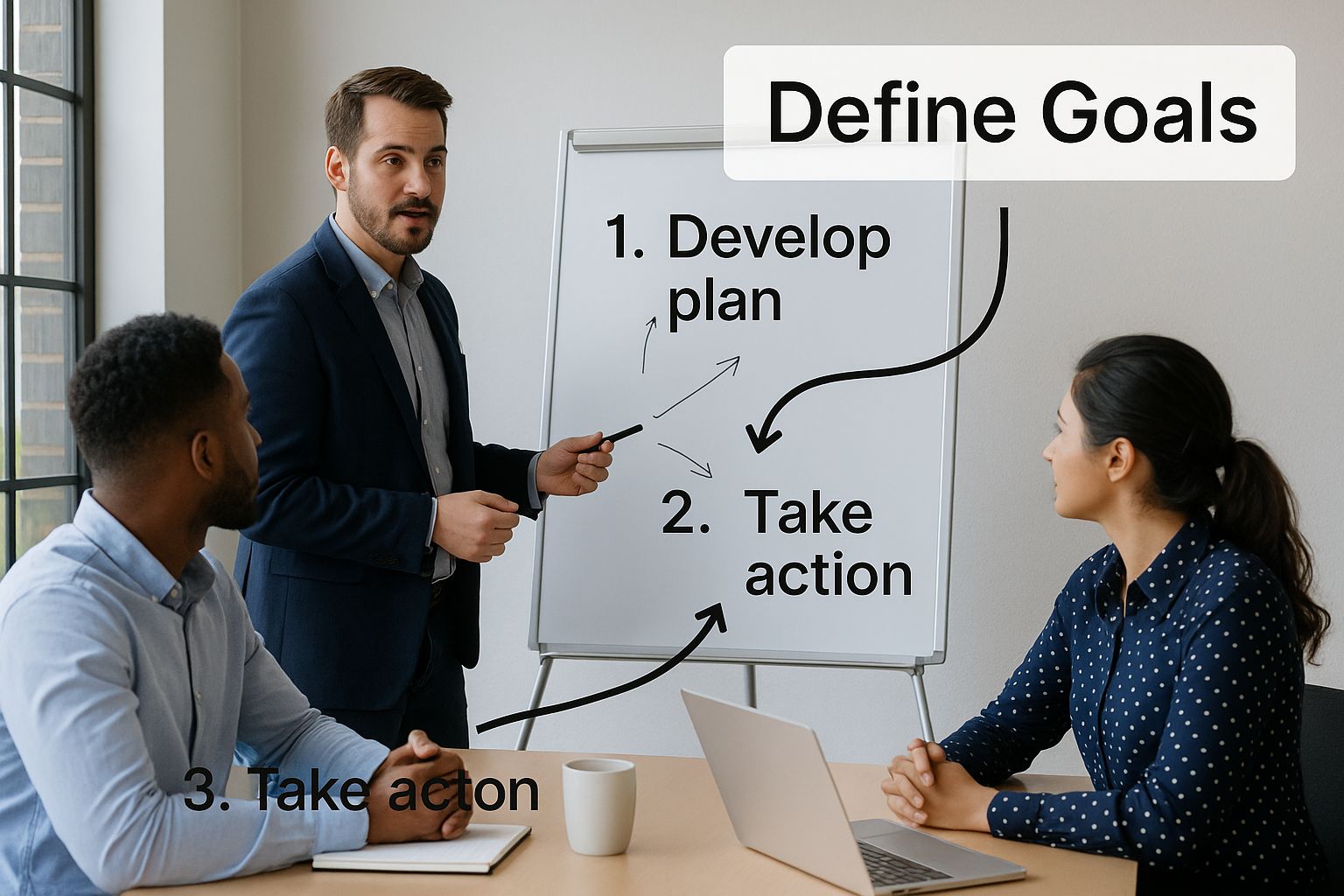
As you can see, defining your goals isn't a task you do in isolation. It’s a collaborative effort that becomes the driving force for team focus and alignment.
Articulating Your Core Values
If your purpose is the 'what' and 'why', your core values are the 'how'. They are the practical guidelines for behaviour on your team. For these to have any real impact, they must be more than just pretty words. They need to be observable behaviours that you actively hire for, promote, and, when necessary, let people go for.
Here’s how you can make your values stick:
Create Them Together: Get your team in a room for a workshop to hash out 3-5 core values. This collaboration is key for getting genuine buy-in.
Define the Behaviours: For each value, spell out what it looks like in practice. If a value is "Radical Candour," a corresponding behaviour might be, "We give direct feedback respectfully and quickly, even when it’s tough."
Weave Them into Everything: Make your values a part of your team's DNA. Talk about them in performance reviews, project kick-offs, and daily stand-ups.
A team's purpose provides the 'what' and the 'why,' but its values provide the 'how.' Without clear behavioural guidelines, even the most inspiring vision will falter under the pressure of day-to-day execution.
Setting Tangible and Transparent Goals
With a clear purpose and solid values in place, the next step is to set goals that people can actually see and touch. High-performing teams thrive on clarity and a sense of progress. They need to know exactly what the target is and how they're being measured against it.
A fantastic way to do this is by using the Objectives and Key Results (OKRs) framework. It’s brilliant for creating alignment and transparency. For our solar energy example, an objective could be "Enhance Customer Satisfaction." The key results to measure this might be:
Achieve a Net Promoter Score (NPS) of 80
Reduce post-installation support tickets by 20%
This process breaks a big, abstract vision down into a concrete action plan. It ensures every single person understands how their work contributes to the team’s overall success, which fosters a powerful, collective drive towards a shared goal.
To make this even clearer, let's break down the essential elements that create this strong foundation for any high-performing team.
Core Components of a High-Performance Foundation
This table outlines the bedrock elements every leader needs to put in place.
Component | Description | Key Action for Leaders |
|---|---|---|
Clear Purpose | A specific, inspiring statement that defines the team's ultimate goal and impact. | Co-create a concise purpose statement that is easily remembered and emotionally resonant. |
Shared Vision | A vivid picture of what future success looks like for the team. | Articulate a compelling future state that guides daily decisions and attracts talent. |
Core Values | The non-negotiable behavioural principles that guide how the team works together. | Define 3-5 values with observable behaviours and integrate them into all team processes. |
Tangible Goals | Measurable, transparent targets that connect individual work to the team's purpose. | Implement a framework like OKRs to set quarterly goals and track progress openly. |
Getting these core components right is the first, and most critical, step. This is the foundation upon which all other high-performance attributes are built.
Strategic Recruitment to Attract Top UK Talent

Once you’ve nailed your team's purpose, the real work begins: bringing the right people on board. This isn't just about filling a vacancy. It’s a strategic search for individuals who possess not only the hard skills but also the mindset and behaviours that will lift the entire team.
In the UK's competitive talent market, generic recruitment tactics simply don't cut it anymore. The best people aren’t just looking for a paycheque; they want to join a mission-driven team where they can see their work making a real difference. Think of your recruitment process as their first taste of your team's culture.
Crafting Job Descriptions That Speak to Achievers
Your first interaction with a potential hire is almost always the job description. Far too many companies treat this as a dry HR formality—a boring list of duties and qualifications. This is a huge missed opportunity. A great job description is a marketing tool, selling your team’s vision to the exact professional you’re trying to attract.
Don't lead with a laundry list of responsibilities. Start with the "why." Talk about the team's mission and the exciting problems the new hire will get to solve. Frame the role around its impact, not just its tasks.
For instance, instead of writing this:
"Responsible for managing social media accounts."
Try something more compelling, like this:
"You will own our digital voice, building a community of advocates and driving real growth through creative social media strategies."
This subtle shift in language makes a world of difference. It attracts ambitious, results-focused people, not just those looking to tick boxes. From the get-go, it sets the stage for a conversation about contribution and achievement. If you're an early-stage company, this comprehensive founder's guide to hiring for startups offers some excellent tactics for landing those crucial first hires.
Uncovering Soft Skills with Behaviour-Based Interviews
Technical skills are usually straightforward to check. What's much harder to gauge are the soft skills that truly define a high performer: things like resilience, adaptability, and genuine collaboration. A "gut feeling" is often wrong. The most reliable way to dig into these traits is through the behaviour-based interview.
The idea is simple but incredibly powerful: past behaviour is the best predictor of future performance. So, instead of asking "what would you do if…", you ask candidates to describe specific situations from their past.
By focusing on concrete past experiences, you move beyond polished interview answers and get real evidence of how a candidate thinks, acts, and solves problems under pressure. This is essential when building a high-performing team.
You should structure your questions to probe for the key competencies you need. For example:
To assess resilience: "Tell me about a time a major project you were working on failed. What did you do next, and what did you learn?"
To assess collaboration: "Describe a situation where you had a major disagreement with a colleague. How did you work through it, and what was the result?"
To assess adaptability: "Give me an example of when you had to learn a completely new skill from scratch to get a task done. How did you go about it?"
You're listening for answers that follow the STAR method (Situation, Task, Action, Result). This structured format helps you get the full story, not just a vague anecdote.
Get Your Team Involved in the Hiring Process
Remember, a new person doesn't just join a company; they join a team. A critical step that many managers skip is involving the existing team in the interview process. This isn't about passing the buck; it's about getting vital perspectives and checking for cultural fit in a real-world way.
Peer interviews give your team a chance to see how a candidate communicates and works with others. It also empowers them by giving them a say in building their own high-performing team. They'll naturally be more invested in a new colleague's success if they helped choose them.
A simple way to do this is to have a candidate meet with two or three team members for a casual chat or even a short, collaborative problem-solving session. Ask for their feedback afterwards. They can often pick up on subtle interpersonal cues that a hiring manager might miss, dramatically reducing the risk of a technically skilled but culturally disruptive hire.
Cultivating a Culture of Psychological Safety

You can assemble a team of the most talented people and give them the clearest goals, but they’ll never hit their stride without a foundation of psychological safety. This isn't about being 'nice' or creating a workplace free from pressure. It’s about building an environment where people feel safe enough to be themselves.
What does that look like in practice? It means team members feel secure enough to voice a dissenting opinion, ask a "silly" question, or admit they’ve made a mistake—all without fearing punishment or humiliation.
Without this safety net, innovation grinds to a halt. People stop taking smart risks, brilliant ideas go unspoken, and small problems fester because nobody wants to be the one to deliver bad news. Building this culture is perhaps the most crucial part of creating a high-performing team; it's the invisible architecture that holds everything else up.
The Leader's Role in Modelling Vulnerability
Psychological safety always starts at the top. As a leader, your team is constantly looking to you for cues on how to behave. If you project an image of perfection and never admit you're wrong, you’re sending a clear signal: mistakes are not welcome here.
To build real trust, you have to deliberately model vulnerability. I know it can feel unnatural at first, but its impact is huge.
Admit Your Own Mistakes: When you get something wrong, own it openly. Try saying, "I made the wrong call on that decision, and here’s what I learned from it." This simple act normalises imperfection and reframes failure as a chance to learn.
Acknowledge What You Don't Know: Using phrases like, "That's a great point, I don't have the answer right now, but let's figure it out together" is powerful. It shows that it’s okay not to have all the answers and invites everyone to solve problems collectively.
True leadership isn't about being infallible; it's about being human. When you model vulnerability, you give your team permission to do the same, unlocking a level of honesty and creativity that is impossible to achieve in a culture of fear.
Setting the Ground Rules for Open Dialogue
You can’t just tell a team to "be more open" and expect it to happen. You need to establish clear, structured guidelines for how you communicate, especially when debating ideas or navigating disagreements. This ensures discussions stay constructive and respectful.
A great way to do this is by creating a Team Charter—a living document you build together. It might include simple principles like:
Challenge ideas, not people. Focus on the merits of a concept, not the person who suggested it.
Assume positive intent. Trust that your colleagues are coming from a good place, even when you disagree.
No interruptions. Let everyone finish their thought without being cut off.
Listen to understand, not just to reply.
These simple rules can transform potential conflict into productive friction. It's that very friction that polishes ideas and leads to better outcomes.
Turning Failures into Learning Moments
High-performing teams don't avoid failure; they just learn from it faster than everyone else. How you react when something goes wrong is a defining moment for your team's culture. If your response is to assign blame, people will quickly learn to hide their mistakes.
Instead, when a project stumbles or a target is missed, treat it as a data point. Run a blameless post-mortem or an after-action review, focusing the discussion on a few key questions:
What did we expect to happen?
What actually happened?
What can we learn from the gap?
What will we do differently next time?
This process removes the personal fear from failure and turns it into a valuable, collective lesson. It reinforces that the goal is continuous improvement, not flawless execution. For UK businesses, building this kind of resilience is key to retaining staff. You can find more practical advice by exploring our guide on how to improve employee retention with effective strategies in the UK.
This focus on culture is especially relevant in the UK, where workplace dynamics have shifted so much. While a recent poll showed 45% of UK HR leaders flagged competitive pay as vital for retention, it's clear that culture now plays an equally important role.
With 69% of UK employees saying they would work harder if they felt recognised, things like trust, feedback, and flexibility are no longer optional extras. They are essential. Companies that get this right see significantly lower turnover—a huge advantage in a tight labour market.
How Great Leadership Unlocks High Performance
You can have the perfect strategy and a fantastic culture, but without great leadership, your team will never reach its full potential. Think of your leaders as the spark plugs in a high-performance engine. They’re the ones who inspire, motivate, and clear roadblocks so their team can truly fly.
The best leaders I've worked with understand their job isn't to have all the answers. Instead, their real role is to create an environment where the team can find the answers for themselves. This means shifting from being a traditional 'boss' to a modern 'coach'—moving from giving orders to asking great questions, and from supervising tasks to actively mentoring your people.
Move From Micromanagement to Empowerment
Nothing kills team morale and performance faster than micromanagement. It breeds resentment, crushes creativity, and screams, "I don't trust you." High-performing teams, on the other hand, are built on a foundation of empowerment. People need to feel a real sense of ownership over their work.
Making this shift means getting comfortable with letting go. Your job is to define the "what" (the goal) and the "why" (why it matters), but then you have to give your team the space to figure out the "how." This isn't about disappearing; it's about being available for guidance, not for minute-by-minute instructions.
True empowerment is about trusting your team to think, innovate, and own their results. When people feel that trust, they bring their A-game—investing all their energy and creativity into their work.
Create a Continuous Feedback Loop
Let's be honest, the annual performance review is a relic. It’s too little, too late. The best teams run on a continuous feedback loop where communication is constant, constructive, and always looking forward. This helps build a culture where feedback is seen for what it is: a gift to help someone grow, not a criticism.
So, how can you build a healthier feedback culture?
Keep it frequent and informal. Don't save feedback for a scheduled meeting. Share it in your regular one-to-ones or right after a project wraps up.
Talk about behaviour, not personality. Instead of saying, "You were quiet in that meeting," try something like, "I noticed you didn't get a chance to share your thoughts on the new proposal. I’d love to hear them." It's specific, actionable, and doesn't put anyone on the defensive.
Normalise peer-to-peer feedback. Create safe, structured ways for team members to share constructive thoughts with each other. This builds a powerful sense of collective responsibility.
The Clear Link Between Managers and Engagement
The impact of a manager on their team's performance isn't just a feeling; the numbers are crystal clear. In the UK, a manager or team leader directly influences a staggering 70% of team engagement.
However, recent Gallup research shows a worrying trend: manager engagement in the UK is falling, and the ripple effect is costing the economy billions in lost productivity. It's simple—when managers are checked out, their teams follow suit. You can dig deeper into these leadership statistics and their impact on UK businesses.
This makes developing your leaders the single most important investment you can make. Despite the challenges, there's a huge opportunity here. The same data shows that 79% of UK employees want to do their best work. They are ready and willing to contribute. By investing in empathetic, emotionally intelligent leaders who provide clarity, support, and growth, you can unlock that potential. Ultimately, building a team that excels starts with building leaders who know how to inspire them.
Creating Systems for Continuous Improvement
The journey to building a high-performing team doesn’t end when you make a great hire.The journey to building a high-performing team doesn’t end when you make a great hire. That's really just the beginning. The best teams I've seen are never static; they are wired for constant learning and adaptation.
They understand that peak performance isn't a final destination but a continuous process of getting better, day in and day out. To get there, you have to deliberately build systems that make growth a natural, everyday ritual.
This isn’t about some impossible chase for perfection. It’s about embedding a growth mindset deep into your team’s DNA. Every project—whether it's a soaring success or a painful failure—becomes a goldmine of insight. The real goal is to create sustainable habits that keep your team sharp, agile, and always moving forward.
Learning from Wins and Setbacks
High-performing teams don't just finish a project and immediately jump to the next thing. They pause, they reflect, and they learn. This is where structured debriefs like After-Action Reviews (AARs) or retrospectives become your most valuable tools. These aren't about pointing fingers or assigning blame; they're about collectively figuring out what happened and why.
You can use a simple AAR framework after any significant project or event. Just ask four key questions:
What did we set out to do? (This gets everyone aligned on the original plan and goals.)
What actually happened? (Focus on the objective facts, not opinions or stories.)
Why was there a difference? (This is the crucial step. Dig into the root causes together.)
What will we do differently next time? (This turns abstract lessons into concrete, actionable steps.)
By making these reviews a consistent practice, you make it safe to talk openly about performance. It completely reframes setbacks, turning them from something to be feared into powerful opportunities to improve.
Aligning Individual Growth with Team Goals
Continuous improvement isn't just a team sport; it’s deeply personal. Every single person on your team should have clear development goals that not only advance their own career but also directly contribute to the team's mission. When you get this right, you create a powerful synergy where individual ambition fuels collective success.
Sit down with each person and create a simple Individual Development Plan (IDP). Focus on just one or two key skills they want to build over the next quarter and connect those skills directly to an upcoming team objective.
For instance, if the team’s goal is to deliver more compelling client presentations, a team member’s IDP might focus on mastering public speaking or data visualisation. This approach makes personal development feel relevant and immediately useful, which is a huge motivator. It also ensures all growth efforts are strategically aligned. As people develop new capabilities, it’s also vital to plan for their future within the company. For more on this, you can explore our guide on mastering the succession planning process.
A team's capacity to grow is ultimately limited by the growth of its individual members. By investing in personal development that aligns with team objectives, you create a self-reinforcing cycle of high performance.
Fostering a Culture of Smart Experimentation
Truly great teams aren’t afraid to try new things. If you want to build a genuine culture of innovation, you have to actively encourage and celebrate smart experimentation. This means giving your team the psychological safety to test new ideas, even if they don't always pan out.
This is especially critical in the UK, where employee engagement is a real challenge. With only around 31% of UK workers feeling genuinely engaged, creating an environment that sparks curiosity is non-negotiable. The data is clear: highly engaged teams are 21% more profitable, and their employees are 87% less likely to leave. Given that manager engagement has also dipped to 27%, leaders must take the reins and build a culture where people feel empowered to contribute their best ideas. You can find more on these UK employee engagement statistics and their impact on performance.
So, how do you do it? Try setting aside a small portion of the team's time—even just 10%—for "innovation sprints" to tackle old problems in new ways. The key is to celebrate the learning, not just the outcome. When an experiment fails, praise the team publicly for their courage and lead a discussion on what was learned. This sends a powerful message: trying and learning is what matters most here.
Got Questions About Building High-Performing Teams? Let's Talk.
Even with a perfect plan on paper, leading a team is all about navigating the messy, real-world challenges that pop up every day. As a leader, you’re bound to face tricky situations that need a careful hand. Here, we'll dig into some of the most common questions we hear from UK leaders and offer some practical, straight-talking advice.
Getting these moments right is what really separates a good leader from a great one. The trick is to tackle issues head-on, but with empathy, clarity, and a constant eye on the team's long-term health.
How Do I Deal with an Underperformer Without Killing Team Morale?
This is the classic leadership tightrope walk. You can't just ignore someone who isn't pulling their weight—it’s not fair to the rest of the team and it will inevitably drag everyone down. But coming in too heavy-handed can create a culture of fear, which is just as damaging. The answer lies in a private, supportive, and well-structured approach.
First things first: get your facts straight. Forget vague feedback like "you need to step up". You need specific, objective examples. Think missed deadlines, recurring errors in reports, or other observable behaviours and measurable results.
Next, find a time for a private one-to-one chat. Your tone is everything here. Frame it as a supportive check-in, not a disciplinary hearing. Try opening with questions to understand what’s really going on:
"I’ve noticed [mention your specific observation]. Is everything alright?"
"What’s getting in your way at the moment?"
"Is there anything you need from me or the team to help you get back on track?"
More often than not, underperformance isn't about a bad attitude. It could be due to problems outside of work, a gap in skills, or simply confusion about their role. When you lead with genuine curiosity, you build trust. From there, you can work together on a clear, time-bound plan to get things back on course. This shows the rest of the team that you handle problems constructively, which actually boosts morale.
We’ve Had a Big Win. How Do We Keep the Momentum Going?
It’s natural to feel on top of the world after landing a huge project or smashing a target. But that high can wear off fast, and complacency can creep in. Truly high-performing teams don't just have one-off wins; they make excellence a habit. The key is to celebrate the success, then immediately raise the bar.
After a big achievement, don't just crack open the prosecco and move on. Hold a proper "after-action review" to figure out what went right. Ask the team:
What were the specific things we did that led to this win?
How can we bake that process into how we work every day?
Now that we've done this, what's the next big challenge we can aim for?
The most dangerous moment for a team is right after a victory. Sustaining high performance means immediately refocusing that winning energy on the next, more ambitious goal. Never let success become a resting place.
This simple shift reframes success as a launchpad, not a finish line. It creates a powerful cycle of achievement and ambition. And don't forget to celebrate the small, everyday wins, too. Recognising consistent effort is what keeps people engaged and fired up for the long haul.
Do These Ideas Actually Work for Remote and Hybrid Teams?
Absolutely, but you have to be much more deliberate about it. The core ingredients of a great team—a clear purpose, psychological safety, and open feedback—are universal. The difference is that in a remote or hybrid setup, you can’t rely on those chance conversations by the coffee machine to build your culture. You have to design it intentionally.
For distributed teams, communication has to be more structured and more frequent. This means:
Over-communicating your goals: Use a central digital hub where everyone can see the team’s objectives and track progress in real-time.
Creating virtual psychological safety: Go out of your way to ask quieter team members for their thoughts on calls. Set up dedicated chat channels for open, non-judgemental discussion.
Scheduling time for connection: Organise virtual coffee chats or online team-building activities that have nothing to do with work. These are crucial for building the personal bonds that underpin trust.
The fundamentals don't change, but the execution has to. For remote teams, proactive and structured communication is the glue that turns a collection of individuals into a genuinely connected, high-performing team.
Building and scaling a high-performing team, especially in fast-moving sectors like energy and technology, demands a smarter approach to recruitment. Talent People specialises in partnering with high-growth organisations to deliver agile, project-based hiring solutions. We ensure every new person you bring on board genuinely elevates your team's performance.
Find out how we can help you build the team you need to win at https://talentpeople.co.

Comments