Managing Project Scope Creep: Proven Strategies for Success
- Talent People

- Aug 6, 2025
- 13 min read
Effectively managing scope creep isn’t just about ticking boxes on a project plan. It's a continuous, hands-on effort that involves setting firm boundaries from the start, having a clear process for handling changes, and keeping everyone in the loop. Without this discipline, even the most well-intentioned additions can send your project spiralling off track, blowing past deadlines and budgets.
The True Cost of Uncontrolled Scope Creep

Scope creep is far more than a simple project management headache; it's a silent killer. Before we get into the nuts and bolts of how to prevent it, we need to be brutally honest about the damage it causes when left to its own devices. Think of it like a tiny, slow leak in a boat. A single drip doesn't seem like a big deal, but ignore enough of them, and you'll find yourself sinking.
It often starts innocently. A "quick favour" for a key stakeholder or a "small tweak" suggested by a developer can feel harmless. But each one sets a precedent, and over time, these little additions pile up. Before you know it, you're behind schedule, the budget is gone, and your team is burning out on work that was never meant to be part of the project.
The Domino Effect of Small Changes
Here’s where scope creep gets really sneaky: its cumulative impact. I’ve seen it happen countless times. A client asks for what sounds like a minor change, such as adding one more field to a sign-up form. In the moment, it seems easy enough to say yes.
But that one "simple" request has a ripple effect that no one initially considers. It often means:
Altering the database schema to accommodate the new data.
Updating the backend API to handle it.
Redesigning parts of the user interface.
Running entirely new cycles of quality assurance testing.
Rewriting user guides and help documentation.
What was pitched as a five-minute task suddenly snowballs into days of unplanned work. This diverts your team from the core features you promised to deliver and puts the entire project timeline at risk.
Scope creep isn't a theoretical problem; it has very real consequences that can be measured in time, money, and morale. The table below summarises the main areas where uncontrolled changes will hit your project the hardest.
How Unchecked Scope Changes Impact Your Project
Area of Impact | Description of Consequence |
|---|---|
Budget | Unplanned work consumes financial resources, leading to cost overruns and depleted contingency funds. |
Timeline | Additional tasks push back key milestones and the final delivery date, causing significant delays. |
Team Morale | Constant changes and shifting priorities lead to frustration, burnout, and reduced productivity. |
Product Quality | Rushing to accommodate new features often means cutting corners on testing and quality assurance for the entire product. |
Client Relations | Failure to deliver on the original promises erodes trust and can damage long-term business relationships. |
Failing to get a grip on scope isn't just a process issue—it's a fundamental business failure with serious repercussions.
Real-World Consequences in the UK
This is especially true in complex technical environments. Look at the UK's public sector, for example, where scope creep is a notorious culprit behind project failure. Research has shown that a staggering 81% of public sector IT projects in the UK run over schedule, largely because of uncontrolled changes. With over 60% of all organisational projects in the UK now being IT-related, this represents a massive risk to public money and essential services. You can read more about these public sector project findings and their wider implications.
Uncontrolled scope expansion doesn't just delay projects—it erodes profit margins, diminishes product quality, and crushes team morale. It turns a well-planned project into a reactive, chaotic scramble.
When you fail to manage scope, you're not just failing a project; you're damaging your company's reputation and your relationship with clients. That’s why getting this right isn’t some optional admin task. For any project manager serious about delivering results, it’s a core survival skill.
Building a Rock-Solid Project Foundation

The best way to stop scope creep in its tracks is to build a project foundation so solid there’s simply no room for it. This isn't about damage control after the fact; it’s about proactive, preventative work that happens long before a single task is started.
It all begins with an ironclad Statement of Work (SOW).
A vague SOW is practically an open invitation for scope creep to wander in. Terms like "user-friendly interface" or "standard reporting features" sound fine on paper, but in reality, they're subjective black holes. What's "user-friendly" to one person is a nightmare to another. The goal here is to stamp out every bit of that ambiguity.
So, instead of a loose requirement like "implement social media sharing," get specific. A much better SOW entry would be, "Add a 'Share' button to all blog articles, allowing users to share a direct link to their personal LinkedIn and Twitter feeds." See the difference? There's no guesswork, just a clear, agreed-upon baseline.
Defining What Is In and Out of Scope
Here’s a step that far too many teams skip: a truly robust project plan doesn't just define what you will do—it clearly states what you won't do.
Creating an "out of scope" list is one of the most powerful things you can do to manage stakeholder expectations from the very beginning. It closes the door on common misunderstandings and those "oh, just one more small thing" requests before they even happen.
Your "out of scope" section might include things like:
Third-party integrations that aren't explicitly listed in the core requirements.
Ongoing content creation or data entry after the project goes live.
Development of a native mobile application (if the project is for a web platform only).
Post-launch SEO optimisation or digital marketing campaigns.
This isn't about being difficult; it's about being incredibly clear. It gives you a formal document to refer to when you need to gently push back on requests that fall outside the project's agreed boundaries. You’ll need a skilled project manager to handle these conversations well. If you’re looking for the right person, this UK guide to hiring project managers offers some solid advice.
Achieving Formal Sign-Off
Once you've documented your project with crystal-clear objectives, deliverables, and exclusions, there's one final, crucial step: getting formal sign-off from every key stakeholder. This isn't just ticking a box. It's an act of shared commitment.
The signed SOW becomes your project's constitution—the single source of truth that everyone has read, understood, and agreed to. It turns the scope from a vague idea into a firm, mutual agreement.
This formal sign-off is your shield. When a casual request for a change pops up in an email or a meeting, you can point back to the document everyone signed. It lets you pivot the conversation to your formal change control process instead of getting stuck in a debate over who said what. It's your most powerful tool for managing project scope creep before it even has a chance to start.
Keeping Everyone on the Same Page
Look, a brilliant project plan is a great start, but it's only half the story. The real work—and where most projects go off the rails—is in communication. Misaligned expectations are the single biggest cause of scope creep, hands down. You can have the most detailed plan in the world, but it won't stand a chance if your stakeholders feel out of the loop or don't really get what's in and what's out.
The trick is to shift their role. Instead of being a potential source of scope changes, you want them to become your biggest advocates for protecting the scope. This all starts with setting realistic expectations from the very first meeting and keeping the lines of communication wide open.
Laying the Groundwork for a Smooth Project
Before a single line of code is written, you need to get everyone in a room and agree on what "done" actually looks like. I'm not just talking about the list of deliverables in the Statement of Work. It’s about getting to the core of why you're doing the project in the first place and making sure everyone is nodding along to the main goals.
Your best weapon against scope creep? Regular, structured updates. Don't wait for people to come to you with questions. Be proactive. Send out concise progress reports that don't just list what you've ticked off. They should clearly state what's next on the agenda and, crucially, link it all back to the original scope we all agreed on. This constant, gentle reminder keeps the project's true north in everyone's mind.
A project manager’s most important job isn't just managing tasks; it's managing expectations. When stakeholders trust your process and feel informed, they are far less likely to push for changes that derail the project.
You have to be on the front foot with this. The hard truth is that scope changes are going to pop up, no matter how much you plan. Sometimes it's because the client's needs genuinely evolve, and other times it's just a simple miscommunication. A landmark survey by the Project Management Institute (PMI) found that scope creep hit a staggering 52% of projects globally. Even the top-performing organisations weren't bulletproof; about a third of them still saw their scope grow mid-project. You can discover more insights from this PMI scope creep study to see just how common this challenge is.
How to Handle Those "Great New Ideas"
Stakeholders will have new ideas. That’s actually a good sign—it shows they’re engaged and thinking about the project. The skill is in how you handle these moments without letting them blow up your schedule. When a client suggests a shiny new feature, your first instinct shouldn't be to say "no."
Instead, acknowledge the idea and gently guide it towards your change control process. Try saying something like, "That's an interesting thought. Let's get that formally logged so we can properly assess what it would mean for our timeline and budget."
This simple response works wonders. It does three things at once:
It validates the stakeholder. You're not dismissing them; you're taking their idea seriously.
It reinforces the process. You're subtly reminding them that all changes have a cost.
It turns an emotional request into a logical decision. It's no longer a 'quick favour'; it's a business decision with clear trade-offs.
By getting good at these conversations, managing project scope creep stops being a battle and becomes a partnership. You're building a relationship based on honesty and mutual respect, which turns potential arguments into productive discussions about what’s truly best for the project.
Putting a Practical Change Control Process in Place
Let's be realistic: change is going to happen. No matter how perfect your Statement of Work is or how aligned everyone seems at the start, new ideas and requests will pop up. The real trick to taming scope creep isn't to block all change, but to manage how it gets into the project. A solid, formal change control process is your best friend here.
Forget about creating some monstrous, bureaucratic system that just gathers dust. Your process needs to be lean, clear, and used every single time. It's what turns a panicked "Hey, can you just add this one little thing?" into a structured conversation about business value. Without it, you’re just putting out fires. With it, you're in the driver's seat.
Setting the Ground Rules for Changes
First things first, you need to define a single, clear path for any new request to follow. This can't be a quick chat in the hallway or a comment lost in a long email chain. It needs a dedicated, formal channel.
This is where a simple change request form is invaluable. It doesn’t have to be complicated. All it really needs to capture is:
What the change is, described in specific detail.
Why this change is important for the project to succeed.
Who is requesting it.
The expected benefit or value the change brings to the table.
Just the act of filling this out forces stakeholders to pause and properly think through their request. It elevates an idea from a passing thought into a concrete proposal, which is exactly what you need to evaluate it properly.
A change control process isn't about saying 'no'. It’s about creating a framework that forces a conversation about cost, time, and resources, enabling everyone to make an informed 'yes' or 'no' together.
Once a request is officially submitted, your real work begins. As the project manager, you need to dig in and do a proper impact assessment. This means figuring out the true cost of the change across the board—budget, timeline, and people. What are the ripple effects? Will you need to bring in new people, pull a key developer off another critical task, or push back other deadlines that depend on this work?
Getting this assessment right is a huge part of managing project risk. For a deeper dive on a related topic, this guide to recruitment risk management has some great insights.
The image below shows a simple flow from the initial request to the final decision. This is the core of keeping scope creep under control.
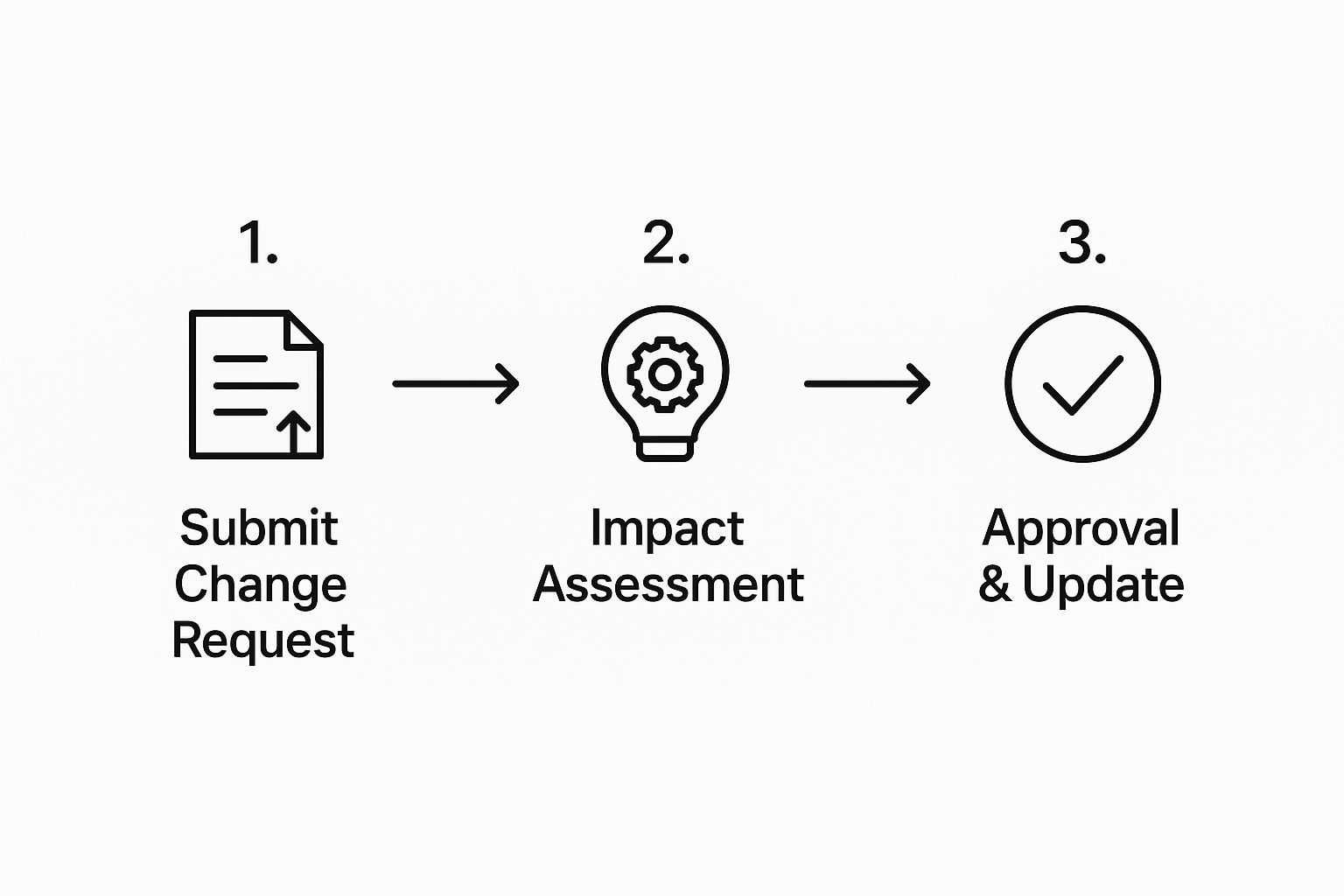
Following a process like this ensures no change sneaks into the project without everyone understanding its full impact first.
Explaining the Trade-Offs and Empowering Your Stakeholders
Once your assessment is done, it's time to present your findings back to the stakeholders. The goal here isn't to be a blocker or tell them they can't have what they want. It’s about laying out the trade-offs in plain English.
You might frame it like this: "Absolutely, we can build that advanced reporting dashboard. Our analysis shows it will add £15,000 to the budget and will push our launch date back by three weeks. Is the business comfortable with that trade-off?"
This completely shifts the conversation. You're no longer the gatekeeper saying no; you're a strategic partner providing the data they need to make a smart business decision. It places the ownership right back on their shoulders, empowering them to weigh the new feature's value against the extra cost and time.
When you stick to this process every single time, you build a culture of accountability. Every change becomes a deliberate choice, not an accidental addition that slowly sinks the project.
Spotting and Stopping Scope Creep in Real Time
Even with the most watertight plan, scope creep has a nasty habit of finding a way in. The real challenge isn’t just about planning; it’s about spotting the warning signs as they happen and knowing how to act. These red flags often show up disguised as small, harmless requests.
They might be tucked away in a long email chain or dropped casually at the end of a weekly call. You'll hear things like, "While you're in that part of the code, could you just add...?" or "This is only a tiny tweak, it shouldn't take long." These informal requests are the first whispers of a project heading off course.
Identifying the Tell-Tale Signs
The trick is to develop an ear for these phrases. Any request, no matter how small, that tries to sidestep your formal change control process is a potential issue. Your job is to keep a close eye on progress—not just against the schedule, but against the original scope everyone signed off on.
I’ve seen scope creep rear its head in a few common ways:
Informal "drive-by" requests from stakeholders trying to bypass the official channels.
'Gold plating' from your own team, where developers add unrequested features because they believe it adds value.
Vague feedback from a client that subtly implies more work than was ever specified.
New stakeholders who join the project midway through, bringing a fresh set of ideas and expectations with them.
When these things happen, you need to step in immediately. Don't wait and see. This proactive approach is essential because the financial fallout can be massive. Research from the UK's construction sector found that a staggering 85% of projects hit by scope creep go over budget, with cost overruns averaging a painful 27%. This is what happens when new work gets added without a corresponding budget adjustment.
Think of your project’s baseline as your compass. Any deviation, no matter how small it seems, needs to be questioned. Ignoring small changes is how large projects fail.
Turning a Confrontation into a Conversation
So, what do you do when you spot a potential issue? The aim isn't to be confrontational. It's about being clear and consistent. When a client or even a team member makes an off-the-cuff request, you need a go-to response ready.
A polite but firm script is your best friend here. Try something along the lines of: "That's a really interesting idea. So we can give it the proper attention it deserves, could you pop it into our change request form? That way, we can fully assess its impact on the timeline and budget."
This response achieves two things beautifully. It acknowledges their input, making them feel heard, but it also gently steers them back to the process you all agreed on. It turns a potentially awkward "no" into a structured, professional chat about priorities and trade-offs. This kind of clear communication is not only good for the project but also for building a strong, respectful team culture. In fact, these skills are vital if you want to hold on to your best people. You can read more about that in our guide on how to improve employee retention with effective strategies in the UK.
By sticking to this approach, you can turn a major project risk into a minor, manageable course correction.
Right, so you’ve got a solid plan for keeping scope creep in check. But let's be honest, real-world projects always throw a few curveballs. Here are a few common questions I hear from project managers in the trenches, especially when things are moving fast in a technical setting.
How Do You Handle Scope Creep in an Agile Project?
This is the million-pound question, isn't it? The beauty of Agile is that you don't fight change—you embrace it. The trick isn't to lock down the entire project scope from the start. Instead, you fix the scope for each individual sprint.
When new ideas and requests pop up from stakeholders, they're not dismissed, but they also don't get jammed into the current sprint. We treat them as new user stories and add them straight to the product backlog. From there, the product owner can prioritise them for future sprints based on what brings the most business value.
This creates a fantastic balance. The development team can stay laser-focused on hitting the current sprint’s goals without getting derailed, while the project itself stays flexible enough to adapt as needs change down the line.
What Is the Difference Between Scope Creep and Gold Plating?
It's easy to mix these two up because they both result in unplanned work, but where they come from is completely different.
Scope creep is an external pressure. It’s that classic scenario where clients or other stakeholders keep adding new "must-have" requirements after the project has kicked off, often without going through a proper change process to account for the extra cost and time.
Gold plating, on the other hand, is an inside job. This is when your own team starts adding extra bells and whistles that nobody ever asked for. They usually mean well, thinking they’re adding value or making the product even better. But both are toxic to a project. Knowing the difference is key: one points to a need for better stakeholder management, while the other calls for more discipline within the team.
A simple way I remember it is: Scope creep is an unmanaged change requested by them. Gold plating is an unrequested "improvement" added by us. Both will wreck your timeline and budget.
How Can I Say No to a Client Without Damaging the Relationship?
Just saying "no" to a client is almost always a bad idea. The art is in turning that "no" into a "not right now" or, even better, a "yes, and here’s what that involves."
Instead of shutting them down, gently steer them back to the process you both agreed on. You could say something like, "That's a really interesting idea. Let's get it logged as a formal change request so we can properly look at what it would mean for our timeline and budget."
Suddenly, you’re not a barrier; you're a strategic partner helping them think through the consequences. It frames the conversation around collaboration.
You can also put the decision back in their court: "We can absolutely build this feature. It would add about three weeks and £10,000 to the project. The alternative is to stick with the original plan to hit our launch date. What works best for you?" This empowers the client to make a proper business decision and keeps the relationship on solid ground.
Building a team that gets these nuances is fundamental to project success. Talent People partners with high-growth companies to deliver agile, project-based hiring for complex technical roles. We connect you with the leaders and technical experts who know how to deliver results on time and on budget. Find your next project expert at https://talentpeople.co.

Comments