Mastering Competency Based Interviewing Techniques
- Talent People

- Aug 30, 2025
- 14 min read
Competency-based interviews are all about getting past the theory and into the reality of a candidate's abilities. They're a structured way to figure out if someone has the right skills and behaviours by asking them to talk about their actual past experiences.
Instead of asking hypothetical "what would you do if..." questions, this approach focuses on real-world evidence. The goal is to get a clear picture of how someone has handled specific situations in the past, which is a surprisingly accurate way to predict how they'll perform in the future.
Why Competency-Based Interviewing Is Essential

It’s time to move beyond the CV and uncover what truly predicts success on the job. A traditional interview can often feel like a guessing game, revolving around a candidate's qualifications and how well they can answer abstract questions.
Competency-based interviewing, on the other hand, is built on a simple yet powerful premise: past behaviour is the best predictor of future performance.
This structured method digs into a candidate’s genuine skills by asking them to share specific stories from their professional past. It completely shifts the focus from what someone says they can do to what they have actually done.
Moving from Theory to Evidence
The real strength of this approach is its objectivity. Before you even start interviewing, you define the key competencies needed for the role—things like problem-solving, teamwork, or leadership. This creates a consistent framework to evaluate everyone against.
Every candidate gets assessed against the same criteria, which goes a long way towards minimising the unconscious bias that can so easily creep into less structured conversations.
This shift is becoming critical in the UK market. Research from the Chartered Institute of Personnel and Development (CIPD) found that a massive 83% of UK employers now prioritise skills-based hiring over traditional qualifications. This isn't just a trend; it's a clear move towards valuing proven abilities. If you're interested in this evolution, you can dig deeper into why skills-based hiring is gaining traction in the UK.
To really understand the difference, let’s look at how the two interview styles stack up.
Traditional vs Competency Based Interviews
Aspect | Traditional Interview | Competency Based Interview |
|---|---|---|
Focus | CV, qualifications, and general impressions. | Past behaviours and specific, proven skills. |
Questions | Hypothetical or opinion-based, e.g., "What are your weaknesses?" | Behavioural, e.g., "Tell me about a time you missed a deadline." |
Evidence | Based on the candidate's self-assessment and claims. | Based on concrete examples and real-world stories. |
Consistency | Highly variable; often subjective and prone to bias. | Consistent and structured; all candidates answer similar questions. |
Outcome | Predicts how well someone interviews. | Predicts future job performance with greater accuracy. |
As you can see, the competency-based model provides a much more reliable and fair way to assess who is genuinely right for the role.
Building Stronger, More Resilient Teams
When you hire for specific competencies, you’re doing more than just filling a vacancy; you are strategically building a more effective team. This technique allows you to find real evidence of resilience, adaptability, and collaboration—qualities that are almost impossible to gauge from a CV alone.
By focusing on a candidate's past actions, you create a reliable forecast of their future performance. This leads to a fairer process and hires who are better aligned with both the role's demands and your company's culture.
Ultimately, adopting competency-based interviewing is about making smarter, evidence-led hiring decisions. It equips you to identify individuals who have not only the technical skills but also the behavioural attributes needed to thrive in their roles and contribute to your organisation’s long-term success.
Right, before you can even think about asking those clever interview questions, you need a map. A competency framework is exactly that – your map for what you're actually looking for. It's the absolute foundation of the whole process. Without one, you're just firing questions into the dark.
Think of it as the blueprint for what a successful person looks like in a specific role at your company. It’s about getting really clear on the skills, behaviours, and knowledge that make someone great, not just good enough. This is what makes your interviews sharp and focused on what really matters.
Core vs. Role-Specific Competencies
A solid framework is usually split into two parts. First, you have your core competencies. These are the things that everyone in the company should have, from the new apprentice right up to the CEO. They're tied directly to your company's culture and values – the non-negotiables.
For instance, your core competencies might be things like:
Collaboration: Genuinely working together, listening to different views, and aiming for a shared goal.
Adaptability: Not just coping with change, but rolling with it and finding your feet when things are uncertain.
Client Focus: Having that constant drive to understand what your clients need and delivering it.
Then you have role-specific competencies. These are the nuts and bolts of a particular job. A Senior Project Manager in the renewables sector needs to be brilliant at things like risk management and stakeholder engagement. A software developer, on the other hand, needs to be a wizard with a specific coding language or know agile methodology inside out.
Getting this distinction right is crucial. It means you’re hiring for the job and for the company. You're looking for someone who can do the work now, but also someone who will fit in and stick around for the long haul. That cultural alignment is key to keeping your best people.
Defining What "Great" Actually Looks Like
Here’s a tip: don’t try to build this framework in an HR silo. The best ones are born from collaboration. Get in a room with the department heads and, more importantly, some of their top performers. They're the ones living and breathing this stuff every day.
Ask them direct questions. "Think about your best people. What do they do that makes them so good?" or "What was the one skill that got someone through that last tricky project?" The gold is in their answers.
A well-defined competency framework takes hiring from a gut-feel chat to a strategic, evidence-based decision. It lines everyone up, so all your interviewers are looking for the same signs of success. That makes the whole thing fairer and much more reliable.
This teamwork ensures your definition of "great" is based on what actually works in your business, not just what sounds good on paper. Once you've nailed these competencies, they become the backbone for everything that follows – your interview questions, your scoring guides, and your final decision. It’s the first, and most important, step to getting competency-based interviewing right.
Crafting Questions That Reveal True Potential
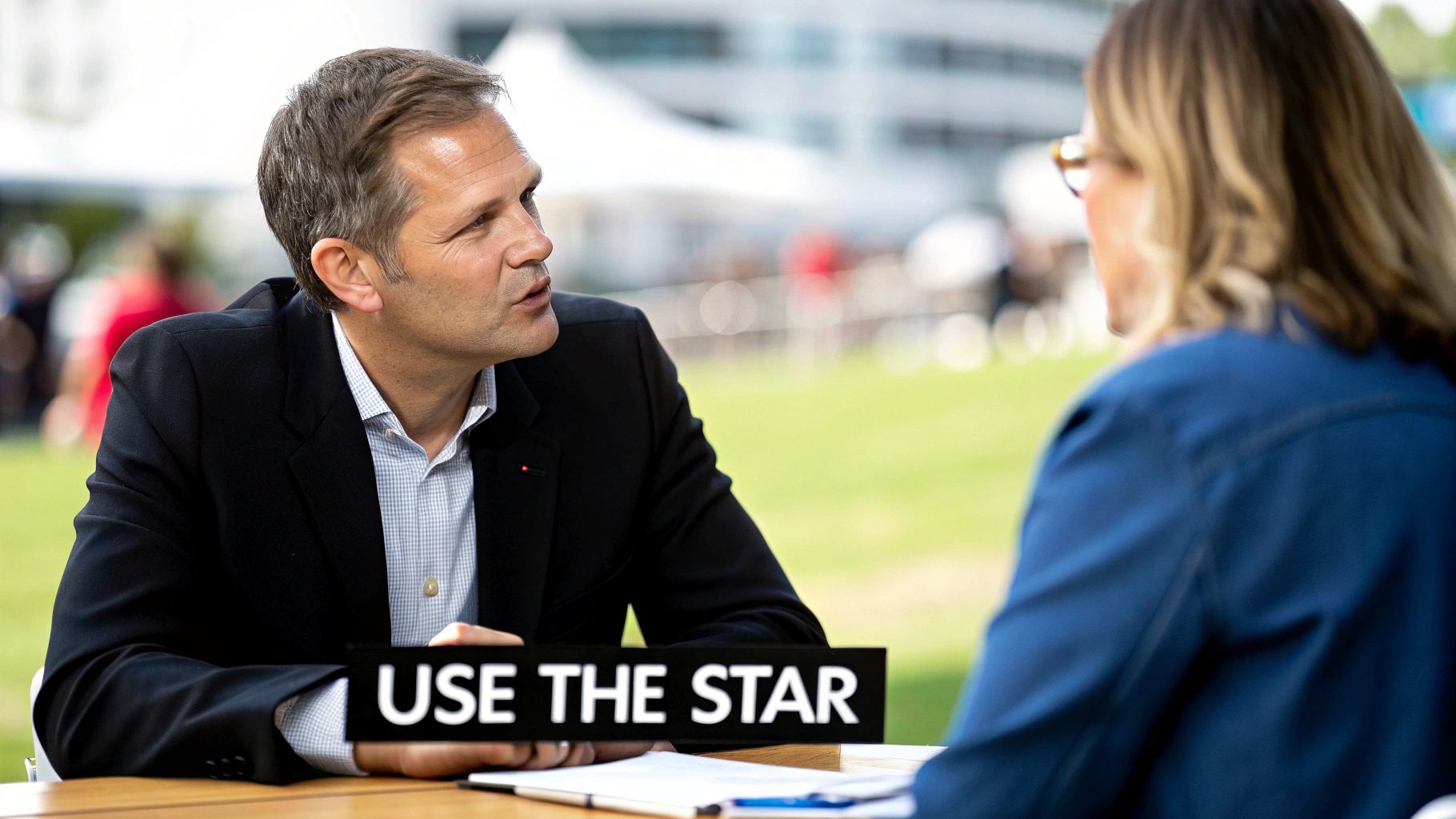
We’ve all been there. You ask a question, and you get a textbook, rehearsed answer that tells you absolutely nothing. To get past the polish and understand what a candidate is really capable of, you need to ask questions that make them tell a story.
This is the heart of effective competency-based interviewing techniques. It’s about creating prompts that pull out real, evidence-based examples from their past. It’s no surprise that up to 50% of UK employers now lean on this method. You can learn more about how UK companies use this interview style to get a sense of its popularity.
Using the STAR Method as Your Guide
You've probably heard of the STAR method for answering questions, but I find it’s even more powerful as a tool for designing them. When you're writing a question, mentally walk through how a candidate would answer it using this structure: Situation, Task, Action, Result.
Situation: Does your question prompt them to set a clear scene?
Task: Does it push them to define the challenge or goal they faced?
Action: Crucially, does it force them to explain the specific things they personally did?
Result: Does it naturally lead them to share the outcome?
If your question doesn't guide them through this narrative arc, it’s not going to get you the rich, behavioural evidence you need. It’s the difference between hearing a vague claim and hearing a compelling story.
Moving from Generic to Genuinely Insightful Questions
The best questions are tied directly to the core competencies you identified earlier. The secret is in the phrasing. Always start with storytelling prompts like, "Tell me about a time when..." or "Walk me through a situation where...".
Let's break down the before-and-after for a few key competencies:
For Problem-Solving:
Instead of: "How do you solve problems?"
Try: "Describe a complex project where the original plan fell apart. What specific steps did you take to get it back on track?"
For Leadership:
Instead of: "Are you a good leader?"
Try: "Tell me about a time you had to get a reluctant team on board with a new idea. How did you approach it, and what was the outcome?"
For Adaptability:
Instead of: "How do you handle change?"
Try: "Give me an example of a time a major change landed on your team with little warning. How did you adapt, and what did you do to support your colleagues?"
The most insightful questions don't just ask what a candidate did. They dig into the why behind their actions and what they learned. That's where you uncover their real thought process and potential for growth.
The Power of the Follow-Up Probe
Your first question just opens the door; the real gold is found in the follow-up. Probing questions are your tool for digging deeper and getting the specifics you need to make an informed decision. Don't ever feel awkward about gently steering the conversation back on track if a candidate starts to wander.
Some of my go-to probes are:
"And what was your specific role in all of that?"
"Can you walk me through your thinking at that moment?"
"What was the most difficult part of that for you, personally?"
"Looking back, is there anything you'd do differently now?"
These simple follow-ups help you isolate their individual contribution from the team's, understand their decision-making logic, and check for self-awareness. It’s a skill that separates a good interviewer from a great one.
How to Score Candidates Fairly and Consistently
Hiring on a ‘gut feeling’ is a recipe for disaster. It's notoriously unreliable and almost always leads to inconsistent, biased decisions. To get away from vague impressions and focus on hard evidence, you need a structured scoring system. This is the bedrock of any solid competency-based interview, making sure every candidate is measured by the same ruler.
The whole point is to create a simple, clear rubric that takes the guesswork out of the equation. This frees up your interviewers to concentrate on the quality of a candidate’s examples, not just how charming they are. When you standardise the evaluation, the entire process becomes fairer and much easier to justify.
Building a Simple Scoring Rubric
You don't need a PhD in psychometrics to build a good scoring system. A simple 1-5 rating scale is perfectly fine, as long as everyone agrees on what each number actually means in terms of observable behaviour. Consistency is everything here—your interviewers must have a shared understanding of what a "3" looks like versus a "5".
Let's take a common competency like ‘Problem-Solving’ and see what this looks like in practice.
Below is a quick example of how you could break down the scoring for this specific skill.
Sample Scoring Rubric for 'Problem-Solving' Competency
Score | Behavioural Indicators |
|---|---|
1 (Poor) | The candidate couldn't give a relevant example or described actions that made things worse. |
2 (Basic) | A weak example was given, with an unclear process or outcome. |
3 (Meets Expectations) | Provided a solid example of solving a problem with a logical approach. The steps taken were appropriate and led to a decent resolution. |
4 (Strong) | Talked through a complex problem, detailing a well-reasoned solution with a positive outcome. They showed good judgement. |
5 (Exceptional) | Described a highly complex or ambiguous problem and detailed an innovative, proactive solution. They clearly learned from the experience and took steps to prevent future issues. |
This kind of structure forces interviewers to back up their scores with cold, hard evidence from the candidate’s answers. It's a powerful way to minimise the unconscious bias that can creep into less structured conversations.
A well-defined scoring rubric is what turns an interview from a friendly chat into a proper assessment. It’s how you make sure you’re comparing candidates on proven skills, not just on how well you got on with them.
This chart shows just how consistently interviewers can rate core skills when they're all using the same structured rubric.
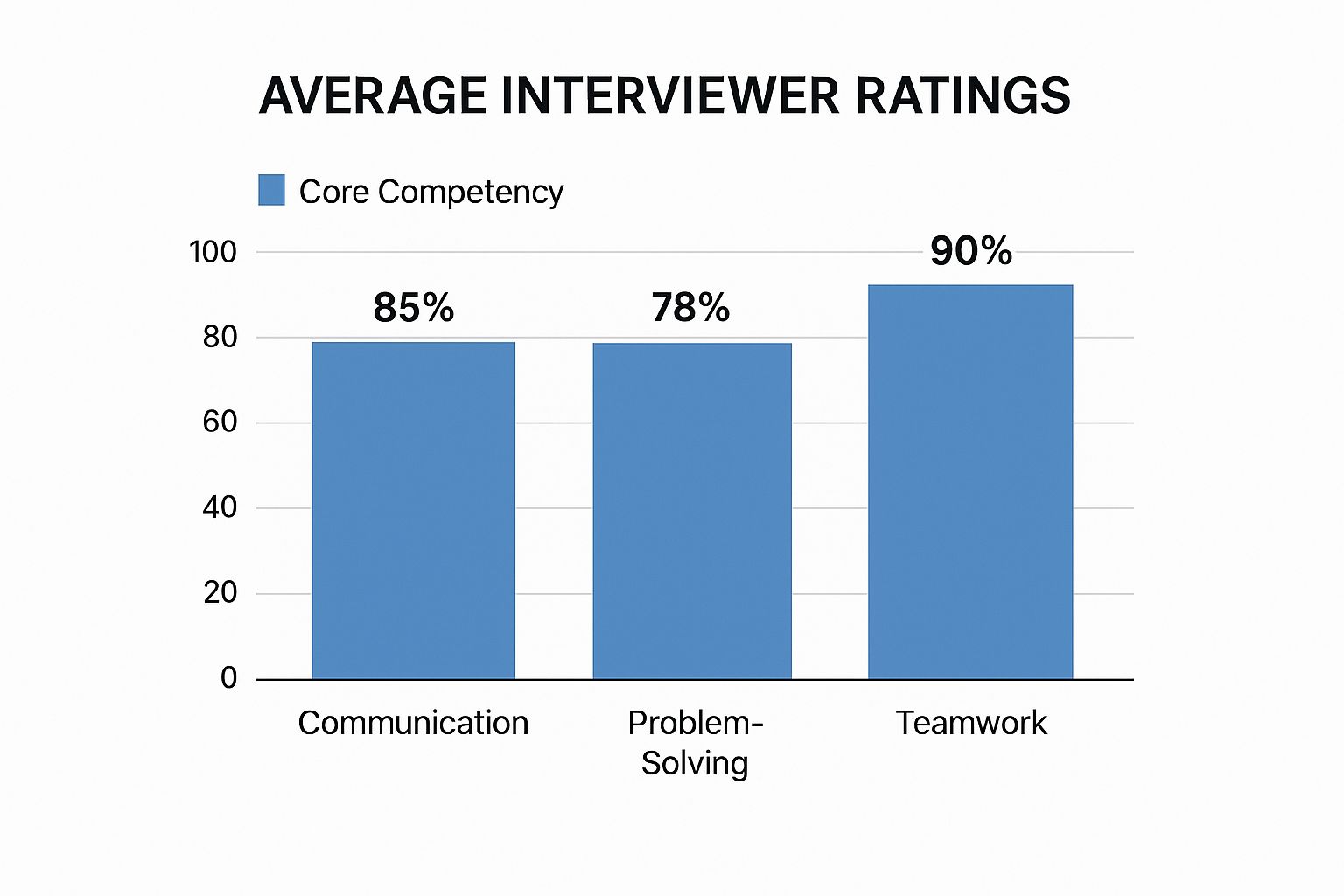
The data often shows that teamwork scores highly, which makes sense—it’s usually easier for people to come up with strong stories about collaboration. Problem-solving, on the other hand, can be a much tougher competency for candidates to demonstrate well under pressure.
Creating a Scoring Matrix for Comparison
After the last interview, a scoring matrix is your best friend for comparing everyone side-by-side. Think of it as a simple spreadsheet: each row is a candidate, and each column is one of your key competencies.
Once you plug in the scores from each interviewer, you get a fantastic visual overview of the talent pool. You can immediately see who is a strong all-rounder versus those who shine in just one or two specific areas. This data-first mindset is crucial for making better hiring decisions. If you want to dive deeper into this, have a look at our guide on smarter hiring with UK recruitment metrics.
At the end of the day, this systematic approach doesn't just lead to better hires. It strengthens your entire recruitment process, making it more robust and equitable for everyone involved.
Training Your Team to Interview Effectively
You can have the most brilliant interview process on paper, but it’s only as good as the people running it. I’ve seen perfectly designed competency-based interviewing techniques fall flat simply because hiring managers weren’t shown how to use them properly. This step is so often rushed or skipped entirely, but it’s absolutely critical for consistency and fairness.
Good training isn't just about handing out a script. It’s about teaching your team to listen for evidence, take notes that actually mean something, and score candidates against the rubric without letting their gut feelings take over.
Tackling Common Interviewer Pitfalls
We all have unconscious biases – it's just part of being human. Training is your chance to bring these common traps out into the open so your team can actively work to avoid them.
During your sessions, make sure you cover these classic pitfalls:
The Halo Effect: This is a big one. It’s that tendency to let one brilliant answer or a candidate’s charming personality cast a positive "halo" over everything else, even if they haven't provided solid evidence for other key skills.
Confirmation Bias: This happens when an interviewer makes a snap judgement in the first few minutes and spends the rest of the interview looking for proof they were right, while ignoring anything that challenges that first impression.
Similarity Bias: We naturally gravitate towards people who remind us of ourselves. This can lead interviewers to favour candidates with similar backgrounds or hobbies, instead of focusing purely on who is the best fit for the job.
Training isn't about turning your managers into robots. It’s about giving them the tools to make objective, evidence-based decisions, ensuring every candidate gets a fair assessment based on their proven abilities.
Maintaining Rigour in Virtual Interviews
With so many interviews happening remotely now, we've got a whole new set of challenges to deal with. Technical glitches are a reality for a lot of people – around 62% of candidates report having issues – and a dropped connection can easily derail an interview and create a poor impression.
Train your team on how to handle these moments with grace. A little empathy and a calm approach to getting things back on track can make a huge difference to the candidate’s experience. If you want to dive deeper into this, we have a helpful guide on [how to improve candidate experience](https://www.talentpeople.co/post/how-to-improve-candidate-experience-top-strategies-tips).
Video calls also demand slightly different skills. It’s much harder to pick up on body language, and building genuine rapport through a screen takes conscious effort. Teach your interviewers to be more deliberate with their listening skills—using clear verbal cues like "that's interesting, tell me more" to show they're engaged. The whole process is stressful enough without a clunky video call adding to it.
Common Questions About Competency-Based Interviewing
Even with a solid plan, switching to a new way of hiring always brings up a few questions. Getting to grips with the nuances of competency-based interviews will build your team's confidence and ensure the new approach rolls out smoothly. Let's dig into some of the most common queries that pop up.
How Do We Adapt Questions for Senior vs Junior Roles?
This is a big one. It’s a classic mistake to use the same competency questions for a graduate as you would for a department head. While the core competency—let's say "Problem-Solving"—might be consistent, the scope of the challenges they face will be worlds apart. Your questions have to reflect that reality.
For a junior role, you might ask something like:
"Tell me about a time you spotted a small error in a process. What did you do to fix it?"
This gets at their attention to detail and personal initiative on a manageable scale.
But for a senior or leadership role, you need to probe for a much bigger-picture perspective:
"Describe a time you inherited a team or project that was failing. Walk me through how you diagnosed the core issues and turned the situation around."
Here, you're not just looking for a fix; you're exploring their strategic thinking, leadership grit, and ability to untangle complex, messy problems. The expected answer is a story with far more strategic weight and business impact.
The key isn't changing the competency itself, but adjusting the scale of the situation. Senior roles demand examples with wider business impact, while junior roles rightly focus on individual accountability and execution.
Can We Use This Method for Internal Promotions?
Absolutely. In fact, competency-based interviews are brilliant for internal mobility. You already have a wealth of performance data on an internal candidate, but this method helps you look beyond how they succeeded in their current role.
It gives you an objective way to assess if they have the potential to handle the challenges of the next level. Think about a high-performing technical expert being considered for their first management role.
You can design questions to specifically test for those emerging leadership competencies:
"Describe a situation where you had to influence a colleague to adopt a new way of working, even though you had no formal authority over them."
"Walk me through a time you took the lead on a project that fell outside your usual duties. What was the outcome?"
This approach gives you concrete evidence that they have the right behaviours to succeed as a leader, moving the conversation beyond just their technical skills. It also makes the whole promotion process feel fairer and more transparent for everyone involved.
What Are the Biggest Mistakes to Avoid When Starting Out?
When teams are new to this method, a few common stumbles can easily undermine the whole process. Knowing what they are is half the battle.
Vague Competency Definitions: If "Teamwork" isn't clearly defined with behavioural examples, one interviewer might score based on friendliness, while another looks for someone who challenges colleagues constructively. You end up with inconsistent and unreliable scoring.
Forgetting to Probe: This happens all the time. An interviewer accepts a surface-level story without digging for the details. Train your team to ask follow-up questions like, "What was your specific contribution?" or "What was the hardest part of that for you?" to get the full picture.
Ignoring Unconscious Bias: While this structured process helps reduce bias, it doesn't magically eliminate it. It's still vital to train your interviewers on this. You can learn more about creating fairer hiring processes by understanding [unconscious bias in recruitment](https://www.talentpeople.co/post/unconscious-bias-recruitment-fair-hiring-strategies).
How Can We Show the ROI of This Hiring Model?
Let's be honest, switching up your hiring process needs buy-in, and that usually means showing a return on investment (ROI). While it might seem a bit abstract at first, the benefits are very real and measurable. Focus on tracking a few key metrics before and after you make the switch.
Quality of Hire: Look at the performance ratings of new hires after six or twelve months. A successful programme should show that people hired this way perform better and get up to speed faster.
Staff Retention: Track the turnover rate for new hires, especially within the first year. Competency-based interviews are far better at assessing long-term cultural and behavioural fit, which nearly always boosts retention. A drop in early turnover is a direct cost saving.
Time to Hire: It might take a little longer to set up initially, but a well-oiled competency-based process can become incredibly efficient. Clearer criteria lead to clearer decisions and far less debate among the hiring panel.
By presenting solid data on these points, you can build a powerful business case that proves this isn't just a different way to interview—it's a better one.
At Talent People, we specialise in helping high-growth organisations in complex sectors like energy and technology build the high-performing teams they need to succeed. Our project-based, embedded approach ensures every hire is aligned with your strategic goals. Learn more about how we can accelerate your project delivery.

Comments