Smarter Hiring with UK Recruitment Metrics
- Talent People

- Jul 23, 2025
- 15 min read
Here's the rewritten section, designed to sound like it was written by an experienced human expert.
So, what exactly are recruitment metrics? Think of them as the data points that tell you the real story behind your hiring efforts. They separate what feels like it's working from what actually is. Put simply, they give you clear, actionable insights so you can stop guessing and start making smart, data-driven decisions.
Moving Beyond Outdated Hiring Numbers
Let's be honest—the old way of measuring recruitment success is broken. For years, many UK businesses have relied on simple figures like the number of applicants. That’s a bit like driving a modern car while only looking at the speedometer. Sure, you know you're moving, but do you know if you're going in the right direction? Are you about to run out of fuel or is the engine about to overheat? The same goes for recruitment.
The UK's job market has changed, and our approach to hiring needs to change with it. Economic shifts and new technology demand a completely new dashboard of recruitment metrics to stay ahead. It's no longer about just filling seats; the game has shifted from quantity to quality and efficiency.
Focusing on the right data isn't just about making your process more efficient. In today's market, it's about survival and finding the people who will genuinely drive your business forward.
A New Reality for UK Recruitment
Recent trends really drive home why this shift is so vital. For example, between February and April 2025, the UK had 761,000 open job positions. That figure marks a significant decline, pointing to a cooling market and a return to pre-pandemic hiring levels. This tells us that companies are becoming more cautious. And with nearly half of UK firms boosting their investment in automation and AI, the very nature of recruitment is being reshaped. You can discover more about how these trends are transforming UK hiring success.
In this new environment, traditional, high-volume stats are becoming less and less relevant. Instead, the metrics that matter are the ones that measure long-term value. This includes things like:
Quality of Hire: This isn't just about qualifications on a CV. It’s about the real, long-term contribution a new employee makes to your team.
Source Effectiveness: Which channels are actually delivering the candidates who not only get the job but also thrive and stick around?
Hiring Velocity: How fast can you move from a job opening to a signed offer? In a competitive market, speed is crucial for landing top talent before someone else does.
Ultimately, navigating today’s landscape means leaving outdated numbers behind. It’s about taking a more strategic view of your hiring, using insightful recruitment metrics to build a resilient, high-performing workforce that’s ready for whatever comes next.
The Four Pillars of Recruitment Measurement
To get a real grip on your recruitment efforts, you need a simple way to organise your data. I find it helps to think of it like a building supported by four essential pillars: Time, Cost, Quality, and Efficiency. Get these four right, and you have a solid framework for measuring what truly matters to your business.
Each pillar helps you answer a critical question about your hiring process, turning raw numbers into real, actionable insights. When you see how these pieces fit together, you can start building a much smarter and more effective recruitment engine.
Think of it this way: Time is your competitive speed. Cost is your total investment. Quality is the long-term value you gain. And Efficiency is the overall health of your hiring machine.
Let’s take a closer look at what each of these pillars represents in the real world. They aren't just abstract ideas; they're the buckets that hold the most important metrics you’ll ever track.
Breaking Down the Pillars
Time: This pillar is all about speed and agility. In today's market, the best candidates are off the market fast. Time-based metrics help you find and fix the bottlenecks in your process, so you can snap up top talent before your competitors even get a look-in.
Cost: This is so much more than a new hire’s salary. It’s the total financial investment you make to find and bring someone on board. This includes everything from job ad spending and agency fees to the internal hours your own team puts in. Keeping this under control is fundamental for managing your budget and proving your team's return on investment.
The infographic below shows how different metrics branch out to cover both the efficiency of your process and the ultimate outcome of your efforts.
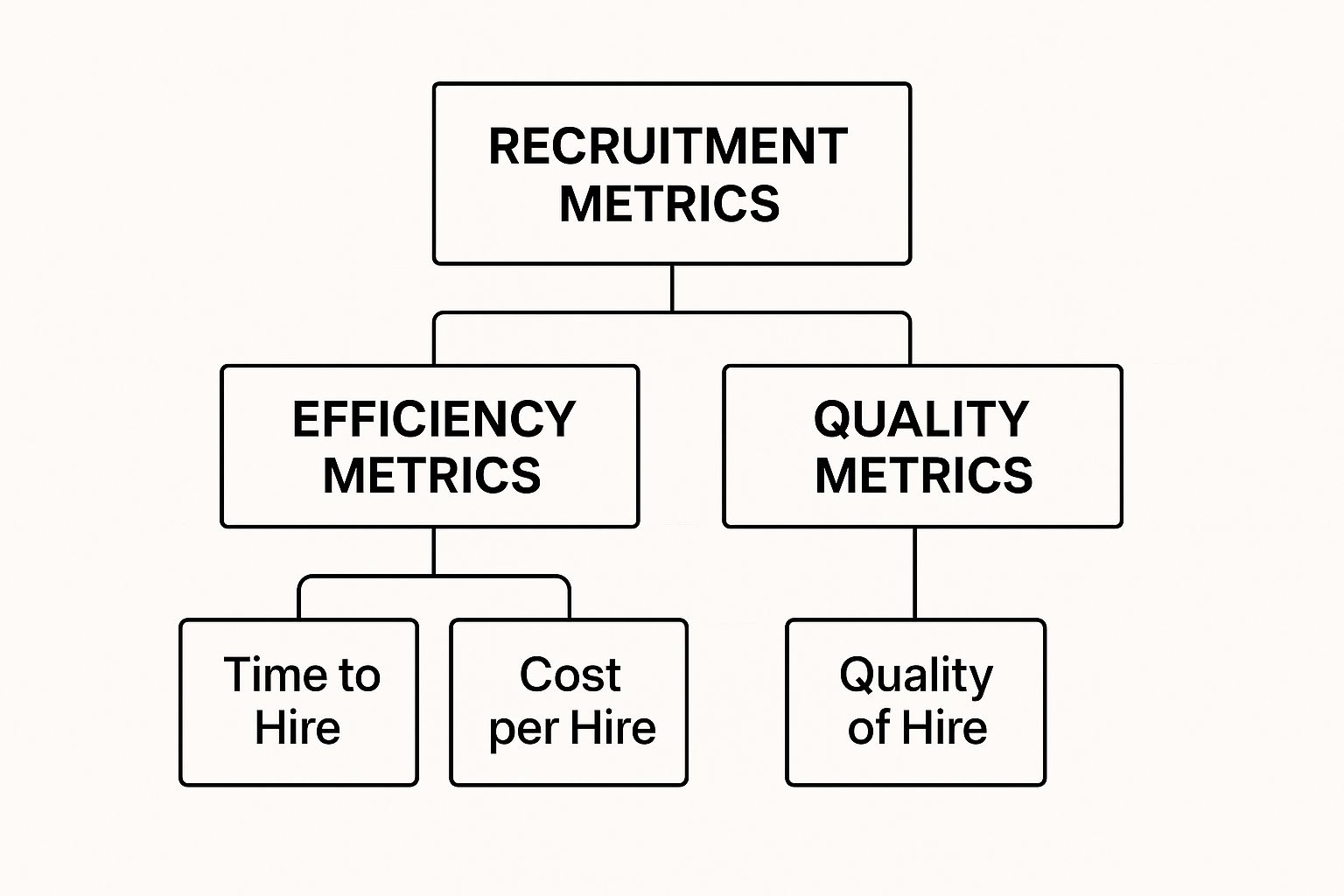
As you can see, metrics like Time to Hire and Cost per Hire measure how well your process is running, while something like Quality of Hire tells you about the success of that process.
From Process to Performance
While time and cost measure the inputs and speed of your recruitment, quality and efficiency look at the results and the overall health of your system.
Quality: This is, without a doubt, the most important pillar of all. A great hire adds value for years, becoming a high-performance part of your team. A bad hire, on the other hand, can be expensive, disruptive, and a drain on morale. This metric is all about the long-term value an employee brings to the business.
Efficiency: This pillar tells you how healthy your recruitment funnel is. It looks at the conversion rates between each stage—for instance, how many applicants get an interview, or how many offers are accepted? High efficiency means your process is well-oiled and great at moving the right people forward.
To tie this all together, here’s a simple table summarising how these pillars give you a complete picture of your hiring success.
Metric Pillar | Primary Focus | Key Question Answered |
|---|---|---|
Time | Speed and agility of the hiring cycle | "How fast can we find and secure top talent?" |
Cost | Total financial investment per hire | "What is the true cost of filling this position?" |
Quality | Long-term value and performance | "Are our new hires contributing to business success?" |
Efficiency | Health of the recruitment funnel | "Is our process effective at advancing the best people?" |
This four-pillar approach creates a powerful feedback loop. You can use what you learn from your quality and efficiency numbers to fine-tune your process, which in turn helps you hire faster and more cost-effectively.
By balancing your focus across these four pillars, you build the foundation for every strategic hiring decision you make. For a closer look at putting this into practice, you can learn more about smarter hiring with recruitment data analysis in our detailed guide.
Essential Metrics Your Team Must Track

Right, you've got the framework. Now it's time to roll up our sleeves and put it to work. Moving from ideas to actual numbers is where you start to see real, meaningful change. This is your practical toolkit—the core recruitment metrics every single hiring team should have on their radar.
We're going to walk through the big four: Time to Hire, Cost per Hire, Quality of Hire, and Source of Hire. But forget dry, textbook definitions. For each one, I’ll explain how it hits your company's bottom line and give you straightforward ways to calculate and track it.
Time to Hire: The Speed of Opportunity
Time to Hire is simply the number of days it takes from a candidate first applying for a role to the moment they accept your job offer. Think of it as a measure of your hiring team's agility. A shorter Time to Hire usually means a smoother experience for the candidate, and crucially, less chance of losing your top pick to a nimbler competitor.
This metric is a fantastic diagnostic tool. If your Time to Hire is consistently dragging on, it's a massive red flag pointing to a bottleneck somewhere in your system. Are approvals getting stuck on someone's desk? Are interviews scheduled too far apart? Finding these delays is the first step to fixing them.
To calculate it, just count the days from when a candidate officially enters your pipeline to the day they sign on the dotted line. By tracking this for every single hire, you'll get an average you can actively work to bring down over time.
Cost per Hire: The True Price of Talent
Cost per Hire tells you exactly what your business shells out, on average, to get one new employee through the door. Knowing this number is absolutely vital for setting your budget, proving the value of your recruitment efforts, and making smart choices about where to put your money.
And this isn't just about the obvious, external bills. To get the real picture, you need to add up all the related expenses.
External Costs: This bucket includes everything you spend on job board ads, recruitment agency fees, marketing campaigns, and any assessment software you might use.
Internal Costs: This covers the time your own team—recruiters, hiring managers, and interviewers—dedicates to the hiring process, plus any bonuses paid out for employee referrals.
Just add all these costs together over a set period (say, a quarter) and divide that total by the number of hires you made in that same timeframe. The result is your average Cost per Hire, a critical health check for your recruitment spending.
Quality of Hire: The Ultimate Success Metric
This is, without a doubt, the most important recruitment metric. It's also the trickiest to pin down. Quality of Hire measures the actual value a new employee brings to your organisation. A top-quality hire doesn't just fill an empty seat; they perform brilliantly, mesh with the company culture, and contribute to your long-term success.
Because it's not a single data point you can just pull from a system, you have to blend a few different inputs to get a score that means something.
To truly gauge the 'quality' of a hire, you have to look past the CV and the interview. It’s about measuring their real-world performance and impact once they're properly settled into their role.
The best way to do this is by combining a few key data points, usually gathered 6 to 12 months after the new hire's start date:
Performance Reviews: Use the score from their first formal performance review.
Hiring Manager Satisfaction: Send a simple survey to their direct manager, asking them to rate their satisfaction with the new hire's skills and cultural fit.
Retention Rate: Are they still with the company after a year? A hire who walks out the door quickly represents a poor return on your investment.
By combining these elements into a scorecard, you can finally put a reliable number on what great hiring actually looks like.
Source of Hire: Where Your Best Talent Comes From
Source of Hire is all about tracking which channels are actually delivering your successful candidates. Are your best people finding you through LinkedIn, employee referrals, a niche job board, or your own company careers page? Knowing the answer is fundamental to getting the most out of your recruitment budget.
Without this data, you're flying blind. You could be pouring a significant amount of cash into channels that bring in floods of applicants but very few actual hires. By tracking the Source of Hire, you can double down on what works and slash spending on what doesn't. It's a simple metric that directly ties your team's activities to financial efficiency, making sure every pound spent is working as hard as possible.
Winning the Race for Talent with Time-Based Metrics

In a competitive job market, speed is everything. While other metrics look at cost and quality, time-based recruitment metrics tell you how quickly you can find and secure great candidates before someone else does. Think of your hiring process like a factory production line; a tiny delay at one station can bring the whole operation to a grinding halt.
But this isn't about rushing for the sake of it. These metrics act as diagnostic tools, shining a light on the exact bottlenecks that are slowing you down. By understanding how long it takes to get from one stage to the next, you can root out hidden problems and create a much smoother, more appealing experience for your candidates.
The Key Difference Between Time to Fill and Time to Hire
It's easy to get these two mixed up, but they measure different things. Time to Fill and Time to Hire are two of the most important time-based metrics, and together they give you a full picture of your hiring speed.
Time to Fill tracks the entire lifecycle of a vacancy. It's the total number of days a job is open, starting from when the role is approved right up to the moment a candidate accepts your offer.
Time to Hire focuses purely on the candidate's experience. It measures the number of days between a person applying for a role and accepting the job offer.
A long Time to Fill might mean there was a delay in getting the role signed off internally. On the other hand, a long Time to Hire suggests your interview or offer process is what’s causing the hold-up. Tracking both helps you pinpoint exactly where to focus your efforts.
Analysing Your Hiring Stages
To get real, actionable insights, you need to break your hiring process down and measure the time between each key stage. This detailed view shows you precisely where things are getting stuck.
Think of your hiring funnel as a relay race. It doesn’t matter how fast one runner is if the baton hand-off is fumbled. Measuring stage-to-stage time helps you perfect every transition.
Common stages you should be tracking include:
Time from Application to Screening
Time from Screening to First Interview
Time from Final Interview to Offer
Time from Offer to Acceptance
If you spot a major lag—say, between the final interview and the offer being made—it’s a huge red flag. It probably means your internal approval process is too slow, and you're risking your preferred candidate getting a better offer elsewhere. Fixing just one bottleneck like this can make a massive difference to your success rate.
This need for speed is even more critical in the UK's resilient labour market. In early 2025, total workforce jobs climbed to 37.1 million, an increase of 187,000 over the quarter before. Employment levels are now 1.5 million higher than they were before the pandemic. With such strong and sustained demand for talent, a swift and efficient hiring process isn't just nice to have—it's essential. You can explore more about the UK's employment figures on ONS.gov.uk.
How to Control Costs and Avoid a Bad Hire

Recruitment isn't just an expense on a spreadsheet; it's a direct investment in your company's future. Getting a handle on the financial side of hiring is absolutely essential for keeping your budget in check and proving your team's value.
The most straightforward way to do this is by tracking your Cost per Hire. This single figure gives you a clear, tangible number for the total investment needed to bring a new person onto the team. Think of it as the final bill for all your talent acquisition efforts, rolling every related expense into one.
These expenses fall into two main buckets:
External costs: These are the obvious ones you pay out for, like job board adverts, social media campaigns, recruitment agency fees, and any skills assessment tools or background checks.
Internal costs: Just as vital, these include the salaries of your recruitment team for the time they spend on a role, the hours your hiring managers and interviewers put in, and any employee referral bonuses you pay.
By keeping track of all these moving parts, you get a precise picture of what you're spending. To dig deeper, you can check out our complete guide on how to calculate Cost per Hire in the UK. This transparency is what allows you to spot where money is being wasted and make smarter choices about where to put your resources next.
The Hidden Cost of a Bad Hire
While knowing your Cost per Hire is important, it's nothing compared to the staggering financial and cultural damage of making a bad hire. A poor hiring decision goes way beyond the initial recruitment bill. It creates a domino effect of negative consequences that can drain your company's resources for months, if not years.
A bad hire drags down productivity, either because they underperform or need an excessive amount of hand-holding. They can also poison team morale, disrupt proven workflows, and ultimately force you to go through the entire expensive recruitment process all over again.
The real danger isn't the money you spend to hire someone; it's the massive, hidden cost of hiring the wrong person. This mistake can undermine team culture, drain productivity, and ultimately hurt your bottom line far more than any recruitment fee.
The numbers paint a pretty stark picture for UK businesses. The average cost to get a new employee up and running is about £6,125. But a single bad hire at the managerial level can end up costing a business a shocking £132,000.
What’s more, with 95% of UK companies admitting they've made at least one poor hiring decision, the financial risk is very real. These figures hammer home why using recruitment metrics to guide your hiring decisions is so critical.
This is where tools like an Applicant Tracking System (ATS) come in handy, helping you manage spending by tracking which sources give you the best candidates and keeping the process efficient. By focusing on smart, data-led recruitment, you not only control your upfront costs but also dramatically lower the risk of making a financially crippling bad hire.
Building a Data-Driven Recruitment Culture
Knowing your recruitment metrics is a brilliant start, but the real magic happens when you use that information to make meaningful changes. The aim is to create a culture where data is a central part of every hiring conversation, not just a report gathering dust in the HR office. It’s about shifting from reactive hiring to a strategic approach that genuinely powers the business forward.
The key is to make your hiring data easy for everyone to access and understand. You don't need a complicated, all-singing, all-dancing system from day one. In fact, many successful teams start by tracking the basics on a simple spreadsheet before moving on to more sophisticated HR software or an Applicant Tracking System (ATS).
Making Data Accessible to Everyone
The best way to get everyone thinking with data is to make your recruitment insights available to the whole team. This comes down to a few practical steps:
Create Simple Dashboards: Turn key metrics like Time to Hire and Source of Hire into simple charts and graphs. This lets anyone see performance at a glance.
Hold Regular Reviews: Make the numbers a regular topic in your weekly or monthly hiring meetings. Ask questions like, "Why is this number so high?" or "What can we do differently to improve this?"
Set Clear Goals: Establish realistic, data-backed targets for the team. For example, you could aim to reduce the average Time to Hire by 10% over the next quarter.
This approach stops recruitment metrics from being abstract numbers and turns them into a shared language for getting better. For more on this, check out our guide on data-driven recruiting for modern hiring.
Getting Buy-In from Leadership
To get the resources and support you need, you have to present your findings effectively to leadership. The trick is to frame your metrics in the language of business results. Don't just state the Cost per Hire; explain how cutting it by 15% frees up budget that can be used for other important company projects.
Don’t just present data; tell a story with it. Explain the 'why' behind the numbers, the impact on the business, and the clear, actionable steps you plan to take to improve.
By consistently showing the link between smart hiring and business success, you build a powerful case for your team's value. This puts you in a great position to champion a culture where every hiring decision is strategic, informed, and perfectly aligned with the company’s long-term goals.
Got Questions About Recruitment Metrics? We've Got Answers
Stepping into the world of recruitment metrics can feel a bit daunting. It often brings up more questions than answers at first. To help you find your footing, we've tackled some of the most common queries we hear from hiring teams who are ready to let data guide their decisions.
Where Should I Start if I'm Not Tracking Any Metrics?
If you're starting from a blank slate, the key is not to get overwhelmed by trying to measure everything all at once. Instead, zero in on two core recruitment metrics that will give you the most bang for your buck right away: Time to Hire and Source of Hire. Think of them as your foundation.
Time to Hire immediately gives you a baseline for your entire process, shining a light on any significant delays. At the same time, Source of Hire is crucial for figuring out where your best candidates are actually coming from. This lets you channel your budget into the most effective channels from the very beginning. You can get started with nothing more than a simple spreadsheet.
How Can I Actually Measure Something as Vague as 'Quality of Hire'?
Quality of Hire might seem a bit fluffy and subjective, but you can absolutely put a number to it. The secret is to combine a few different data points, usually gathered 6-12 months after someone joins. This gives them enough time to properly settle in and show what they're made of.
A single metric can't capture 'quality'. It's a composite score built from performance, longevity, and manager feedback. This blend of data gives you a reliable and balanced view of your hiring success.
To get a real number, you can create a simple scorecard. Here’s what to include:
The new hire’s first official performance review score.
Their retention status (are they still part of the team?).
A satisfaction score from their direct hiring manager (a quick survey works great).
By combining these points, you can create a tangible ‘quality’ score for every person you hire and start tracking the average over time.
How Often Should I Be Looking at My Recruitment Data?
The right rhythm for reviewing your metrics really depends on the metric itself and how much hiring you're doing. Day-to-day operational metrics, like how long it's taking to fill a specific role, are best watched weekly or fortnightly. This lets you catch and fix any bottlenecks before they cause major headaches.
On the other hand, bigger-picture strategic metrics like Cost per Hire and Quality of Hire are best reviewed quarterly. This timing gives you enough data to spot genuine trends, helping you make smarter, more informed tweaks to your overall talent strategy.
At Talent People, we build data-led recruitment strategies that help high-growth companies hire more effectively in tough markets. Whether you're scaling a team in the energy sector or looking for niche tech leadership, we make sure every hire is set up for long-term impact. Discover our project-based hiring solutions.

Comments