RPO Recruitment Process Outsourcing Explained
- Talent People

- Sep 16, 2025
- 18 min read
Let's get one thing straight: Recruitment Process Outsourcing (RPO) isn't just about hiring someone to find people for you. It's a fundamental shift in how you approach building your team.
Imagine this: instead of calling a recruitment agency to find a single, temporary accountant, you hand over the keys to your entire finance department to a dedicated team of experts. That's the difference RPO makes for your hiring.
What Is RPO and How Does It Actually Work?
Think of an RPO provider as an extension of your own business, a true partner embedded within your organisation. They don't just sit on the sidelines filling empty seats; they live and breathe your company culture, understand your long-term goals, and work from the inside to make your entire hiring process better.
This is a world away from the traditional recruitment agency model. An agency's job is typically transactional—they fill a specific role, collect their fee, and the relationship ends. An RPO partnership, on the other hand, is built for the long haul. The goal is to create a hiring engine that’s efficient, scalable, and consistently brings in the right people for your business.
An effective RPO partner becomes a true ambassador for your brand. They ensure every candidate, whether hired or not, has a positive experience that reflects your company's values.
Core Components of an RPO Partnership
So, what does this actually look like day-to-day? A good RPO partnership will take ownership of the entire recruitment journey, which usually includes:
Talent Sourcing and Attraction: They don't just post a job ad and wait. They actively hunt for the best talent, engaging with people who aren't even looking for a new job yet.
Candidate Screening and Assessment: It's about more than just ticking boxes on a CV. They dive deep to find candidates who not only have the right skills but will also thrive in your company's unique environment.
Interview Coordination and Management: All the back-and-forth scheduling and logistics? Handled. This frees up your managers to focus on what they do best: assessing top-tier candidates.
Offer Management and Onboarding: From making the offer to managing negotiations, they handle it all, ensuring your new hire feels welcomed and ready to go from day one.
RPO vs Traditional Recruitment Agencies at a Glance
It can be tricky to grasp the key differences between these two approaches. This table breaks it down, showing how RPO offers a more strategic partnership compared to the transactional nature of traditional agencies.
Feature | RPO (Recruitment Process Outsourcing) | Traditional Recruitment Agency |
|---|---|---|
Relationship | Strategic, long-term partnership | Transactional, role-by-role basis |
Integration | Embedded within your company culture | External service provider |
Focus | Improving the entire hiring process | Filling a specific, immediate vacancy |
Cost Model | Monthly management fee, cost-per-hire | Percentage-based fee on candidate's salary |
Accountability | Shared responsibility for hiring outcomes | Fills the role, then the job is done |
Technology | Manages and optimises your tech stack | Uses their own internal systems |
Candidate Experience | Manages the full journey as your brand | Represents multiple clients simultaneously |
Ultimately, choosing between RPO and a traditional agency comes down to your long-term goals. If you need a quick fix for a single role, an agency is fine. But if you want to build a sustainable talent pipeline and improve your hiring function from the ground up, an RPO partnership is the way to go.
Why UK Businesses Are Turning to RPO
This move toward RPO is gaining serious momentum here in the UK, where finding the right people is a constant challenge. The UK recruitment industry is huge, contributing an incredible £44.4 billion to the economy. Yet, a staggering 65% of UK employers say they struggle to find candidates with the right skills.
It's this persistent skills gap that has pushed nearly half of UK companies (48%) to bring in RPO partners. They're looking for a more proactive solution to a problem that isn't going away. As highlighted in trends from Robert Walters UK, RPO helps businesses build the skilled, resilient workforce they need to not just survive, but to grow and compete.
The Real Business Benefits of an RPO Partnership

Thinking about recruitment process outsourcing (RPO) as just a way to fill job vacancies is missing the bigger picture. It’s a strategic decision, one that can genuinely transform your talent acquisition from a necessary expense into a real competitive advantage. The true value comes from how it reinforces your entire organisation from the inside out.
Let’s break down the five core benefits you get from a proper RPO partnership, each one helping you perform better and grow, especially in the competitive UK talent market.
Significantly Reduce Your Hiring Costs
One of the first things you'll notice is a drop in your cost-per-hire. If you've ever dealt with traditional recruitment, you know how unpredictable agency fees, advertising spends, and the hours your managers sink into interviews can be. It all adds up, fast.
An RPO partner brings order to that chaos. They manage the whole recruitment lifecycle using tried-and-tested methods, which naturally creates efficiencies and cuts down on wasted time and money. It’s not just about paying lower fees; it’s about building a more cost-effective hiring machine.
A study from the Recruitment Process Outsourcing Association found that a well-run RPO programme can slash cost-per-hire by more than 20%. Those are significant savings you can plough back into other critical parts of the business.
Improve the Quality of Your Hires
Filling a role quickly is one thing, but getting the right person in that seat is what really matters. A bad hire can be a massive drain, costing you in lost productivity, wasted training budget, and even team morale. RPO providers stake their reputation on improving the quality of hire; it's a key measure of their success.
They do this by going beyond the usual job boards. They have specialised sourcing techniques to find passive candidates – those high-performers who aren't actively looking but are a perfect fit. They also use structured assessments, like behavioural interviews and skills tests, to make sure a candidate doesn’t just have the right CV but also fits your company culture. This thorough approach leads to employees who perform better and stick around for longer.
Scale Your Hiring Efforts Seamlessly
Business doesn't move in a straight line. One quarter you might need to hire fifty engineers for a new project, and the next, you're hitting the brakes. An internal team can really struggle with these peaks and troughs, leaving them either overworked or with nothing to do.
This is where the flexibility of an RPO partnership really comes into its own.
Scaling Up: When you’re hit with a sudden hiring surge, your RPO provider can instantly bring in more resources. No need for you to frantically hire and train temporary recruiters.
Scaling Down: During quieter periods, you can simply reduce the RPO support. This ensures your recruitment costs directly reflect your actual hiring needs.
This kind of agility means you always have the right amount of recruiting firepower, making your business far more responsive to whatever the market throws at it.
Enhance Your Candidate Experience and Employer Brand
Every single interaction a candidate has with your company shapes how they see you. A messy, slow, or impersonal hiring process can seriously tarnish your reputation and convince top talent to look elsewhere.
RPO providers are experts at crafting a smooth and positive candidate journey. They become ambassadors for your brand, ensuring every applicant gets clear communication, timely feedback, and a professional experience from start to finish. This focus on candidate care doesn't just boost your offer acceptance rates; it strengthens your employer brand, making it easier to attract the best people next time.
Access Top-Tier Recruitment Technology
Keeping up with the latest recruitment tech – from Applicant Tracking Systems (ATS) to fancy sourcing tools and analytics platforms – is a full-time job in itself. It requires a hefty budget and specialist knowledge that many companies just don't have.
When you team up with an RPO provider, you get immediate access to their entire tech stack. They bring not only the tools but also the expertise to use them effectively. This means you can make more data-driven hiring decisions, reach more candidates, and automate processes, giving you a technological edge without the massive upfront cost.
Finding the Right RPO Model for Your Company

Deciding to go with recruitment process outsourcing (RPO) is a big strategic step, but it’s certainly not a one-size-fits-all deal. Think of it like a toolkit. You wouldn't use a sledgehammer to hang a picture frame, would you? The same logic applies here; you need the right RPO model to solve your specific hiring puzzle.
The real magic of RPO is its flexibility. It offers different ways to work together, each designed for a particular goal or situation. Getting your head around these models is the first step to unlocking a truly valuable partnership. When you choose the right framework, you get a solution that actually fits your budget, your operational headaches, and your long-term vision.
Let's break down the three main models to help you find the perfect match.
End-to-End RPO for a Complete Transformation
Imagine handing over the keys to your entire talent acquisition function to a team of experts. That’s End-to-End RPO in a nutshell. It’s the most comprehensive option, where your provider takes full ownership of every single part of your permanent hiring process—from finding and screening candidates to managing offers and getting them settled in.
This is a long-term partnership, not a quick fix. It’s designed to fundamentally change how you find and keep great people.
This approach is perfect for a company looking to:
Completely rebuild an inefficient or struggling recruitment department.
Make significant, lasting savings and see a real jump in the quality of hires.
Create a consistent, high-calibre hiring process that runs like clockwork across the business.
An End-to-End solution embeds your RPO partner right into your company culture, making them feel like a genuine part of your team. It’s a powerful move for any business that wants to make talent its true competitive advantage.
Project-Based RPO for Specific Initiatives
Sometimes you don't need a complete overhaul. Maybe you just have one big, time-sensitive hiring challenge that your in-house team simply can't manage on its own. This is exactly where Project-Based RPO comes in. It’s a laser-focused solution designed to nail a specific hiring project with a clear beginning and end.
You might use Project-Based RPO for things like:
Staffing a brand-new office or facility, like opening a tech hub in Manchester.
Building out a specialist team to get a new product off the ground.
Quickly scaling up a department to cope with a sudden surge in demand.
This model gives you instant access to specialist recruiters and their resources for a fixed period. It’s a brilliant way to hit ambitious targets without the long-term commitment of an End-to-End partnership.
On-Demand RPO for Ultimate Flexibility
What happens when your hiring needs are all over the place? One month you need to hire ten people; the next, you need none. On-Demand RPO is built for exactly this kind of rollercoaster. With this model, you can bring in an expert recruiter or a small team for a short burst of time to get you through a hiring spike.
This model acts like a flexible, expert resource you can switch on and off as needed. It's perfect for handling seasonal peaks, unexpected staff turnover, or covering for an internal recruiter's extended leave.
It gives you immediate support without locking you into a long-term contract, making it a seriously cost-effective way to handle unpredictable recruitment workloads. You get the expert firepower you need, precisely when you need it.
Choosing the right RPO model is all about matching the solution to your business reality. It’s a definite step up from less predictable hiring methods. For example, the traditional contingent recruitment model in the UK often involves a 20% fee per placement and sees recruiters filling only about one in two roles they work on. This effectively doubles the real cost.
In contrast, a well-planned RPO model delivers a consistent, strategic solution that can halve the effective fee per hire while also boosting candidate quality. For a deeper look at these differences, you can learn more about how contingent labour works in our detailed UK business guide.
Your Roadmap to a Successful RPO Implementation
Kicking off an RPO partnership is a big deal. It’s not just about signing on the dotted line; it’s a major shift in how you find and hire talent, and it needs a solid, well-thought-out plan to work. A smooth transition doesn’t happen by chance. It’s born from careful planning, open communication, and making sure everyone—your team and your new partner—is on the same page from the get-go.
Think of it like building an extension on your house. You wouldn't just let the builders show up and start knocking down walls. You'd need a detailed blueprint first. This implementation plan is your blueprint, ensuring every stakeholder is aligned and the foundation for a strong, lasting partnership is set.
Start With an Internal Health Check
Before you even start looking at RPO providers, your first move should be to look inwards. You need an honest assessment of your current recruitment process—what’s working, and more importantly, what isn’t? This internal audit is absolutely crucial.
Get your key people in a room: hiring managers, team leads, and senior leadership. It's time to ask some tough questions. Where are the real bottlenecks? Why do we keep losing great candidates at the final hurdle? What critical skills will we need in two years that we’re already struggling to find?
This deep dive helps you move beyond vague feelings like "we need to hire better" and crystallise specific, solvable problems, such as "we need to cut our time-to-fill for senior tech roles by 30%".
Secure Stakeholder Buy-In
Bringing in an RPO partner can feel like a huge change, especially for your internal HR and talent teams. That’s why getting everyone on board early is so important. You need to frame this partnership for what it is: not a replacement for your team, but a powerful new resource to supercharge their efforts.
Explain how the RPO provider will take on the heavy lifting of sourcing, screening, and scheduling. This frees up your own people to focus on the high-value, strategic work—things like employee development, succession planning, and building an incredible company culture. When your team sees the RPO provider as an ally, the whole process becomes a collaborative success.
Define What Success Looks Like
You can't hit a target you can’t see. Before you engage with any provider, you have to define exactly what success means to you in clear, measurable terms. These are your Key Performance Indicators (KPIs) and Service Level Agreements (SLAs).
These aren't just contractual formalities; they are the very backbone of your partnership. They create total transparency and hold everyone accountable. Make sure they are specific, measurable, and tied directly to your wider business goals.
Common RPO KPIs and SLAs often include:
Time-to-Fill: The average number of days from opening a role to getting an offer accepted.
Cost-per-Hire: The total recruitment spend divided by the number of successful hires.
Quality of Hire: This is often tracked through the performance reviews of new starters after six or twelve months.
Hiring Manager Satisfaction: Simple, regular surveys to see how happy managers are with the candidates and the process.
By setting these benchmarks from day one, you create a shared understanding of what a successful RPO partnership looks like. It removes ambiguity and ensures both sides are working towards the same measurable outcomes.
Manage the Change Process Effectively
At its heart, implementing RPO is a change management project. Your existing employees and managers are bound to have questions, and maybe even a few concerns. A proactive communication plan is your best tool for addressing these worries and ensuring a seamless transition.
The journey with an RPO partner follows a clear, structured path, from initial discovery right through to full integration.
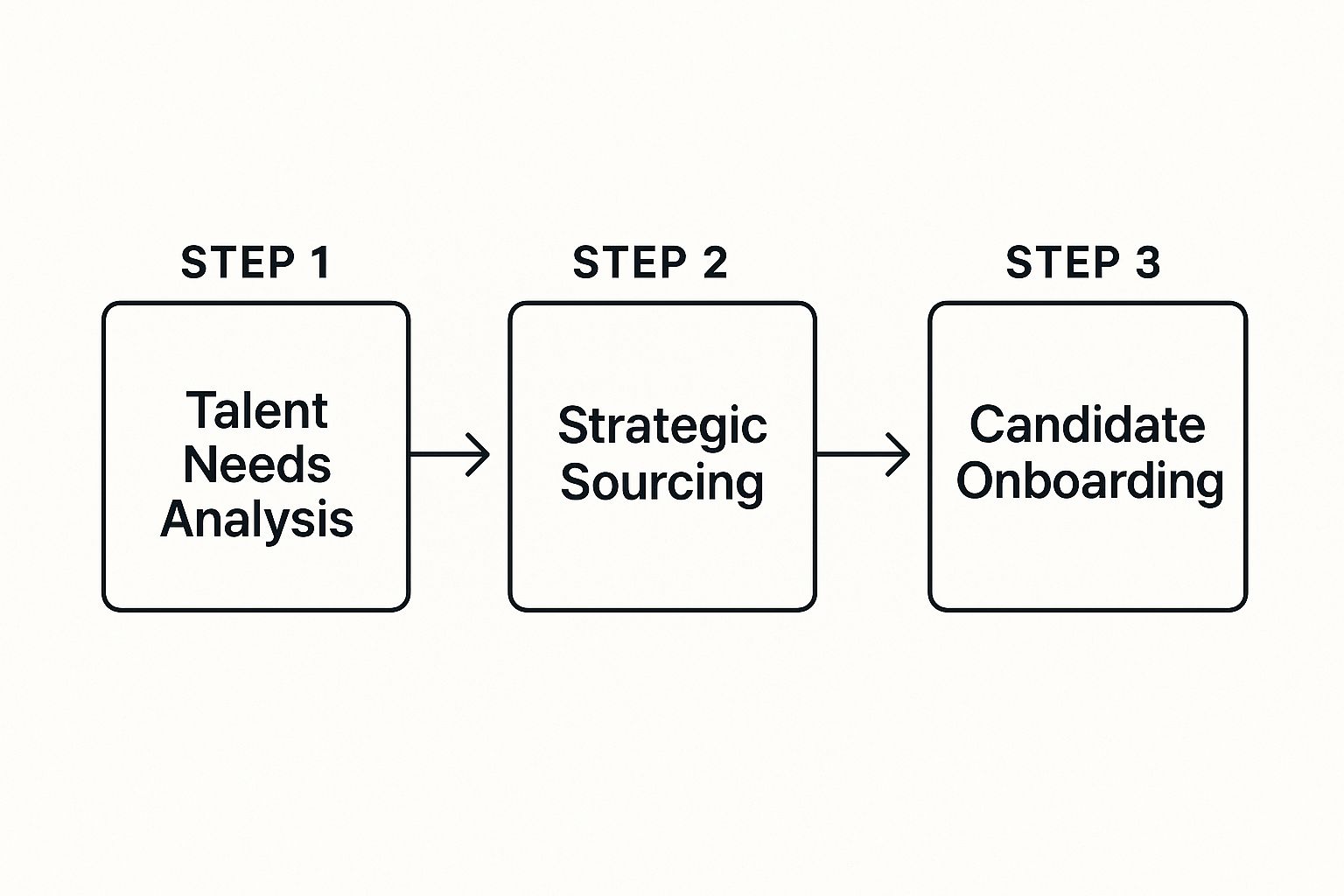
As this shows, it all starts with a deep dive into your business needs and ends with a smooth, welcoming onboarding for every new hire. Sharing this process helps demystify the change for your entire team.
You’ll need to clearly map out new workflows, introduce the RPO team, and offer training on any new systems. A well-managed transition prevents disruption and builds real momentum for the new partnership. To get this right, you might find some useful tips in these 8 key change management strategies for 2025.
To help guide you, here's a simple checklist outlining the key stages of a successful RPO implementation.
RPO Implementation Checklist
This checklist breaks down the RPO launch into manageable phases, helping you stay on track from initial planning to going live.
Phase | Key Action | Success Indicator |
|---|---|---|
1. Discovery | Conduct internal audit of current recruitment gaps and pain points. | A clear document outlining specific challenges and measurable goals. |
2. Alignment | Secure buy-in from all stakeholders (HR, leadership, hiring managers). | Documented support and shared understanding of the RPO's purpose. |
3. Definition | Define and agree upon KPIs, SLAs, and reporting requirements. | A signed-off agreement detailing all metrics for success. |
4. Selection | Vet and select an RPO provider that aligns with your culture and goals. | A chosen partner with a clear proposal and proven track record. |
5. Planning | Develop a detailed project plan with timelines, roles, and milestones. | A comprehensive implementation plan is shared with all key parties. |
6. Execution | Launch communication plan, provide training, and begin the transition. | Smooth handover of processes with minimal disruption to hiring. |
7. Optimisation | Hold regular review meetings to track progress against KPIs and adapt. | Data-driven adjustments are made to improve performance continually. |
Following these steps methodically will ensure everyone understands their role and feels supported, paving the way for a successful and transformative partnership.
How to Choose the Right RPO Provider

Choosing a partner for your recruitment process outsourcing (RPO) is a massive decision. This isn’t like picking new office software; you're selecting a partner who will directly shape your company’s culture, fuel its growth, and sharpen its competitive edge.
The right provider feels like a natural extension of your team. The wrong one can quickly become a disconnected and expensive headache. To find the perfect match, you need to look beyond the price tag and focus on what really matters: finding a provider that genuinely gets your industry, your culture, and your vision for the future.
Evaluate Industry-Specific Expertise
Don't settle for a jack-of-all-trades. You need a partner who speaks the language of your industry and understands its unique pressures and quirks. A provider with a proven track record in your sector already has the right talent networks and a deep understanding of the skills you’re looking for.
When you’re vetting potential partners, get straight to the point with your questions:
Proven Track Record: "Can you show me case studies from UK clients in our specific sector, like energy or technology?"
Talent Networks: "How do you find candidates for those highly specialised, hard-to-fill roles in our industry?"
Market Knowledge: "What are the current hiring trends you're seeing in our market, and how would you adjust your strategy to them?"
A partner with real sector expertise won’t just fill vacancies. They’ll offer strategic advice based on what’s actually happening on the ground, helping you stay one step ahead.
Assess Technological Capabilities
Modern recruitment is driven by technology, and your RPO provider needs to be at the front of the pack. Their tech stack becomes your tech stack, giving you access to powerful tools that can transform your hiring efficiency and quality. The key isn't just if they use tech, but how they use it to get you better results.
Across the UK, top RPO services are using artificial intelligence (AI) and machine learning (ML) to automate sourcing, screen CVs, and engage candidates with chatbots. This tech-first approach does more than just speed things up; it supports bigger goals like improving diversity and planning your future workforce. To get a sense of how providers are innovating, it's worth exploring insights on the UK recruitment process outsourcing market.
Ask potential partners, "How do your analytics tools help us make better hiring decisions?" Their answer will tell you if they see technology as a strategic asset or just an admin tool.
Ensure a Strong Cultural Fit
This is the one factor everyone underestimates, but it’s often the most important. The provider's team will be talking to your hiring managers, your candidates, and your senior leaders. If their values and communication style clash with yours, you're in for a rough ride.
Pay close attention to your interactions during the selection process. Are they transparent and collaborative? Do they listen properly, or just try to sell you a pre-packaged solution? A true partner will take the time to really understand your company culture so they can be a genuine ambassador for your brand.
A great way to test this is to ask to meet the actual team who would be working on your account, not just the sales reps. It gives you a much better feel for what the day-to-day relationship will actually be like.
Scrutinise Their Reporting and Results
At the end of the day, a top-tier RPO provider is all about the data. They should be able to show you their value clearly and consistently through transparent reports on the metrics that actually matter to your business. Vague promises about "better hires" simply won't cut it.
You need specifics. Ask to see sample reports and dashboards. A great partner will track and report on:
Time-to-fill and cost-per-hire to demonstrate efficiency.
Quality of hire metrics, such as performance data for new employees.
Candidate and hiring manager satisfaction scores to measure the experience.
By carefully weighing up these four areas—expertise, tech, culture, and results—you can move beyond simply finding a vendor and start building a truly strategic partnership.
Measuring the Success of Your RPO Partnership
So, you’ve brought an RPO partner on board. It’s a big move, and now you need to prove it was the right one. How can you tell if it's genuinely paying off? Measuring success isn't just about looking at the bottom line; it’s about blending the hard numbers with the less obvious, but equally crucial, strategic wins to get the full picture.
A great RPO partnership delivers results you can actually see and report on. The trick is to focus on the metrics that matter most to your business—things like efficiency, the quality of people you’re hiring, and how it all impacts performance. This shifts the conversation from, "How much did this cost?" to "What have we gained?".
Key Metrics to Track Your RPO Success
To get a real sense of the impact, you need to keep an eye on a few specific Key Performance Indicators (KPIs). These numbers give you a clear, objective view of what your RPO provider is delivering and where they’re adding the most value.
Time-to-Fill: This is the classic recruitment metric. It’s the average number of days it takes from a job opening going live to a candidate accepting the offer. If this number is dropping, it's a great sign your hiring process is becoming faster and more responsive.
Cost-per-Hire: While it's not the only thing that matters, this one is vital for proving financial return. A good RPO partner should bring this figure down by finding smarter ways to source candidates, reducing reliance on expensive agencies, and generally making the whole process more efficient. For a deeper dive, check out our guide on how to calculate cost-per-hire in the UK.
Quality of Hire: This is arguably the most important metric for long-term success. You can measure it by looking at the performance review scores of new hires after six or twelve months, or by seeing if they stick around longer than people hired previously. Great scores here mean your RPO partner is finding people who don't just fill a seat, but truly thrive.
Satisfaction Scores: Don't forget to ask the people involved! Simple surveys for hiring managers and new candidates can tell you a lot about their experience. Positive feedback on communication, the process, and the calibre of candidates is a strong signal that the partnership is working well for everyone.
Articulating the Intangible Benefits
Not every benefit of RPO fits neatly into a spreadsheet. These softer gains are just as important and contribute massively to the health of your business in the long run. Learning to talk about this value is key to making a solid business case.
A strong RPO partnership enhances your employer brand with every interaction. It ensures every candidate, whether hired or not, leaves with a positive impression, turning them into advocates for your company.
This boost to your brand reputation makes it easier to attract top-tier talent down the line, often without even trying. On top of that, your RPO partner can offer invaluable strategic advice on what’s happening in the market, from salary trends to what your competitors are up to.
By combining the hard data with these powerful, less tangible benefits, you can paint a complete and compelling picture of the strategic value your RPO programme brings.
Common Questions About RPO
Deciding to bring in an RPO partner is a big move, so it’s completely normal to have questions. You’re not just buying a service; you’re rethinking a core part of your business. Before you dive in, you need to be sure it’s the right fit.
Let’s cut through the noise and tackle some of the most common questions we hear from business leaders.
What Does an RPO Service Typically Cost?
This is usually the first thing people want to know, but there’s no simple, one-size-fits-all answer. The cost of RPO really depends on what you need – think of it less like a fixed product price and more like a flexible subscription that adapts to your goals. The final figure will come down to the model you select, how many people you need to hire, and how complex those roles are.
Most providers use one of these common pricing structures:
Monthly Management Fee: You pay a predictable, fixed fee each month. This works brilliantly if you have steady, ongoing hiring needs and want to keep your budget clear and simple.
Cost Per Hire: This is a pure performance model. You only pay a set fee when a candidate is successfully hired. It’s a great way to tie your spending directly to results.
Hybrid Model: A popular middle ground. This blends a smaller monthly management fee with a success-based cost for each hire, giving you a mix of stability and accountability.
The goal is to find a structure where cost and value go hand-in-hand. A good RPO partner will be transparent about their pricing and work with you to find a model that aligns with your hiring rhythm, ensuring you’re only paying for the support you actually use.
How Is RPO Different From an MSP?
It’s easy to get RPO and MSP mixed up because they both manage talent, but they operate in completely different worlds. They’re two sides of the workforce coin.
An RPO partner is all about your permanent employees. They embed themselves into your company to manage the entire hiring journey, from finding candidates to getting them settled in. They are, for all intents and purposes, your internal recruitment team.
An MSP (Managed Service Provider), on the other hand, deals with your temporary or contingent workforce. This includes all your freelancers, contractors, and agency staff.
So, put simply: RPO builds your core, long-term team. An MSP manages your flexible, on-demand talent.
Can RPO Work for Small to Medium Businesses?
Yes, absolutely. There’s a common misconception that RPO is only for huge corporations, but that’s not the case anymore. The flexibility of modern RPO models makes them a fantastic option for Small and Medium-sized Enterprises (SMEs).
Many providers now offer project-based or on-demand RPO solutions that are perfect for smaller businesses. Imagine you need to hire an entire new team to launch a product or expand into a new region. A project-based RPO gives you access to an elite recruitment function without the long-term cost of hiring an in-house team. It levels the playing field, allowing you to punch above your weight and compete for the best people.
At Talent People, we design agile hiring solutions that drive growth for ambitious companies. Whether you're scaling a tech team or resourcing a critical energy project, we provide the expertise to build your high-performing team. Discover our project-based RPO solutions today.

Comments