The Guide to Executive Search Consulting
- Talent People

- Sep 7, 2025
- 17 min read
When you hear the term "executive search," you might think of it as just another name for recruitment. But that’s not quite right. It's a highly specialised service—often called headhunting—that’s all about finding and attracting top-tier leaders for a company’s most critical roles.
We’re not talking about posting a job advert online and waiting for applications to roll in. Executive search is a proactive, deep-dive process designed to pinpoint high-impact executives like CEOs, VPs, and board members who aren't even looking for a new job.
What Is Executive Search Consulting?

Think of it this way: if your company were building a landmark skyscraper, you wouldn't just hire any old builder. You’d find a world-renowned architect known for designing iconic structures. That’s the perfect analogy for executive search consulting. It’s a bespoke, retained service focused entirely on filling the senior leadership roles that will shape your company's future.
These aren’t just jobs; they are strategic appointments that can set the course for your organisation for years. The people best suited for them are rarely scrolling through job boards. They are what we call 'passive candidates'—successful leaders who are delivering great results where they are, often for your direct competitors.
How It Differs From Regular Recruitment
The real difference is in the method. Traditional recruitment is often reactive, sifting through applications from people who are actively looking for work. Executive search, on the other hand, is much more like a strategic intelligence mission.
Consultants act as advisors, meticulously mapping the entire market to identify individuals who have the precise skills, experience, and personality to fit a very specific senior role. It’s a methodical process built on confidentiality, deep industry insight, and a huge network of trusted contacts. For a closer look at the mechanics, you can learn more about what an executive search firm does in our detailed guide.
Executive search isn't just about filling an empty chair. It’s about solving a critical business problem by securing a leader who can drive growth, handle complexity, and create lasting value.
To really see the difference, it helps to compare the various ways companies hire. While in-house teams and contingency recruiters are essential for many positions, executive search fills a unique need for those high-stakes leadership appointments where you simply can't afford to get it wrong.
Executive Search vs Other Recruitment Methods
The table below breaks down the key differences between the main hiring methods.
Method | Target Roles | Fee Structure | Ideal For |
|---|---|---|---|
Executive Search | C-Suite, Board, VP, Director | Retained Fee: Paid in instalments to guarantee a dedicated, exclusive process. | Securing mission-critical leaders and highly specialised, hard-to-fill roles. |
Contingency Recruiting | Mid-level Management, Specialist Roles | Success-Based Fee: Paid only upon successful placement. | Filling multiple, less-senior positions where speed is a key factor. |
In-House Hiring | All Levels (Entry to Senior) | Internal Costs: Salaries and operational overhead for the TA team. | Managing ongoing recruitment needs and building a consistent talent pipeline. |
As you can see, each approach has its place. The key is knowing which one to use for the right situation, especially when the future of your company is on the line.
The Strategic Value of an Executive Search Partner

Bringing an executive search firm on board is much more than just filling a gap in the org chart. Think of it as a strategic investment in your company’s future, one that pays dividends long after the new hire walks through the door. It’s a methodical, intelligence-led approach that most internal teams or standard recruitment agencies simply can’t match.
The biggest win? Gaining access to the hidden talent market. The leaders you truly want are rarely looking for a job; they’re too busy succeeding in their current one. These passive candidates won’t be scrolling through job boards or responding to a generic LinkedIn message. But a seasoned executive search consultant has spent years building trusted, confidential relationships, allowing them to approach these high-flyers with real credibility.
This isn't about just scraping together a list of names. It’s about deeply understanding what drives these top executives, what their career ambitions are, and what kind of challenge might tempt them to make a move. The outcome is a carefully curated shortlist of proven leaders, not just a pile of available applicants.
Gaining Deep Market Intelligence
A top-tier search partner essentially becomes your eyes and ears in the marketplace. While they're mapping out the talent landscape for your specific role, they're also gathering invaluable intelligence. This process can reveal how your competitors are structured, who their rising stars are, and what they're paying them.
This kind of insight can directly shape your own business strategy. You might spot a gap in your own leadership team or identify an emerging skill set that’s becoming mission-critical in your industry.
An executive search engagement provides more than just candidates; it delivers a real-time, strategic overview of the talent ecosystem you compete in, giving you a distinct competitive advantage.
This level of market analysis is a fundamental part of the executive search consulting service. It transforms the hiring process from a simple task into a powerful source of business intelligence.
Ensuring Confidentiality and Objectivity
Let’s face it, many senior leadership changes are incredibly sensitive. You might be replacing a long-serving executive or creating a new strategic role that you don't want your competitors getting wind of. Executive search firms are masters of discretion.
They act as a confidential buffer, shielding your company’s identity until the right moment. This helps maintain internal morale and stops the market from speculating.
What's more, an external partner brings a much-needed objective eye. They aren't caught up in internal politics and can assess both internal and external candidates against the same rigorous, unbiased criteria. This ensures the final decision is based purely on who is best for the role and the company’s future, leading to a much stronger cultural and functional fit.
Mitigating the High Cost of a Bad Hire
Hiring the wrong person for a senior leadership role is a multi-million-pound mistake. The financial fallout goes way beyond their salary and the recruitment fee. We're talking about lost productivity, plummeting team morale, and strategic blunders that can take years to undo.
A rigorous, professional search process is your best defence against this. Through exhaustive due diligence, in-depth referencing, and sophisticated assessments, executive search consultants drastically reduce the chances of a mis-hire.
The value here is immense. The sustained demand for this specialised service is clear from its market size. In the United Kingdom, the Executive Search Recruiters industry is a major player with an estimated market size of £1.8 billion, and it's been growing steadily for the last five years. You can explore further details on the UK executive search market to get a sense of its scale. Leading organisations see this investment not as a cost, but as a critical insurance policy against a catastrophic hiring error.
How the Executive Search Process Works
The world of executive search can feel a bit like a black box, a mysterious process where high-stakes leadership roles are filled behind closed doors. But it's far from a simple ‘find and place’ job. In reality, it’s a carefully planned journey with distinct, crucial stages, all designed to reduce risk and find a leader who won't just fit in, but will truly drive the business forward.
When you understand how it works, the mystery disappears. You can see exactly what you should expect when you partner with a top-tier search firm. It's a collaborative effort that starts with a deep dive into your business and ends with a leader who is set up for long-term success.
This image gives you a bird's-eye view of the typical executive search workflow, breaking it down into three main phases.
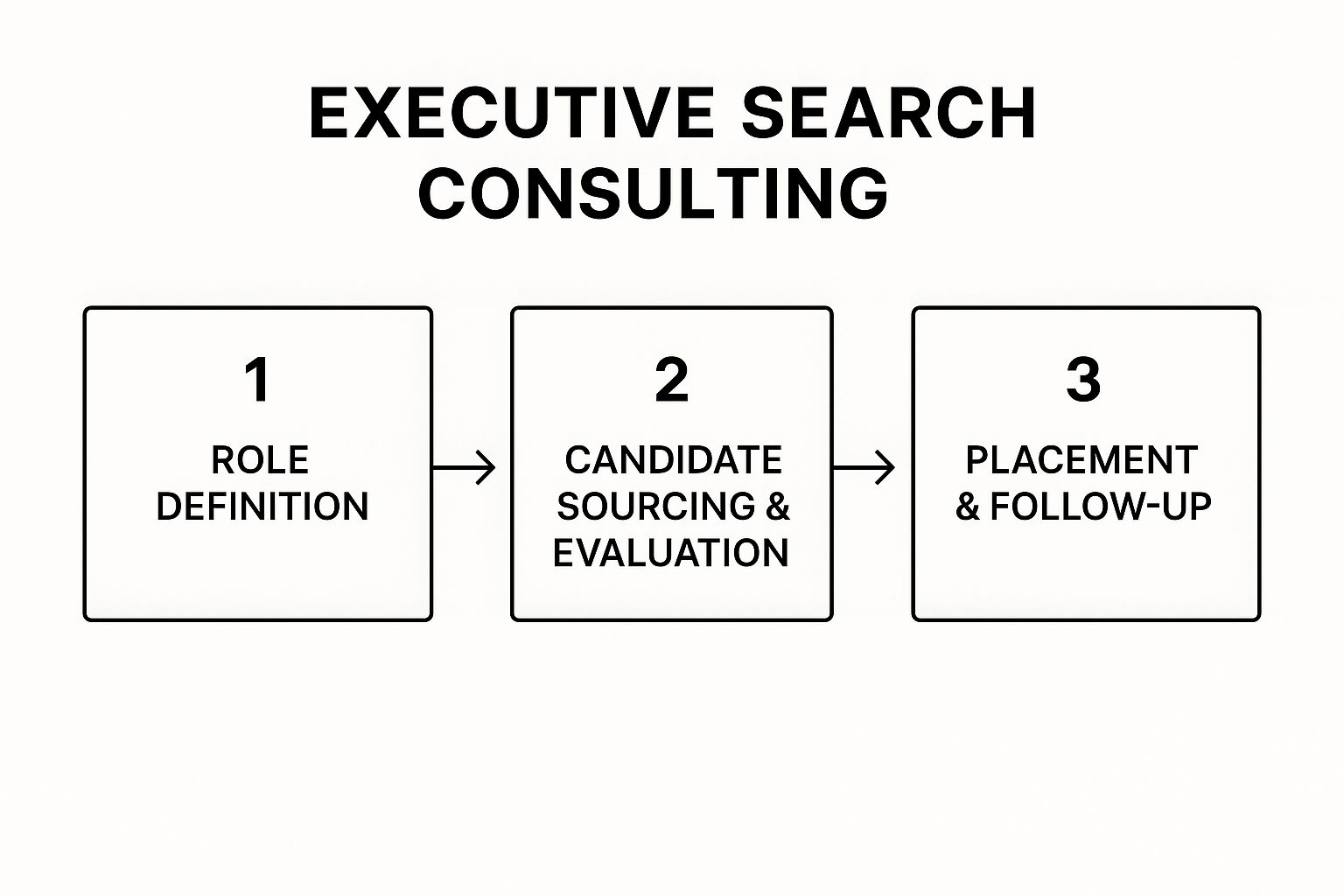
As you can see, it moves logically from defining the strategy, to hands-on sourcing and assessment, and finally to making the placement and making sure the new leader settles in properly.
Phase 1: Defining Success
This first phase is, without a doubt, the most important. Get this wrong, and the entire search is built on a shaky foundation. It all starts with the search firm getting under the skin of your business, your culture, and your goals for the future.
Your consultant should act as a strategic partner, working hand-in-glove with the hiring manager and other key people to build a detailed picture of the perfect candidate. This goes way beyond a simple job description.
Here’s what typically happens:
Discovery Sessions: These are intensive meetings designed to get to the heart of the role. What makes it so important? What challenges will the new leader face? What, specifically, do you need them to achieve in their first 12-18 months?
Creating the Position Specification: This is where everything is put down on paper. It’s a detailed document covering responsibilities, essential skills, experience, and the kind of cultural fit needed to succeed. Think of it as the blueprint for the entire search.
Market Reality Check: The consultant will analyse compensation benchmarks and what’s happening in the market to make sure the role is positioned competitively enough to attract the very best talent.
This foundational work ensures everyone is on the same page about what "great" looks like before the search truly begins.
Phase 2: Sourcing and Assessment
With a clear blueprint in hand, the search firm gets to work. This is where their deep industry knowledge and extensive network really shine.
This isn't about posting a job advert and waiting for the phone to ring. It's a proactive, research-driven hunt for the best possible candidates, especially those top-tier leaders who aren't even looking for a new role but could be tempted by the right opportunity.
The process usually involves these steps:
Market Mapping: First, they systematically identify the target companies and sectors where your ideal executives are likely working right now.
Candidate Identification: Using a mix of their own databases, industry contacts, and fresh research, they build out a 'longlist' of potential candidates.
Confidential Outreach: They then discreetly approach these individuals to see if they might be interested and to introduce the opportunity in a compelling way.
Rigorous Vetting: This is the critical filtering stage. Through in-depth interviews and assessments, they measure each candidate against the blueprint. This process narrows the longlist down to a highly-curated shortlist of the 3-5 best contenders.
A huge part of this phase is the consultant’s ability to be an ambassador for your brand. They aren't just screening people; they're selling the opportunity, sharing your vision, and generating real excitement among high-calibre leaders.
Phase 3: Placement and Integration
Once the shortlist is presented to you, it's time for your team to get more involved in the interviews. But the search consultant's job is far from over. They shift into the role of facilitator, advisor, and negotiator, guiding both sides towards a successful hire.
This final stage needs a deft touch to manage everyone's expectations and navigate the complexities that always come with hiring at a senior level. If you want to dive deeper into attracting top leaders, you might find our guide on what is executive recruiting and how to find C-suite talent useful.
Here are the key steps in this final phase:
Interview Management: They coordinate all the interview schedules and prepare both your team and the candidates to make sure the conversations are as productive and insightful as possible.
Referencing and Due Diligence: This involves exhaustive, 360-degree reference checks to verify a candidate’s track record, leadership style, and past performance. No stone is left unturned.
Offer Negotiation: They act as a trusted middle-man to help structure a competitive compensation package and manage the offer process, doing everything possible to secure an acceptance.
Onboarding Support: After the offer is accepted, they work with you to ensure a smooth start for the new hire. This often includes check-ins during their critical first few months to help them integrate successfully.
This complete, end-to-end process is what makes executive search consulting so different from standard recruitment. It's a strategic partnership designed to find you not just a new hire, but a leader who can genuinely transform your organisation.
Key Trends Shaping Executive Search Today

The world of executive search consulting certainly doesn't stand still. Just as business evolves, so too must the methods for finding its leaders. Today, a few powerful trends are fundamentally changing how the best C-suite and board-level talent is found, vetted, and brought on board.
For any organisation trying to build a leadership team that can handle what’s coming next, getting to grips with these shifts is vital. These aren't just passing fads; they represent a deep change in what companies need from their senior hires and how search partners deliver that value.
One of the biggest shifts? The smart integration of technology. We’re talking about much more than a quick LinkedIn search; this is about using sophisticated tools to get a genuine competitive edge.
The Rise of AI and Data Analytics
Historically, executive search has always been a relationship game. It was often seen as more of an art than a science. While personal networks and human instinct are still absolutely crucial, data is now playing a much bigger part. The best firms are now using AI-powered platforms and sharp analytics to supercharge their work.
This technology allows consultants to map entire talent markets with incredible speed and precision. They can spot patterns in career histories, predict which candidates are most likely to thrive in a specific role, and uncover hidden talent pools that old-school methods would simply miss.
For instance, data can help answer mission-critical questions like:
Which executives have a proven track record of leading a successful digital overhaul?
What are the common traits of top-performing leaders in the renewable energy sector?
Where are the up-and-coming talent hubs for very specific, niche technical skills?
This data-driven approach doesn’t replace the human element; it strengthens it. It frees up consultants to focus on what they do best: building genuine relationships, assessing cultural fit, and giving their clients top-tier strategic advice.
A Laser Focus on Diversity, Equity and Inclusion
Diversity, Equity, and Inclusion (DE&I) has firmly moved from a 'nice-to-have' to a non-negotiable business priority. Boards, investors, and customers rightly demand leadership teams that reflect the diverse world we live in. As a result, executive search consulting firms have become critical partners in making this happen.
Top-tier search firms are now expected to deliver diverse shortlists as standard. They proactively build deep networks within underrepresented communities and use search strategies specifically designed to reduce unconscious bias at every step.
Building a truly inclusive leadership team is no longer just about fairness; it's a proven driver of innovation, better decision-making, and superior financial performance. An expert search partner is essential for making it a reality.
This means moving beyond token gestures. It’s about embedding DE&I principles into the very fabric of the search methodology—from writing inclusive job descriptions to ensuring assessment criteria are equitable and challenging clients to look beyond their usual hiring circles. The end goal is to build leadership teams with a genuine breadth of perspective and experience.
The Surge in Interim Executive Appointments
With the pace of change only getting faster, companies often need senior leadership on a more flexible basis. This has caused a sharp rise in demand for interim executives—seasoned leaders who can jump in to manage a crisis, spearhead a critical project, or fill a gap during a permanent search. The market is projected to top £2.5 billion, with interim roles now making up a fifth of all executive placements. This executive search market update digs into the growing need for this kind of flexible leadership.
This trend is part of a wider move towards more agile ways of working. Interim leaders deliver immediate impact without the long-term commitment of a permanent hire, offering a powerful solution for businesses going through transformation or uncertainty. Leading search firms have responded by building dedicated practices, keeping a bench of vetted, on-demand executive talent ready to go at a moment's notice.
How to Choose the Right Executive Search Firm
Picking an executive search partner is as critical as the hire itself. You’re not just outsourcing a task; you’re building a strategic alliance to find your company’s next leader. The right firm becomes an extension of your own team, bringing deep market knowledge and a rigorous process that minimises the risk of a bad hire.
Get it wrong, and you could be facing a long, frustrating process that only turns up underwhelming candidates. But a great partnership feels seamless and insightful, delivering a leader who can make a genuine impact. It all comes down to knowing what to look for and asking the right questions.
Industry and Functional Specialisation
First things first, look past the glossy brochures and get into a firm's actual track record. Do they really understand the unique challenges, language, and competitive pressures of your industry? A generalist firm might be fine, but a specialist who lives and breathes your sector will have a much deeper network and a more intuitive grasp of what a great hire looks like.
This expertise should also cover the specific role you're hiring for. A firm brilliant at placing CFOs might not be the best choice to find your next Chief Technology Officer.
Ask for concrete examples of recent, similar searches they’ve handled.
Who were the clients?
What were the specific challenges of those roles?
How long did the process take from start to finish?
This level of detail will quickly show you who the real experts are. A partner with proven functional expertise will simply move faster and with more precision. For a deeper dive, our guide on hiring a modern executive search consultant has more on this.
Their Research Process and Reach
The heart of any successful executive search consulting project is the quality of the research. You need a partner who does more than just flick through their existing database. Ask them to walk you through their research method, step-by-step. How do they map the market, pinpoint potential candidates, and make that crucial first approach?
Their process should be proactive, methodical, and built around your specific needs. If the role demands it, they should be able to show a global reach, proving they can find top talent no matter where they are.
A firm’s real value is its ability to find and engage high-calibre passive candidates—the people who aren’t actively job-hunting but are a perfect fit for the role. This requires a sophisticated and discreet outreach strategy.
In a tight talent market, this is more important than ever. The UK, for example, is facing a significant talent shortfall in senior roles, estimated at around 20%. It’s no surprise that 75% of UK companies now turn to executive search firms for their C-level hires, valuing their systematic approach. You can discover more insights about executive search challenges in the UK and see why a robust methodology is so vital.
Cultural Fit and Communication
Finally, don’t underestimate the importance of good chemistry. You’ll be working very closely with your search consultant, so a strong cultural fit and a transparent communication style are absolutely essential. The relationship should feel like a collaboration, not just a transaction.
During those initial chats, pay attention to how they listen. Are they asking insightful questions that challenge your thinking, or are they just nodding along? The best consultants act as trusted advisors, unafraid to offer a different perspective based on what they're seeing in the market.
Set clear expectations for communication from day one.
Reporting Frequency: How often will you get progress updates?
Key Metrics: What information will be in those reports?
Feedback Loop: How will they use your feedback as the search moves forward?
To help you with this, we’ve put together a simple checklist to guide your conversations.
Checklist for Vetting an Executive Search Firm
Use this table as a practical guide during your evaluation process. It will help you systematically compare firms and ensure you're asking the questions that truly matter.
Evaluation Criteria | Key Questions to Ask | What to Look For |
|---|---|---|
Industry Specialisation | Can you share 3-5 recent placements in our industry? What are the key trends you're seeing in our sector right now? | Specific, relevant case studies. Deep, current market knowledge beyond buzzwords. |
Functional Expertise | How many searches have you completed for this specific role? What were the unique challenges? | A clear track record of placing similar roles. An understanding of the role's nuances. |
Research Methodology | Can you walk me through your process for identifying and engaging passive candidates? | A proactive, multi-channel strategy. Evidence of original research, not just database searches. |
Network and Reach | How do you access talent pools outside of your immediate network or geography? | A clear explanation of their global or regional networks and research capabilities. |
Consultant Experience | Who will be leading our search? What is their personal track record? | The lead consultant should have direct, relevant experience. Avoid being passed to a junior team. |
Communication & Reporting | What does your reporting process look like? How often will we connect? | A commitment to regular, transparent updates with clear metrics and candidate feedback. |
Cultural Alignment | How do you assess for cultural fit between a candidate and our organisation? | A defined methodology for understanding your culture and assessing it in candidates. |
Fee Structure & Guarantees | What is your fee structure? What kind of guarantee do you offer if a placement doesn't work out? | A clear, transparent fee structure and a fair guarantee period. |
Choosing the right firm is about finding a partner who is as invested in your company’s success as you are. By focusing on specialisation, process, and partnership, you can select a firm that will deliver not just a candidate, but a true leader for your organisation.
Got Questions About Executive Search? We've Got Answers
Even with a clear picture of what executive search is all about, a few practical questions always pop up. It's only natural for business leaders to wonder about timelines, costs, and whether they really need a search firm when they have other hiring tools at their disposal. Let's tackle these common queries head-on so you can move forward with confidence.
Getting clear on these points isn't just about logistics; it’s about aligning expectations from day one and making sure your leadership hire is set up for success.
How Long Does an Executive Search Take?
While no two searches are exactly the same, a typical executive search will take somewhere between 12 to 16 weeks. This clock starts ticking from the initial briefing and stops when your chosen candidate signs on the dotted line. Think of it as a marathon, not a sprint—it's all about precision over pure speed.
We can break that timeline down into a few key phases:
Weeks 1-4: Laying the Groundwork. This is where we dig deep. We'll be defining what success looks like for the role, creating a detailed position specification, and starting to map the market to see who's out there.
Weeks 5-10: The Hunt and Assessment. Now, the search consultants get to work, discreetly approaching and engaging potential candidates. This involves countless confidential conversations and rigorous interviews to whittle a long list down to a handful of the very best.
Weeks 11-16: The Home Stretch. This final stage is all about your interviews with the shortlisted candidates, conducting exhaustive 360-degree reference checks, and navigating the delicate process of putting together and negotiating the final offer.
Of course, things like a highly complex role, a shallow talent pool in a niche market, or even the availability of your own interview panel can stretch this timeline a bit.
What’s the Difference Between Retained and Contingency Search?
The real difference between retained and contingency search comes down to the payment model and, more importantly, the level of commitment it creates. Getting this distinction right is crucial for choosing the recruitment service that fits your specific needs.
A retained search is a true partnership. You pay the search firm a fee in instalments—usually a third to kick things off, a third when they present the shortlist, and the final payment when the candidate is hired. This structure means you get a dedicated team and a thorough, in-depth process focused entirely on your critical hire.
Retained executive search is an investment in a guaranteed process. You're securing a dedicated team, deep market research, and a commitment to finding the absolute best person for the job, not just the one who's easiest to find.
On the other hand, a contingency search is a "no win, no fee" deal. The recruiter only gets paid if they place someone. This model is common for more junior or high-volume roles, and you’ll often have several agencies all competing to fill the same position. It can be faster, but it simply doesn't have the strategic depth, confidentiality, or dedicated focus you get with a retained search.
Why Can’t We Just Use LinkedIn to Find Executives?
Look, LinkedIn is a fantastic tool for professional networking. It's a valuable part of any modern recruitment toolkit. But it is absolutely not a substitute for a proper executive search process, especially when you're hiring for a mission-critical leadership role. Relying only on a platform like LinkedIn comes with some serious limitations.
An executive search consultant brings so much more to the table than just finding profiles. Their real value lies in:
Engaging Passive Talent: Let's be honest, the best leaders are almost never actively looking for a new job. A top-tier consultant has the credibility to start a confidential conversation with a high-calibre candidate who would ignore a standard InMail from an internal recruiter.
Providing Objective Assessment: Consultants offer an impartial, expert third-party view. They are masters at digging into a candidate's real motivations, leadership style, and cultural fit in a way that a CV or an online profile never could.
Ensuring Confidentiality: Many senior hires are highly sensitive. A search firm acts as a vital buffer, protecting your company's identity and stopping market rumours before they start.
Managing the Whole Process: From navigating tricky salary negotiations to conducting deep-dive due diligence and reference checks, a consultant handles all the intricate details. This dramatically reduces the huge risk—and cost—of making a bad senior hire.
Ultimately, a platform like LinkedIn is just a database. Executive search provides the strategy, market intelligence, and risk management that a database alone can never offer.
At Talent People, we design and deliver specialised hiring solutions that build the high-performing teams your projects demand. Whether you're entering a new market or scaling your technical leadership, we ensure every hire is positioned to deliver immediate and lasting impact. Learn more about how we can accelerate your growth.

Comments