Top Project Manager Interview Questions & Expert Tips
- Talent People

- Aug 23, 2025
- 17 min read
Landing a top project manager role requires more than just a stellar CV; it demands a masterful interview performance where you can clearly demonstrate your value. Hiring managers in competitive sectors like technology and energy aren't just ticking boxes. They are searching for candidates who can prove a blend of methodological expertise, robust leadership, and the resilience needed to steer complex initiatives to completion. They want to see how you think, how you solve problems, and how you lead under pressure.
This guide is designed to prepare you for exactly that. We have compiled a comprehensive list of the most critical project manager interview questions you are likely to face. We move beyond generic advice to provide a clear framework for structuring your answers effectively. For each question, we dissect what the interviewer is really asking, helping you to formulate compelling responses that showcase your strategic thinking and practical experience.
Our goal is straightforward: to give you the insights and confidence needed to turn every question into an opportunity. By mastering these key areas, you will be able to articulate your unique strengths and prove you are the right person to lead their next successful project. Let's get started.
1. Tell me about a project that failed or didn't go as planned. What happened and what did you learn?
This is one of the most common project manager interview questions because it tests far more than just your past performance. Interviewers use this question to evaluate your accountability, resilience, and problem-solving skills. They want to see if you can honestly self-assess, learn from setbacks, and apply those lessons to future projects.

A strong answer demonstrates a growth mindset, showing that you view failure not as a career-ender but as a vital opportunity for improvement. It’s a chance to show you can navigate a crisis without placing blame on others.
How to Structure Your Answer
The best way to tackle this question is with the STAR method (Situation, Task, Action, Result). This framework keeps your story concise and impactful.
Situation: Briefly describe the project and its objectives. For example, "We were tasked with launching a new software feature for a key client under a tight deadline."
Task: Explain your specific role and responsibilities within that project.
Action: Detail the steps you took, but focus on the specific actions that led to the challenge or failure. Crucially, explain the proactive steps you took to mitigate the situation once you realised it was going off track.
Result: Clearly state the outcome, even if it was a failure. Then, pivot immediately to what you learned and how you have since applied that learning to deliver better results. This is the most important part of your answer.
Answering Tips
Own the failure: Take responsibility for your part in the setback. Avoid blaming stakeholders, team members, or external factors.
Focus on the lesson: The core of your answer should be about growth. For instance, describe how a budget overrun due to unforeseen technical issues taught you to implement a more robust risk assessment process.
Show positive change: Connect the failure to a subsequent success. Explain how the lesson learned helped you successfully deliver a later project.
2. How do you handle scope creep in a project?
This classic project manager interview question is designed to test your ability to protect a project’s boundaries. Interviewers want to see that you can manage stakeholder expectations, implement formal change control processes, and communicate effectively, even when it means saying "no" professionally.
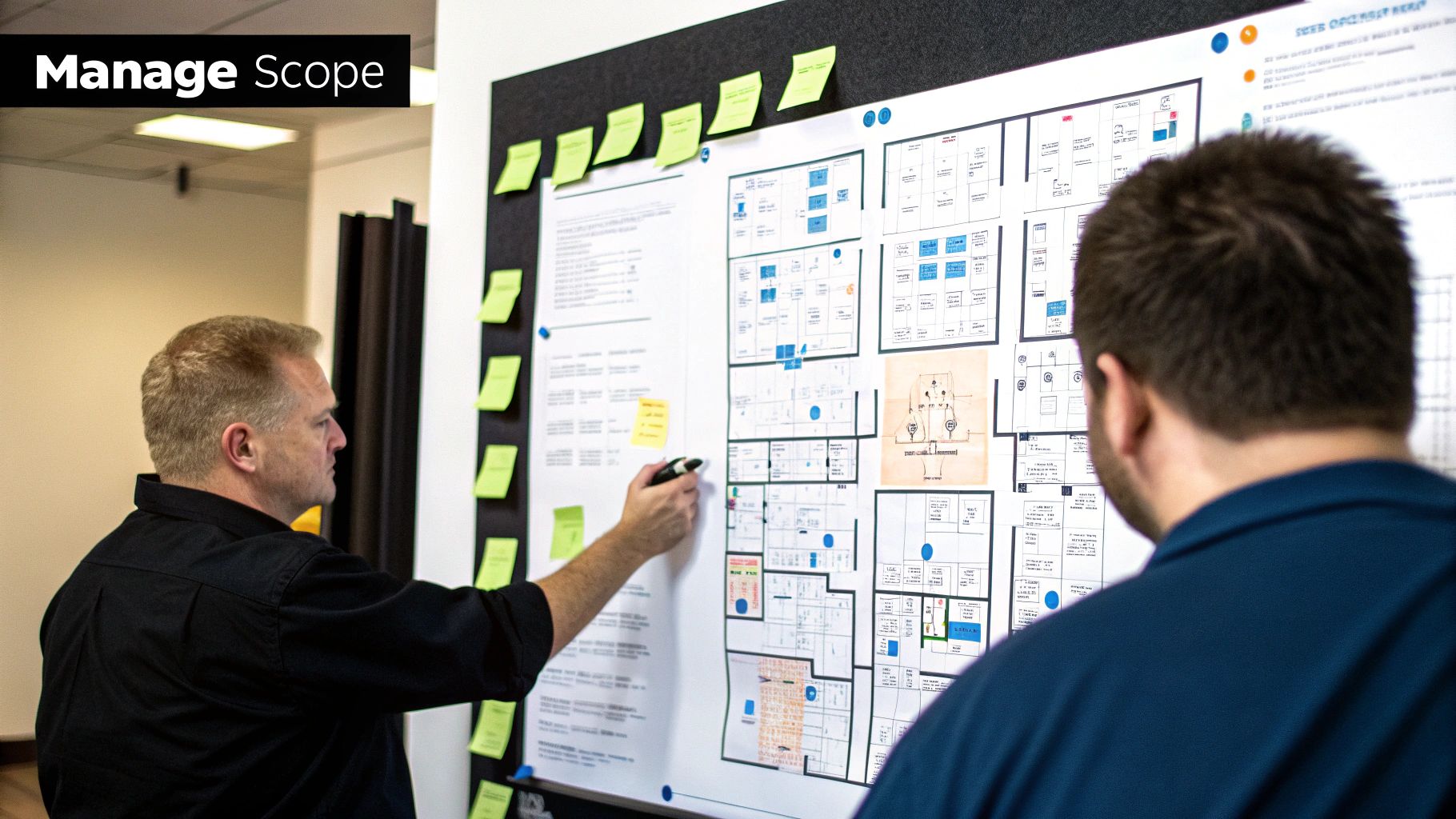
Your answer reveals your understanding of core project constraints like time, budget, and scope. A strong response demonstrates that you can balance client satisfaction with the realistic delivery of the initial project goals, preventing projects from becoming bloated, delayed, and over-budget.
How to Structure Your Answer
A clear, process-oriented answer works best. Walk the interviewer through the logical steps you take when a new request emerges that is outside the agreed-upon scope.
Situation: Start by acknowledging the request and listening to the stakeholder's needs. For instance, "When a stakeholder requests a new feature mid-sprint..."
Task: Explain your immediate responsibility is to analyse the request against the original project scope.
Action: Detail your change control process. This includes documenting the request, performing an impact analysis (on budget, timeline, and resources), and presenting these findings to the relevant stakeholders or change control board.
Result: Describe the outcome. The decision might be to approve the change with adjusted resources, defer it for a future phase, or reject it. Emphasise how your structured process ensures decisions are made transparently and in the project's best interest. You can find proven strategies for managing project scope creep on talentpeople.co.
Answering Tips
Emphasise formal process: Always refer to your reliance on a formal change control process. This shows you are organised and not reactive.
Talk about communication: Highlight your skill in communicating the impact of the requested change to stakeholders, helping them understand the trade-offs.
Show you can say no: Frame saying "no" as a positive action that protects the project's success. For example, "To protect our launch date, we agreed to add that feature to the backlog for phase two."
3. Describe your approach to managing project stakeholders with conflicting priorities.
This question is a cornerstone of project manager interview questions because it assesses your communication, negotiation, and strategic thinking capabilities. Interviewers want to know if you can navigate complex political landscapes, balance competing interests, and align diverse groups towards a common goal without derailing the project. It tests your ability to be a diplomat and a decision-maker simultaneously.

A strong answer demonstrates that you are proactive, not reactive, in managing relationships. It shows you can understand motivations, facilitate compromise, and make tough, data-driven decisions while maintaining professional respect.
How to Structure Your Answer
Use a clear, systematic approach to explain your process. You can frame your answer around a real-world example using the STAR method (Situation, Task, Action, Result) to make it more concrete.
Situation: Briefly set the scene. For instance, "On a recent project, the marketing team wanted to launch a new feature quickly to capture market share, while the engineering team insisted on more time for thorough quality assurance to prevent technical debt."
Task: Define your role. "My responsibility was to mediate these conflicting priorities to agree on a realistic timeline that balanced speed-to-market with product stability."
Action: Detail your stakeholder management process. Explain how you organised meetings, listened to each party's concerns, used a stakeholder map to understand their influence and interest, and facilitated a discussion centred on the project's core business objectives.
Result: Describe the outcome and the lesson. Explain how you reached a compromise, such as a phased rollout, and what you learned about aligning stakeholders early in the project lifecycle.
Answering Tips
Emphasise analysis: Start by mentioning your use of tools like stakeholder mapping to analyse each party's influence, interest, and expectations.
Prioritise active listening: Show that you seek to understand the "why" behind each stakeholder's position before proposing solutions.
Focus on common ground: Explain how you find shared objectives (e.g., customer satisfaction, company revenue) to reframe the conflict as a shared problem.
Be decisive: Mention your willingness to use an agreed-upon escalation path or make a data-driven decision when consensus isn't possible, always communicating the rationale clearly.
4. Walk me through how you would plan and execute a project from start to finish.
This is a cornerstone among project manager interview questions, designed to evaluate your entire project management framework. Interviewers are looking for a systematic, logical approach that demonstrates your understanding of the full project lifecycle, from a vague idea to a successful launch and review. It's your chance to showcase your preferred methodologies, tools, and strategic thinking.

A great answer proves you can create structure from ambiguity and lead a team through a defined process. It shows you're not just a task manager but a strategic planner who considers everything from stakeholder communication to risk mitigation and final delivery.
How to Structure Your Answer
Frame your response around the five standard project management phases. This provides a clear, comprehensive narrative of your process.
Initiation: Start by explaining how you define the project's scope, objectives, and key stakeholders. Mention creating a project charter or business case to secure buy-in.
Planning: Detail how you develop the project plan. Discuss breaking down work into tasks (WBS), creating a timeline (Gantt chart), allocating resources, and setting the budget.
Execution: Describe how you manage the team, facilitate communication, and monitor progress against the plan. This is where you put the plan into action.
Monitoring & Controlling: Explain your process for tracking KPIs, managing risks, and handling change requests. How do you ensure the project stays on schedule and within budget?
Closure: Conclude by explaining how you finalise deliverables, get stakeholder sign-off, and conduct a post-project review or "lessons learned" session.
Answering Tips
Mention methodologies: Briefly state whether you'd use Agile, Waterfall, or a hybrid approach and why it's suitable for the hypothetical project.
Talk about tools: Reference specific software you use for planning, collaboration, and tracking, such as Jira, Asana, or MS Project.
Emphasise communication: Weave in how you keep stakeholders informed at every stage, from kick-off meetings to regular status reports. You can find out more by reading this UK guide to hiring project managers.
Be adaptable: Show you can tailor your approach based on the project's specific needs, size, and complexity.
5. How do you prioritise tasks and manage your time when juggling multiple projects?
This classic project manager interview question is designed to test your organisational skills, strategic thinking, and ability to perform under pressure. Recruiters want to see that you have a systematic approach to managing competing priorities, not just an ability to "work hard." They are assessing your capacity to maintain control and deliver quality across a complex workload.
A confident response shows you can move beyond a simple to-do list and apply established frameworks to make objective decisions. It demonstrates that you can align your daily actions with broader strategic goals, ensuring that the most critical work always gets the attention it deserves.
How to Structure Your Answer
Frame your answer around a clear, logical process. Explain your methodology first, then provide a brief, concrete example of how you've applied it.
Situation: Describe a scenario where you were responsible for several concurrent projects with competing deadlines. For instance, "In my previous role, I was simultaneously managing a major software platform upgrade, a new feature rollout for a key client, and an internal process improvement initiative."
Task: Explain your responsibility was to ensure all projects progressed effectively without sacrificing quality or missing key milestones.
Action: Detail your method. Explain how you used a specific framework, like the Eisenhower Matrix, to categorise tasks as urgent/important. Mention the tools you used (e.g., Jira, Asana) and how you communicated priorities with stakeholders to manage expectations.
Result: Conclude with the positive outcome. For example, "By clearly defining and communicating priorities, we successfully delivered the client feature on time, completed the platform upgrade with minimal disruption, and advanced the internal initiative to its next phase."
Answering Tips
Name your framework: Mention specific prioritisation techniques like MoSCoW (Must-have, Should-have, Could-have, Won't-have) or the Eisenhower Matrix to show you use structured methods.
Talk about tools: Reference project management software (e.g., Trello, Jira, Microsoft Project) to demonstrate your technical proficiency and organisational skills.
Emphasise communication: Highlight how you keep stakeholders informed about shifting priorities and potential timeline impacts. This shows you understand the importance of managing expectations.
Mention delegation: Show you can effectively delegate tasks to team members based on their skills and workload, proving you can lead and empower a team.
6. Describe a time when you had to manage a difficult team member. How did you handle the situation?
This is a classic behavioural question designed to assess your leadership, conflict resolution, and interpersonal skills. The interviewer wants to know if you can navigate sensitive team dynamics, address performance issues constructively, and maintain a positive and productive environment. Your response reveals your emotional intelligence and your ability to lead with empathy and firmness.
A great answer shows you can handle conflict directly and professionally, without letting issues fester. It highlights your capacity to separate the person from the performance issue, focusing on facts and behaviours rather than personality clashes. This is a key part of answering project manager interview questions effectively.
How to Structure Your Answer
Once again, the STAR method is your best friend for structuring a clear and compelling story. It helps you provide context and focus on the outcome.
Situation: Briefly describe the project and the specific challenge presented by the team member. For example, "On a critical software migration project, a senior developer was consistently missing deadlines and was resistant to adopting the new agile processes we had implemented."
Task: Explain your responsibility, which was to address the behaviour to get the project back on track and maintain team morale.
Action: Detail the steps you took. This should include having a private conversation, seeking to understand their perspective, clearly outlining expectations and the impact of their behaviour, and co-creating a performance improvement plan.
Result: Explain the outcome. For instance, "After our discussion, the developer's engagement improved significantly. We realised part of the issue was a skills gap, so we organised training. They became a productive member of the team, and the project was completed successfully." Finish by mentioning what you learned about leadership.
Answering Tips
Show empathy: Start by demonstrating that you tried to understand the team member's point of view before taking action.
Focus on action: Don't dwell on the person's negative behaviour. Emphasise the specific, professional steps you took to manage the situation.
Be professional: Avoid overly personal or emotional language. Frame the issue in terms of its impact on project goals and team performance. Effective team-building strategies are crucial for preventing such issues.
Highlight a positive resolution: If possible, choose an example where your intervention led to a positive change in the team member's performance or attitude.
7. How do you measure project success, and what metrics do you track?
This is a fundamental project manager interview question designed to assess your understanding of value delivery. Interviewers want to know if you can look beyond the traditional "on time, on budget" metrics and connect project outcomes to genuine business objectives. It reveals your strategic thinking and data-driven approach.
A great answer shows you can define success criteria collaboratively with stakeholders and track metrics that truly matter. This demonstrates that you don’t just manage tasks; you manage outcomes and ensure the project delivers its intended value to the organisation.
How to Structure Your Answer
Use a clear, structured approach to explain your methodology for measuring success, providing specific examples relevant to different project types.
Define Success Holistically: Start by explaining that success is multi-faceted. Mention the classic trio (scope, schedule, budget) but immediately expand to include strategic goals like ROI, stakeholder satisfaction, quality, and team morale.
Provide Specific Metric Examples: Give concrete examples of metrics for different projects. For a software launch, this might be user adoption rates and bug reports. For a marketing campaign, it could be conversion rates and ROI.
Explain the "Why": Connect the metrics back to decision-making. Explain how you use this data to make adjustments, communicate progress to stakeholders, and validate the project's success post-launch. For example, "Tracking leading indicators like user engagement during a beta phase allowed us to pivot our development priorities to better meet user needs before the full launch."
Answering Tips
Align metrics with business goals: Emphasise that you always start by understanding the "why" behind the project and tailor your metrics to those specific business objectives.
Balance metric types: Mention a mix of quantitative (e.g., ROI, cost variance) and qualitative (e.g., customer satisfaction surveys, team feedback) metrics.
Show continuous improvement: Explain how metrics aren’t just for a final report but are used throughout the project lifecycle to inform decisions and drive improvements.
8. Tell me about a time when you had to deliver a project with a very tight deadline. How did you ensure success?
This is one of the most revealing project manager interview questions as it directly tests your ability to perform under pressure. Hiring managers want to see your real-world approach to time management, prioritisation, and leadership when the stakes are high. It’s a chance to prove you can make smart decisions quickly without sacrificing quality or team morale.
A strong answer showcases strategic thinking over brute force. It demonstrates that you don’t just work longer hours; you work smarter by ruthlessly prioritising tasks, motivating your team, and communicating with stakeholders effectively to manage expectations.
How to Structure Your Answer
The STAR method is the ideal framework for this question, allowing you to tell a compelling and structured story.
Situation: Briefly set the scene. Describe the project and explain why the deadline was so tight. For example, "A key competitor announced an unexpected product launch, forcing us to move our own launch date forward by six weeks to maintain market position."
Task: Clarify your specific role in navigating this challenge.
Action: Detail the strategic steps you took. This could include reprioritising the backlog, negotiating scope with stakeholders, organising daily stand-up meetings to resolve blockers, and automating certain processes.
Result: Explain the outcome. Clearly state that you met the deadline and highlight any key successes, such as launching on time without critical defects. Conclude by mentioning a key lesson you learned about planning for compressed timelines.
Answering Tips
Focus on prioritisation: Explain how you used frameworks like the MoSCoW method (Must have, Should have, Could have, Won't have) to focus the team's efforts on critical path activities.
Highlight leadership: Emphasise how you kept the team motivated and focused, shielding them from external pressure while ensuring clear communication.
Show you maintained quality: Describe the specific checks and balances you implemented to ensure that speed did not lead to a poor-quality deliverable.
9. How do you identify and manage project risks?
This question directly probes your foresight, strategic thinking, and ability to handle uncertainty. Interviewers want to confirm you have a systematic, proactive approach to risk management rather than a purely reactive one. It assesses your ability to anticipate potential roadblocks and prepare contingency plans to keep the project on track.
A strong answer demonstrates a structured methodology, showing you don't just hope for the best. It proves you understand that identifying and mitigating risks is a core responsibility that protects the project's budget, schedule, and ultimate success.
How to Structure Your Answer
Detailing your risk management process step-by-step shows a clear, organised mind. Frame your answer around your established framework for handling potential issues.
Identification: Explain the techniques you use to find risks, such as brainstorming sessions with the team, reviewing lessons learned from past projects, or conducting a SWOT analysis. For example, "I start by organising a risk workshop with key stakeholders to identify potential issues."
Analysis & Prioritisation: Describe how you assess each risk. Mention evaluating its probability and potential impact on the project, often using a risk matrix to prioritise which ones require immediate attention.
Mitigation & Contingency: Detail your planning process. Explain how you develop specific actions to reduce the likelihood of a risk (mitigation) or create a backup plan if it occurs (contingency). For instance, "For a high-impact risk like vendor dependency, I would identify an alternative supplier as a contingency."
Monitoring: Conclude by explaining how you keep track of risks throughout the project lifecycle, such as maintaining a risk register and discussing it in regular team meetings.
Answering Tips
Be specific: Mention recognised techniques like creating a risk register, using a probability/impact matrix, or conducting pre-mortems.
Balance detail: Show you have a thorough process without getting lost in jargon. The goal is to prove you are proactive, not just academic.
Emphasise communication: Highlight how you communicate key risks to stakeholders and the project team to ensure everyone is aware and aligned.
10. What project management tools and software are you familiar with, and how do you choose the right tool for a project?
This is a key technical question among project manager interview questions. It’s designed to gauge your practical knowledge of the tools of the trade and, more importantly, your strategic thinking. Interviewers want to see that you understand that tools are there to support a methodology, not to replace fundamental project management skills.
A great response shows both familiarity with popular software and a clear process for selecting the right one. It highlights your adaptability and your focus on what will best serve the project, the team, and the stakeholders, rather than just listing every tool you’ve ever used.
How to Structure Your Answer
Frame your answer by first listing a few relevant tools and then explaining your selection criteria. This shows both breadth of knowledge and depth of strategic thought.
List Relevant Tools: Mention a few specific tools, ideally linking them to different methodologies. For example, "In my experience, I've used Jira extensively for agile software projects, Microsoft Project for large-scale, waterfall-style programmes with complex dependencies, and more collaborative tools like Asana and Trello for marketing and creative projects."
Explain Your Selection Process: Detail the factors you consider when choosing a tool. This is the most critical part. Talk about evaluating project complexity, team size and location, client requirements, budget constraints, and integration capabilities with other systems.
Connect to PM Principles: Emphasise that your choice is always driven by the need to facilitate clear communication, track progress effectively, and manage resources efficiently, demonstrating that the principles of good project management guide your technology choices.
Answering Tips
Focus on the ‘Why’: Don't just list software. Explain why you'd choose Jira for a sprint-based project or MS Project for a construction timeline.
Show Adaptability: Mention your ability to quickly learn new tools, as many organisations have their own preferred software stack.
Balance Complexity: Showcase experience with both robust, enterprise-level tools (like Jira) and simpler, more agile ones (like Monday.com), showing you can adapt to different project scales.
Mention Communication Tools: Don't forget to include communication and collaboration tools like Slack or Microsoft Teams, as they are integral to modern project management.
Project Manager Interview Question Comparison
Question / Topic | Implementation Complexity | Resource Requirements | Expected Outcomes | Ideal Use Cases | Key Advantages |
|---|---|---|---|---|---|
Tell me about a project that failed or didn't go as planned | Moderate (behavioral explanation) | Low (interview time) | Insight into accountability, resilience, learning | Assess handling failure and growth mindset | Reveals problem-solving and continuous improvement |
How do you handle scope creep in a project? | Moderate (process knowledge) | Moderate (requires stakeholder input) | Maintain project boundaries and manage changes | Projects with changing requirements | Demonstrates change control and negotiation skills |
Managing stakeholders with conflicting priorities | High (complex interpersonal skills) | Moderate (stakeholder management) | Balance competing interests and maintain relationships | Projects with diverse stakeholder groups | Shows diplomatic communication and conflict resolution |
Plan and execute a project from start to finish | High (comprehensive methodology) | High (covers full project lifecycle) | Systematic project completion and organization | Full project lifecycle management | Reveals end-to-end PM capabilities and methodology knowledge |
Prioritize tasks and manage time with multiple projects | Moderate (organizational skills) | Moderate (time and resource management) | Efficient multitasking and resource allocation | Multi-project environments | Demonstrates prioritization and strategic resource use |
Manage a difficult team member | Moderate (leadership skills) | Low to moderate (people management) | Maintained team productivity and morale | Team-based projects with personnel issues | Shows emotional intelligence and coaching ability |
Measure project success and track metrics | Moderate (analytical skills) | Moderate (data collection and analysis) | Data-driven decision-making and performance tracking | Projects requiring measurable outcomes | Demonstrates accountability and transparency |
Deliver a project with a very tight deadline | Moderate to high (time pressure) | Moderate (intense resource use) | Successful delivery under pressure with quality | Time-sensitive or crisis projects | Shows prioritization and leadership under stress |
Identify and manage project risks | Moderate (systematic thinking) | Moderate (risk analysis activities) | Risk anticipation and mitigation | Projects with high uncertainty or complexity | Enhances project success through foresight |
Familiarity with project management tools and software | Low to moderate (technical knowledge) | Variable (depends on tool usage) | Efficient tool use aligned with project needs | Projects requiring tech-enabled management | Shows adaptability and practical tool experience |
From Preparation to Partnership: Your Next Steps
Navigating the landscape of project manager interview questions requires more than just memorised answers; it demands a strategic fusion of methodology, experience, and self-awareness. Throughout this guide, we've dissected the questions designed to uncover not just what you've done, but how you think, adapt, and lead. From managing scope creep to handling stakeholder friction, the recurring theme is clear: interviewers are looking for evidence of proactive problem-solving and continuous learning.
The most compelling candidates are those who can transform a simple question into a compelling narrative. When asked about a failed project, they don’t just recount the events; they demonstrate resilience and pinpoint specific, actionable lessons. When discussing risk management, they showcase a systematic approach that balances foresight with pragmatism. Your ability to articulate these experiences using the STAR method (Situation, Task, Action, Result) will be your greatest asset, turning theoretical knowledge into tangible proof of your capabilities.
Key Takeaways for Your Interview Preparation
To truly excel, shift your focus from simply answering questions to demonstrating your value as a strategic partner. Here are the core principles to internalise:
Evidence is everything. Don't just claim you're a good communicator or problem-solver. Provide concrete examples where you resolved stakeholder conflicts, mitigated a critical risk, or steered a team through a tight deadline. Quantify your results whenever possible, using metrics like budget adherence, schedule improvements, or team satisfaction scores.
Show, don't just tell. Instead of saying, "I am proficient with Agile methodologies," describe a specific project where you implemented Scrum, managed sprints, and facilitated retrospectives that led to a measurable improvement in team velocity or product quality.
Contextualise your skills. Research the company and the specific role. Tailor your examples to align with their industry, challenges, and project management culture. If they are a fast-growing tech startup, highlighting your experience in an agile, high-pressure environment will resonate more than a story about a long-term, waterfall project in a different sector.
Ultimately, mastering these project manager interview questions is about proving you are not just a task manager but a leader who can deliver value, inspire teams, and navigate the complexities inherent in any project. It’s about showing that you possess the foresight to anticipate challenges and the composure to solve them when they arise. This level of preparation will not only help you secure the role but will also set the foundation for your success within the organisation.
For organisations seeking to build high-performing teams, identifying this calibre of talent is the most critical project of all. At Talent People, we specialise in connecting high-growth companies with elite project management professionals who can navigate complex challenges and drive tangible results. Let us help you ask the right questions and find the leaders who will deliver your most critical projects.

Comments