Top Recruitment Agencies Oil Industry | Find Your Perfect Partner
- Talent People

- Sep 13, 2025
- 13 min read
Let's be blunt: when you're hiring in oil and gas, a generalist recruiter just won't cut it. This isn't a sector where you can afford a learning curve. Partnering with a specialist recruitment agency in the oil industry isn't a luxury; it's a critical part of your hiring strategy. They bring deep market knowledge and a network of niche talent that standard firms can't even begin to access.
Why Specialist Recruiters Matter in the Oil Industry

The oil and gas world moves to its own rhythm. The projects are massive, the deadlines are tight, and the skills needed are incredibly precise. A generalist recruiter might see "Project Manager" on a job spec and think it's straightforward. But an industry specialist knows the world of difference between managing an onshore pipeline project and overseeing a deepwater offshore drill.
This is exactly where a generalist approach falls apart. They don't speak the language. They don't understand the jargon or the technical nuances needed to screen candidates effectively.
For instance, they might not grasp why a BOSIET (Basic Offshore Safety Induction and Emergency Training) certificate is non-negotiable, or the crucial distinctions between upstream, midstream, and downstream experience. The result? A flood of irrelevant CVs that waste your team’s precious time.
The Hidden Talent Pool
Let's face it, the best people in this industry—the top-tier geoscientists, subsea engineers, and rig supervisors—are almost never scrolling through job boards. They’re busy, well-paid, and usually locked into major projects. This is where a specialist agency proves its worth: they know how to reach this passive market.
These recruiters have spent years, often decades, building real relationships and extensive networks. They know who the A-players are, which projects are wrapping up, and who might be tempted by a new challenge if the right one comes along.
A generalist recruiter finds people looking for a job. An oil industry specialist finds the exact person you need, even when they aren't looking.
Navigating Market Volatility
The oil industry is notoriously cyclical. Booms and busts can change your hiring needs almost overnight. A specialist agency is built for this kind of environment. They have the market intelligence to see these shifts coming, helping you quickly scale your team up or down.
When there's a sudden spike in demand for LNG (Liquefied Natural Gas) experts, a specialist already has a shortlist ready. On the other hand, during a downturn, they can find you the right people for efficiency-focused projects or strategic contract roles. This ensures you keep your core expertise without being overstaffed. It’s a level of strategic foresight a generalist firm simply can't provide.
Gauging an Agency's True Industry Expertise

Any agency can call themselves a specialist. But when you're looking for a partner in the oil industry, you need to know their expertise is more than just a tagline on a website. It's your job to get past the sales pitch and find out if they really know their stuff.
A genuine expert understands the nuances of the entire project lifecycle. They can talk specifics about the different skills needed for upstream (exploration and production), midstream (transportation and storage), and downstream (refining and processing) operations. They won’t just be familiar with the terms; they’ll have real-world examples of placing people in each of these distinct sectors.
Probing for Real-World Experience
Forget the generic interview questions. If you want to see what an agency is truly made of, you need to put their problem-solving skills to the test with a real-world challenge.
Try giving them a hypothetical, but tricky, hiring scenario. For instance, tell them you have an urgent need for a team of petroleum engineers who specialise in carbon capture and storage (CCS) technologies.
A truly capable agency won't miss a beat. They should be able to:
Outline a Sourcing Strategy: Talk about specific industry databases they’d tap into, relevant conferences they monitor, and even which competitor companies they’d likely target for talent.
Describe Their Vetting Process: Explain their methods for technically screening candidates for CCS knowledge, which goes far beyond just scanning a CV.
Discuss Market Realities: Give you a realistic picture of current salary expectations and the real availability of talent for such a niche skill set.
The goal here isn't to trip them up. It's to see how they think. Their answer will quickly show you whether they're just sending you CVs or if they're a strategic partner who gets the operational realities of the oil industry.
Resilience Through Market Cycles
The oil and gas industry is famous for its booms and busts. An agency that has survived these cycles is worth its weight in gold because it proves they have stability and a strong network. They’ve been tested.
This is especially true in the UK. We've seen it time and again. Recruitment for UK North Sea roles, for example, fell by roughly 30% between 2014 and 2016 when oil prices took a nosedive. But the agencies that stuck it out saw demand bounce back, with some reporting a 15-20% jump in placements by 2019. You can read more about it in this BDO analysis on recruitment market trends.
Ask potential partners directly: "How did your agency adapt its strategy during the last major downturn? Can you share a case study of a difficult placement you made during that period?"
Their response will tell you everything you need to know. Are they a reliable partner for the long haul, or will they disappear when the market gets tough? For any serious recruitment agency in the oil industry, having that long-term perspective is non-negotiable.
Taking a Hard Look at How They Find and Vet Candidates
Let's be realistic. The best people in the oil and gas industry aren’t scrolling through job boards. A top-tier subsea engineer or a geophysicist with that rare seismic interpretation skill you need? They're already deep into a major project and aren't actively looking.
This is where the real value of a specialised recruitment agency for the oil industry comes into play. Their job isn’t just posting ads; it’s about knowing the landscape. They have established networks and actively map the market, keeping track of which projects are winding down and which key players might be ready for their next challenge. This is headhunting, plain and simple, and it’s worlds away from just filtering a pile of CVs.
It’s all about tapping into that passive talent pool—the people who have the exact skills you need but who you’d never reach otherwise. If you want to dive deeper into building a pipeline like this, we've covered some great approaches in our guide to effective candidate sourcing strategies.
How Deep Do They Dig? Scrutinising the Vetting Process
A polished CV can look great, but it’s just the surface. What really matters is how an agency proves a candidate has the technical chops and safety mindset to back it up. In our world, a single mistake can have catastrophic consequences, so a rigorous vetting process isn't just a nice-to-have; it's essential.
You need to get specific with your questions. Ask them, "If we need a drilling supervisor with experience on a jack-up rig, how exactly do you confirm that experience?" Are they just matching keywords on a CV, or are they getting their own subject matter experts to conduct proper technical interviews?
This is a glimpse of what a solid screening process should look like.
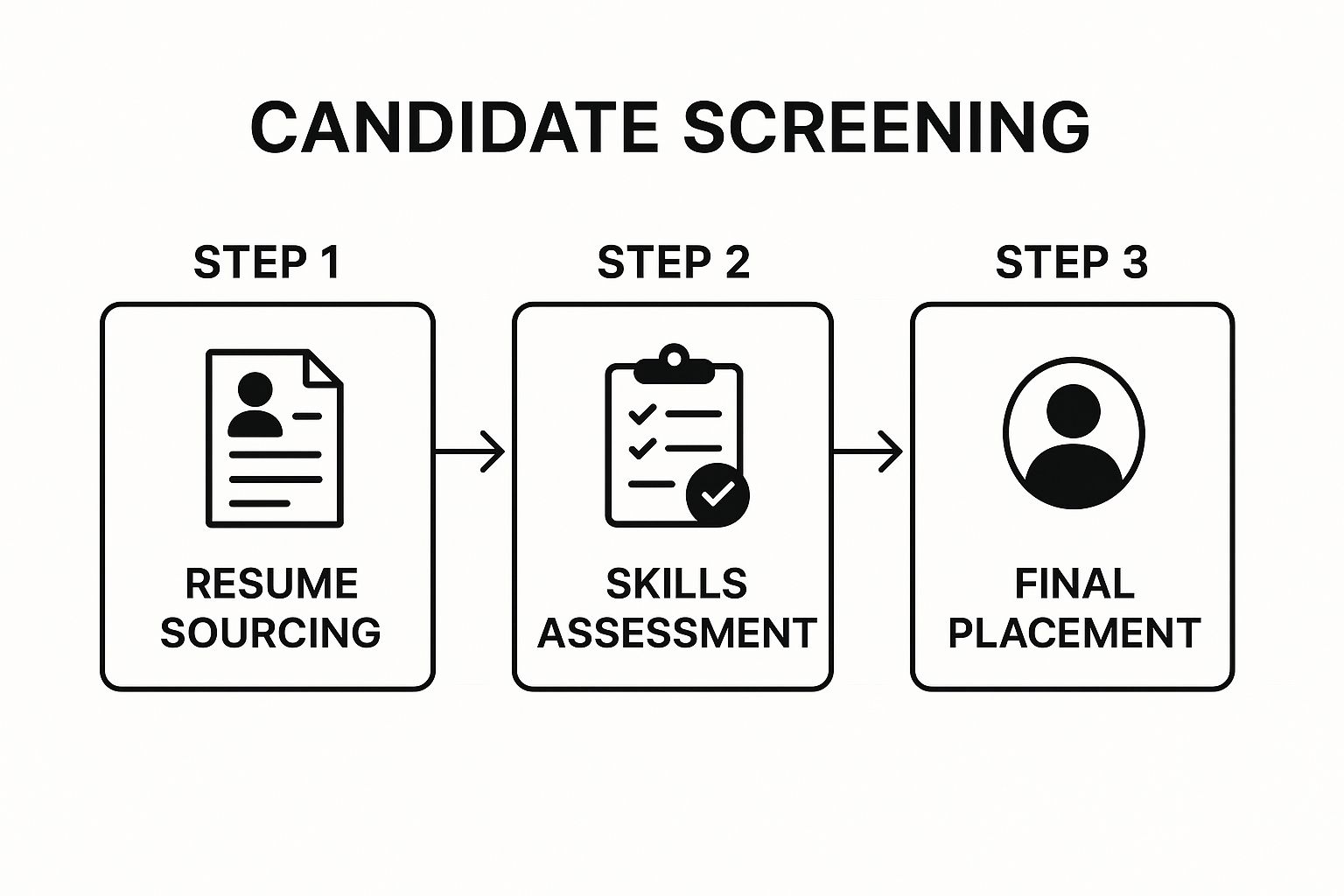
As you can see, finding the person is just the beginning. The real work—the part that protects you—happens long before that candidate's profile ever lands in your inbox.
To help you get granular with your evaluation, use this checklist to probe how seriously an agency takes its vetting responsibilities.
Agency Vetting Process Checklist
Vetting Area | What to Ask or Look For | Why It Matters in Oil & Gas |
|---|---|---|
Technical Screening | Do they use in-house technical experts for interviews? Can they provide examples of technical questions they ask for a specific role? | Ensures candidates have genuine, practical skills, not just theoretical knowledge. Crucial for high-risk operational roles. |
Reference Checks | Do they conduct detailed, role-specific reference checks or just confirm dates of employment? Do they speak to direct supervisors? | Uncovers insights into performance, teamwork, and on-the-job safety behaviour that a CV will never show. |
Safety Record Verification | How do they investigate a candidate’s personal safety record? Do they ask behavioural questions about safety culture? | A candidate’s attitude towards safety is as important as their technical skill. This helps weed out those with a poor track record. |
Cultural Fit Assessment | What’s their method for assessing if a candidate will fit your company’s culture and the specific team they’ll join? | A technically brilliant person who disrupts a team can be a net negative. This ensures a smoother, more productive integration. |
Going through these points will quickly reveal whether an agency understands the nuances of our industry or is just a generic recruitment firm trying to play in the oil and gas space.
Don't Just Trust, Verify: Checking Critical Certifications
Beyond technical skill, safety certifications are the absolute baseline. Any agency worth its salt must have a bulletproof system for verifying these mandatory tickets. This is a deal-breaker.
A great agency won't just take a candidate's word that they have a valid BOSIET or MIST. They'll have a formal process to check the certificate's authenticity and, just as importantly, its expiry date. This simple diligence is what stands between you and a major compliance headache.
When you're vetting an agency, ask to see their compliance checklist. You need to see proof that they systematically verify credentials like:
Offshore Survival: BOSIET (Basic Offshore Safety Induction and Emergency Training) and FOET (Further Offshore Emergency Training).
Medical Fitness: Up-to-date OGUK (Oil & Gas UK) medical certificates.
Trade-Specific Skills: CompEx for anyone working with electrical systems in hazardous zones, or specific NDT (Non-Destructive Testing) qualifications.
How thoroughly they handle this paperwork tells you everything about their understanding of the industry's high stakes. If they seem casual about it or treat it like a simple box-ticking exercise, that’s a massive red flag. You need a partner whose commitment to safety is as serious as your own.
A Look at the UK's Current Oil Recruitment Market

Before you can hire effectively in the UK's oil and gas sector, you need to get your head around what’s happening on the ground. The market right now is a real mix. On one hand, you have companies hiring permanent staff for long-term growth, but on the other, there’s a huge reliance on contractors to handle the ebb and flow of project work.
This split is the defining feature of the industry. Permanent roles are typically for leadership or core operations—the people who provide stability. In contrast, you see a surge in contract positions for rig technicians, project engineers, and managers whenever new offshore work kicks off. Getting this balance right is crucial when you partner with recruitment agencies in the oil industry, as it directly impacts the talent available and how they find it. For a deeper dive, our https://www.talentpeople.co/post/uk-oil-and-gas-recruitment-guide is a great resource.
The Permanent vs Contract Tug-of-War
Choosing between a permanent hire and a contractor isn't just a numbers game. It's a strategic decision that hinges on your project timelines and overall confidence in the market. Permanent staff offer stability and become custodians of your company’s knowledge, which is priceless on complex, multi-year projects.
But the contract market gives you something just as valuable: agility. When a new exploration phase starts or a major shutdown is on the horizon, you need specialist skills, and you need them fast. We've seen a noticeable 10% year-on-year jump in contract placements for technical roles since the post-pandemic ramp-up. It’s a clear reflection of the industry's project-driven nature, where being able to adapt quickly is everything.
One of the biggest jobs for a recruiter is managing expectations. The ideal candidate for a six-month contract has a completely different mindset and career drive than someone looking to put down roots. A good agency gets that and knows how to speak to both.
Tackling the Ongoing Skills Shortage
It’s no secret the UK oil sector is struggling with skills shortages in a few key areas. This isn’t a new headline, but an ageing workforce and fierce competition from the renewables industry have certainly made things tougher.
You’ll feel the pinch most when looking for:
Geoscientists and Reservoir Engineers: Finding this level of deep, specialised expertise is a real challenge.
Data and Digital Experts: As the industry gets smarter, people who can make sense of subsurface data or use AI to streamline operations are worth their weight in gold.
Subsea and Decommissioning Specialists: These are niche skills that are learned on the job, not in a textbook.
The best recruitment agencies in the oil industry are getting creative to solve this. They aren't just sifting through CVs of active jobseekers. They're mapping talent in related sectors, building bridges with universities to get in front of new graduates, and tapping into global networks to bring international experts to the UK. This kind of forward-thinking is the only way to fill the roles that will define the industry's future. Knowing where the gaps are helps you set realistic hiring timelines and put together an offer that people will actually want.
Building a Strategic Partnership with Your Agency
Signing on the dotted line with one of the top recruitment agencies in the oil industry isn't the finish line—it’s the start. The real magic happens when you stop seeing them as just another supplier and start building a proper strategic partnership. This is how you shift the relationship from a simple transaction to a powerful alliance, where your recruiter truly becomes an extension of your own team.
It all starts with that first briefing. A standard job description just won’t cut it. To get the best out of your agency, you need to give them the full story. Talk them through the project's strategic goals, the specific problems this new hire is meant to fix, and where you see the team heading in the long run. This context is gold; it’s what helps them find someone who not only has the right skills on paper but also the right mindset to really succeed.
Establishing Productive Communication Rhythms
Any good partnership is built on clear, consistent communication. Right from the get-go, you should sit down with your agency and agree on a regular schedule for updates and feedback. This isn't about micromanaging them; it's about creating a smooth, efficient loop that keeps the search moving forward.
Figure out a format and frequency that suits everyone. This could be something like:
A quick weekly call to run through the candidate pipeline and discuss what they're hearing from the market.
Using a shared document to track CVs and where each candidate is in the interview process.
A firm agreement to provide detailed feedback within 48 hours of an interview.
Having this structure in place stops things from stalling. It also ensures the agency gets the specific, actionable feedback they need to fine-tune their search. A vague "not the right fit" doesn't help anyone. What you need to provide are concrete details, like, "This candidate's experience was too heavily weighted towards downstream refining, and we really need someone with hands-on upstream exploration expertise." That kind of detail makes all the difference.
Creating a Collaborative Feedback Culture
When you treat your recruitment agency like a true partner, you bring them deeper into the fold. Every piece of constructive feedback you share isn't just about rejecting a candidate; it's about teaching your recruiter the subtle, hard-to-define nuances of what you’re looking for. This collaborative give-and-take helps them zero in on the perfect fit with every CV they send over.
Think about it—your agency is your eyes and ears on the ground. They're constantly gathering market intelligence on everything from salary expectations and what your competitors are up to, to which skills are currently in short supply. This is incredibly valuable information you can use to sharpen your own strategy.
By giving transparent feedback and setting crystal-clear expectations, you empower your agency to become a proactive talent advisor. They’ll start to anticipate your needs, offer insights on team structure, and even spot future leaders before you’ve even thought about creating a vacancy.
At the end of the day, a strong partnership means both parties are fully invested in the same goal. When you move past a simple transactional mindset, you gain a dedicated ally committed to helping you succeed in the long term. If you're new to this way of working, our guide to the outsourced recruitment process is a great place to start.
Your Questions About Oil Industry Recruiters, Answered
Even after you've decided to work with a specialist recruitment agency, a few questions will likely pop up. Sorting out the details – everything from how they get paid to how long things will take – is the key to making the whole process work smoothly.
Let's clear up some of the most common queries. Getting these things straight from day one means you and your agency are on the same page, preventing any nasty surprises later on.
How Do Recruitment Agency Fees Work?
In the oil and gas world, most agencies work on a contingency model. It's simple: you only pay their fee if you actually hire a candidate they've put forward. This is great for you because it’s a no-win, no-fee arrangement, which keeps your financial risk right down.
For those harder-to-fill senior or highly specialised roles, you might come across a retained search. This is where you pay a portion of the fee upfront. It essentially books the agency's dedicated time and resources to focus solely on finding that one perfect person for your critical vacancy.
A typical contingency fee in the UK oil and gas sector will land somewhere between 15% and 25% of the candidate’s first-year salary. This figure can creep up or down depending on how senior the role is and how rare the required skill set is.
Whatever you agree, get it in writing before they start looking. The agreement should clearly state the fee, payment terms, and any guarantee period – a crucial clause that protects you if the new hire decides to leave after a few months.
What’s a Realistic Timeline for Filling a Role?
This is the million-dollar question, and honestly, there's no single answer. The time it takes to find the right person can vary wildly.
You might fill a straightforward contract role, like a project administrator, in a couple of weeks. But if you’re hunting for a permanent Lead Subsea Engineer with very specific North Sea experience, you should be prepared for it to take several months.
The timeline really hinges on a few things:
Skill Scarcity: If you need a niche skill set, the talent pool is smaller, and the search will naturally take longer.
Candidate Location: Looking for talent globally? You'll need to factor in visas and relocation, which adds time and complexity.
Your Interview Process: A slow, clunky internal process can kill momentum. The quicker you can review CVs and schedule interviews, the better.
Notice Periods: Don't forget that top candidates, especially in senior roles, often have to serve notice periods of three months or more.
A good recruiter won’t just tell you what you want to hear. They’ll give you an honest, realistic timeline based on the market, not a wildly optimistic promise they can’t keep.
Can Agencies Help with Both Permanent and Contract Roles?
Absolutely. Most specialist recruitment agencies in the oil industry are set up to handle both. They get that the industry is very project-driven, so companies need a mix of permanent staff and flexible contractors.
You'll often find that agencies have consultants or even whole teams who focus on one or the other. This means you get a true specialist who has the right network, whether you need a permanent Head of Operations or a dozen contract welders for a six-month shutdown. Their ability to handle both makes them a fantastic partner for the long haul.
At Talent People, we build the high-performing teams that drive success in the oil and gas sector. Whether you need an embedded talent partner or a full-cycle project hiring solution, we deliver the expertise to help you scale effectively. Discover our agile, project-based hiring solutions at https://talentpeople.co.

Comments