Your Guide to the RPO Recruitment Process
- Talent People

- Sep 9, 2025
- 13 min read
When you bring on a Recruitment Process Outsourcing (RPO) partner, you’re not just hiring a vendor. You’re embedding a team of recruiting experts right into the heart of your business. It's a true partnership that handles everything from the big-picture workforce planning and hunting for top talent to smooth onboarding and crunching the numbers to see what’s working. They really do become an extension of your own team.
What a Modern RPO Recruitment Process Actually Looks Like

Let's cut through the jargon for a moment. A modern RPO recruitment process isn't just about handing over your hiring to someone else; it’s about weaving a strategic talent partner into your company's fabric. This is where it really differs from traditional agency recruiting, as an RPO partner manages the entire talent journey from start to finish.
Think about it: a standard recruiter fills a job and moves on. An RPO provider, on the other hand, is in it for the long haul. They’re accountable for the results, managing everything from writing job descriptions that actually attract the right people to building a pipeline of great candidates for roles that don't even exist yet.
This joined-up approach is vital here in the UK, where the recruitment industry is a massive £44.4 billion contributor to the economy. With 65% of UK employers saying skills shortages are their biggest headache, it’s no surprise that nearly half are looking to RPO providers for a more lasting solution.
More Than Just Filling Seats
A great RPO partner takes on the role of brand guardian. They make sure every single candidate—whether they get the job or not—has a positive, professional experience. This is absolutely critical for building a strong reputation, especially in competitive fields like tech or renewable energy.
The whole thing is built on close collaboration and shared goals. The core components usually involve:
Strategic Workforce Planning: Looking at your current team and where the business is heading to predict hiring needs before they become a fire drill.
End-to-End Management: Taking care of every single stage, from sourcing and screening to making the offer and welcoming new starters, ensuring it's a slick experience for everyone.
Data-Driven Insights: Using real data to track crucial metrics like time-to-hire, cost-per-hire, and quality-of-hire, which helps to constantly fine-tune the strategy.
A true RPO partnership is proactive, not reactive. You stop just filling empty chairs and start building a talent ecosystem that supports real, long-term growth and makes the business stronger.
The RPO process is a structured journey. Here’s a quick look at the main stages you can expect when you partner with a provider.
Core Stages of the RPO Recruitment Process
Stage | Objective | Key Activities |
|---|---|---|
1. Discovery & Planning | To align on business goals, culture, and hiring needs. | Workshops, stakeholder interviews, process mapping, defining KPIs. |
2. Sourcing & Attraction | To build a pipeline of qualified, engaged candidates. | Multi-channel sourcing, employer branding campaigns, talent pooling. |
3. Screening & Assessment | To identify the best-fit candidates for the role and culture. | CV screening, competency-based interviews, technical assessments. |
4. Offer & Onboarding | To secure the top candidate and ensure a smooth transition. | Offer management, background checks, pre-boarding communication. |
5. Analytics & Optimisation | To measure success and continuously improve the process. | Reporting on KPIs, regular review meetings, feedback loops. |
Each phase is designed to build on the last, creating a seamless and effective hiring machine that delivers tangible results.
A True Extension of Your Team
The best RPO relationships don't feel like a supplier service; they feel like an in-house team. The provider’s recruiters will often use your company email addresses and get fully immersed in your culture. This is so important because it ensures candidates feel like they're talking directly to your company, keeping your brand front and centre.
This tight alignment is what makes the RPO model so effective. You get the specialist skills and fancy tools of an external partner combined with the insider knowledge and cultural fit of your own team. For a closer look, you can get more detail on how Recruitment Process Outsourcing works in our detailed guide. It's a powerful mix built to solve tough hiring problems and deliver results you can actually measure.
Finding the Right RPO Partner for Your Business

Choosing an RPO provider is probably the single most important decision you'll make in the entire rpo recruitment process. Getting this right lays the groundwork for success. A mismatch, on the other hand, can quickly lead to frustration and missed targets. Forget generic checklists—what you need is a practical way to properly vet potential partners.
A great RPO partnership is about so much more than just filling roles. You’re looking for a team that gets the unique pressures of your industry, whether that’s mobilising a renewables project in a new region or scaling a specialist tech team. This is where you have to dig deeper than their sales pitch.
Assessing Industry-Specific Expertise
Your first filter should always be their experience in your sector. A provider with a stellar track record in finance will almost certainly struggle to find niche engineering talent for the energy sector. Their network, their language, and their understanding of what makes a role critical simply won't be there.
The UK RPO market has plenty of providers, so finding one that fits your niche is crucial. To find a provider with genuine industry specialisation, you need to ask the right questions during those initial calls.
Go beyond the basics and get specific:
"Talk me through a time you filled a role similar to our Lead Geotechnical Engineer."
"How do you actually build talent pipelines for high-demand digital skills?"
"From your perspective, what are the biggest hiring challenges in the renewables sector right now?"
Vague answers are a massive red flag. They tell you the provider doesn't have real, hands-on experience in your world.
A partner who speaks your industry's language will grasp complexities faster, anticipate challenges, and ultimately find candidates who are a better technical and cultural fit for your business.
Evaluating Their Technology and Tools
The right tech can make a world of difference in modern recruitment. You need to get a clear picture of the tools a potential partner uses and, more importantly, how they use them. Don't get distracted by buzzwords; focus on how their technology will actually help you.
Take a good look at their tech stack. I'd recommend asking specifically about these three areas:
Applicant Tracking System (ATS): Do they have their own, or can they plug seamlessly into yours? A clunky integration creates data headaches and slows everything down.
Sourcing Tools: What platforms are they using beyond LinkedIn? Ask them about their access to specialist job boards, professional networks, and any AI-powered sourcing bots they rely on.
Analytics and Reporting: How will you see what’s going on? Ask to see sample dashboards or reports so you can understand how they track progress against key metrics like time-to-fill and source-of-hire.
This isn’t just about having the flashiest software. It’s about finding a partner who uses technology to make the hiring process smarter and more efficient, a key part of any solid https://www.talentpeople.co/post/master-your-talent-acquisition-strategy-today.
Gauging Cultural Fit and Collaboration
Finally, never forget that this is a partnership. The provider’s team will become an extension of your own. They'll be interacting with your hiring managers and representing your brand to every single candidate. For that reason, cultural alignment is completely non-negotiable.
Pay close attention to their communication style. Are they actively listening to your needs, or are they just trying to sell you their standard package? A true partner will be curious, ask insightful questions, and might even challenge your assumptions—respectfully, of course.
Ultimately, they should feel less like a vendor and more like a strategic advisor who is genuinely invested in helping you achieve your goals.
Crafting Your Recruitment Blueprint Together

A truly effective RPO strategy isn't something you can just pick off a shelf. The real magic happens when you and your new partner roll up your sleeves and co-create a recruitment plan that's moulded specifically to your business goals and challenges. This is the bedrock of the entire RPO recruitment process.
This initial discovery phase is where the relationship shifts. Your RPO provider stops being just a vendor and starts acting like a genuine extension of your team. To do that, they need to get under the skin of your organisation to figure out what makes it tick—and that goes far beyond a quick glance at a job description.
What Does a 'Win' Actually Look Like?
Before a single candidate is contacted, you and your RPO partner need to be on the exact same page about what a successful hire means for your business. This isn't just about finding someone with the right CV.
It means sitting down together for deep-dive sessions to build detailed candidate personas. These capture the essential skills and experience, of course, but just as importantly, they map out the soft skills and cultural traits someone needs to truly thrive in your environment.
This alignment is also crucial for defining the metrics that will prove the partnership is working. These aren't just vanity numbers; they are the signposts that show you’re making a real business impact.
Key metrics you should lock down from day one include:
Time-to-Hire: How long does it take from opening a job to getting an offer accepted? This tells you if you’re moving fast enough to secure top talent.
Quality-of-Hire: This is the big one. It's often measured by looking at performance reviews or retention rates after 6-12 months. Are your new hires actually performing and sticking around?
Cost-per-Hire: A straightforward calculation of the total investment to get someone on board, which helps you manage your budget and prove ROI.
I can't stress this enough: the blueprinting stage is probably the most important part of the whole process. It turns vague hiring wishes into a concrete, measurable action plan that keeps everyone accountable.
Setting Clear Expectations with Service-Level Agreements (SLAs)
Once your goals and metrics are clear, it's time to translate them into a practical working agreement. This is where Service-Level Agreements (SLAs) come into play. And don't think of these as dense legal documents. A good SLA is a simple, clear guide that sets the rules of engagement for day-to-day work.
For instance, your SLA might state that your RPO partner will deliver a qualified shortlist of candidates within 10 working days of a new role going live. Or it could set out communication standards, like a mandatory weekly progress call with hiring managers and a monthly performance review with leadership.
These agreements take all the guesswork out of the process. Everyone involved—from your own managers to the RPO recruiters—knows exactly what’s expected of them and when. That clarity is what prevents frustration down the line and builds the foundation of trust for a great long-term partnership.
With your recruitment blueprint finalised, it's time to roll up our sleeves and get to work. This is where a solid RPO recruitment process moves from paper to practice, turning those strategic goals into actual hires. We’re moving beyond just posting a job and hoping for the best.
An expert RPO partner fires up a multi-channel sourcing strategy to find the best talent, not just the most available. This means diving deep into their own massive databases, tapping into exclusive professional networks, and launching targeted social media campaigns to catch the eye of passive candidates—the ones who aren't even looking but are a perfect fit for your roles.
Using Technology to Find the Right People
Technology is the engine that drives an efficient and effective search. In the UK, the RPO market is constantly being reshaped by new tech, with Artificial Intelligence (AI) now central to automating the more repetitive tasks. Think screening CVs by the hundred, handling initial candidate messages, and scheduling interviews. This frees up recruiters to do what they do best: build real relationships with the top contenders.
For a deeper dive into these trends, check out the future of recruitment outsourcing on ansrpo.com.
This tech-first approach doesn't just cast a wider net; it brings a new level of precision. Smart tools can pinpoint candidates with niche skills that a manual search would almost certainly miss, giving your business a real advantage in a competitive market.
To give you a better idea of how these different channels stack up, let's look at a quick comparison.
RPO Sourcing Channels Effectiveness Comparison
Sourcing Channel | Typical Speed | Cost-Effectiveness | Best For |
|---|---|---|---|
RPO Provider's Database | Very Fast | High | Filling common roles quickly with pre-vetted talent. |
Professional Networks (e.g., LinkedIn) | Moderate | Moderate to High | Targeting specific industries and senior-level positions. |
Job Boards | Fast | Varies | Attracting a high volume of active job seekers for entry-to-mid-level roles. |
Social Media Campaigns | Moderate | High | Engaging passive candidates and building brand awareness. |
Referral Programmes | Slow to Moderate | Very High | Finding high-quality, culturally-aligned candidates. |
As you can see, a blended approach is almost always the most effective strategy, using the right channel for the right role.
Protecting and Promoting Your Employer Brand
Every single message, email, and phone call a candidate receives from your company shapes how they see your brand. A great RPO partner gets this. They act as a true ambassador for your business throughout the entire hiring journey, making sure every interaction is professional, on-time, and positive.
From the first outreach message to the final feedback call, the candidate experience is carefully managed. This is absolutely critical. Why? Because a positive experience can turn someone you didn't hire into a future applicant or even a vocal supporter of your brand. A bad one, on the other hand, can seriously damage your reputation.
A seamless candidate experience isn't just a "nice-to-have"; it's a strategic necessity. It keeps your top choices engaged and reinforces your reputation as an employer of choice, even for those you don't hire.
This infographic really highlights the key metrics a well-run RPO partnership can move the needle on.
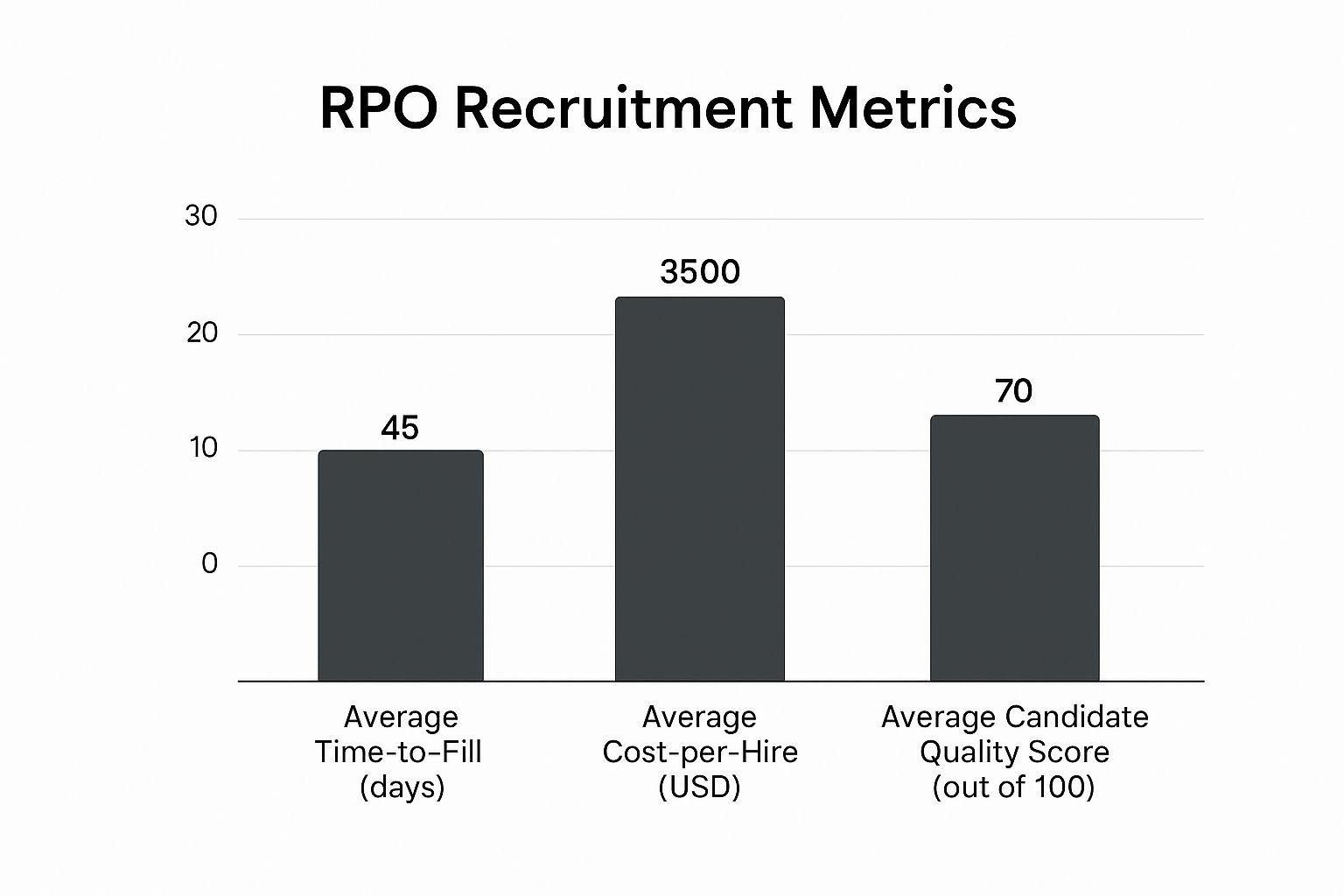
The numbers speak for themselves. A focused RPO process leads to major improvements in efficiency and quality across the board. The end goal is simple: a faster, more cost-effective process that consistently delivers better hires who are ready to succeed from day one.
How to Measure and Improve RPO Performance
Securing top talent is a massive win, but the job isn't done once an offer is signed. The real, long-term value of an RPO partnership comes from constantly sharpening your strategy with data. This is the point where the relationship evolves from just filling roles to building a genuinely intelligent hiring function for your business.
Your RPO partner should be a goldmine of information. The trick is to look past simple metrics like the sheer number of hires. Instead, you need to focus on analytics that paint a complete picture of your entire hiring funnel, digging into the numbers to see what's really happening at each stage.
This approach lets you answer critical business questions and pinpoint exactly where you can get better.
Using Data to Understand Your Hiring Funnel
Your RPO partner's analytics should help you map out the entire candidate journey. A great starting point is to ask for data that clarifies the effectiveness of your sources. Are your best candidates coming from LinkedIn, specialist job boards, or direct outreach? Knowing this helps you double down on the channels that deliver real results and pull back on those that don’t.
From there, zoom in on the conversion rates between each stage:
Application-to-Interview Ratio: How many applications does it take to find one person worth interviewing? A low ratio might mean your job descriptions aren't hitting the mark.
Interview-to-Offer Ratio: Are you consistently losing great people after they’ve interviewed? This could point to a clunky interview process or compensation that’s out of sync with the market.
Offer-Acceptance Rate: A low acceptance rate is a huge red flag. It often means your offers aren't competitive enough or that the candidate experience simply isn't compelling.
By digging into these funnel metrics, you stop guessing and start making informed decisions. You can spot bottlenecks before they become serious problems, ensuring your RPO recruitment process is always getting more efficient.
Driving Improvement Through Regular Reviews
Data is only useful if you actually do something with it. That’s why structured quarterly business reviews (QBRs) with your RPO partner are absolutely essential. Think of these meetings as your dedicated time to review performance against the KPIs you both agreed upon in your initial blueprint.
Don't just show up to look at spreadsheets. Come prepared to discuss not just what happened, but why it happened. For instance, if your time-to-hire has crept up, is it because the market has gotten tougher, or are internal delays in scheduling interviews the real culprit? For more on this, check out our guide on making **smarter hiring decisions with recruitment data analysis**.
These reviews create a powerful feedback loop. They provide a regular forum to tackle challenges, celebrate what's working, and adapt your strategy to shifting business needs or market conditions. This cycle of continuous improvement is what transforms an RPO partnership from a simple service into a strategic asset that fuels your company's growth.
Got Questions About RPO? Let's Clear Things Up
Stepping into a new partnership always brings up questions. The recruitment world is full of its own lingo and different ways of doing things, so let’s tackle some of the most common queries we hear from business leaders about the RPO recruitment process.
The idea here is to give you honest, straightforward answers to help you figure out if this is the right move for your company.
How Is RPO Different From Using a Staffing Agency?
This is easily the question we get asked most, and it’s a crucial one. The difference is fundamental. A staffing agency is purely transactional—they find someone to fill an open role, and their work is done. An RPO provider, on the other hand, is a strategic partner. They take ownership of your entire recruitment function, or a big piece of it.
Here’s a simple way to think about it: a staffing agency sells you a spare part for your machine. An RPO partner helps you design, build, and run the entire production line. They become an extension of your own team, woven into your business to manage everything from sourcing and interviewing to onboarding and making the process better over time.
A staffing agency fills an immediate gap. An RPO partnership is about building a sustainable talent engine for the long haul.
Can We Still Keep Our In-House HR Team?
Of course! In fact, the most successful RPO relationships are built on a strong collaboration with your existing HR and talent teams. An RPO provider doesn't replace them; they become a specialised extension, bringing in extra firepower, tech, and market insights your team can tap into.
This frees up your internal HR experts to concentrate on the bigger picture—things like company culture, employee relations, and professional development. Meanwhile, your RPO partner handles the heavy lifting of day-to-day recruiting. It's a powerful one-two punch where everyone gets to play to their strengths.
What Does an RPO Partnership Typically Cost?
There's no one-size-fits-all price tag for RPO, and that’s actually one of its biggest advantages. The cost is almost always shaped around what you actually need. Most pricing falls into one of these buckets:
Management Fee: A predictable, fixed monthly cost. This is ideal if you have consistent hiring needs and want to keep your budget steady.
Pay-for-Performance: You only pay a fee for each successful hire. This model ties cost directly to results and is incredibly flexible.
Blended Model: A popular hybrid approach. It usually involves a small monthly management fee plus performance-based fees, giving you a nice balance of stability and scalability.
The right model really depends on your hiring volume, how complex the roles are, and what you’re trying to achieve. Any good provider will sit down with you to work out a structure that makes financial sense and delivers a clear return.
How Scalable Is an RPO Solution?
Flexibility is at the heart of the RPO model. It’s designed to expand and contract right alongside your business. If you suddenly land a massive project or decide to enter a new market, your provider can ramp up resources almost immediately to meet the hiring demand.
On the flip side, if things slow down, you can scale back without being saddled with the costs of a large, permanent recruitment team. This kind of agility means you can react to market shifts without missing a beat, ensuring your hiring capacity always aligns with your business needs. It’s this efficiency that helps RPO reduce cost-per-hire by over 20% and slash time-to-hire by up to 55%.
Ready to build a high-performing team with a recruitment strategy that delivers real results? Talent People designs agile, project-based hiring solutions for complex and competitive markets. Let's discuss how we can accelerate your growth. Find out more at https://talentpeople.co.

Comments