Project Controls Manager: Roles, Skills & Career Guide
- Talent People

- Sep 11, 2025
- 16 min read
Think of a project controls manager as the project's central nervous system. They’re the ones making sure all the moving parts are communicating and working together as they should. While the project manager is at the helm steering the ship, the project controls manager is in the control room, providing the critical data and foresight needed to stay on course, on time, and within budget. Their role is all about seeing what's coming, not just reacting to what’s already happened.
What a Project Controls Manager Actually Does

Let’s use an analogy. Imagine a huge, complex construction project. The project manager is the site foreman, making decisions on the ground and leading the crew. The project controls manager, on the other hand, is the one back at HQ, surrounded by dashboards, charts, and performance data. They're constantly analysing progress, costs, and timelines against the master plan.
Their main job is to offer a completely objective, data-backed picture of how the project is really doing. This isn't just about logging what’s been done. It's about using today’s performance data to accurately predict where the project will be tomorrow, next week, and next month. They're there to answer the tough questions that prevent a project from going off the rails.
A Focus on Forecasting and Foresight
A project controls manager brings a specific set of disciplines to the table to maintain order and predictability. Instead of waiting for a budget alert to flash red, they’re analysing spending trends to see a potential overspend coming months down the line. That early warning gives the project manager a crucial window to make adjustments, whether that means reallocating resources or refining the project scope.
Their day-to-day work is built around a few key pillars:
Cost Control: They keep a close eye on all expenses, tracking them against the budget and forecasting the final cost at completion.
Schedule Management: They constantly analyse the project timeline, flagging potential delays and figuring out the knock-on effect of any changes.
Risk Analysis: They’re always on the lookout for potential threats to the schedule or budget, helping the team create solid plans to deal with them.
Change Management: They put strict processes in place to ensure any proposed change is properly costed and timed before it gets the green light.
The real magic of a project controls manager is their ability to turn raw project data into actionable intelligence. They connect the dots between cost, schedule, and risk, allowing leaders to make decisions based on evidence, not just educated guesses.
This proactive approach is what makes the role so valuable. They don't just report that the project is 10% over budget. They deliver an analysis explaining why it's over budget and forecast that if nothing changes, it's on track to finish 25% over budget. That completely changes the conversation from finger-pointing to finding solutions.
At the end of the day, the project controls manager is the guardian of the project’s original plan—its baseline. By setting up robust systems for tracking performance and managing change, they make sure every decision is weighed against its impact on the project's core objectives: finishing on time, on budget, and to the right standard.
So, what does a Project Controls Manager actually do day-to-day? Let's move past the high-level job description and get into the real work.
Their role is a fascinating mix of sharp data analysis, smart forecasting, and clear communication, all aimed at one thing: keeping the project healthy. They aren't just watching from the sidelines; they are the active guardians of a project's baseline, making sure every decision is weighed against its impact on time, money, and scope.
All the responsibilities of a Project Controls Manager are linked, creating a complete system that gives everyone a clear, honest view of how the project is performing. This is what keeps everything on track.
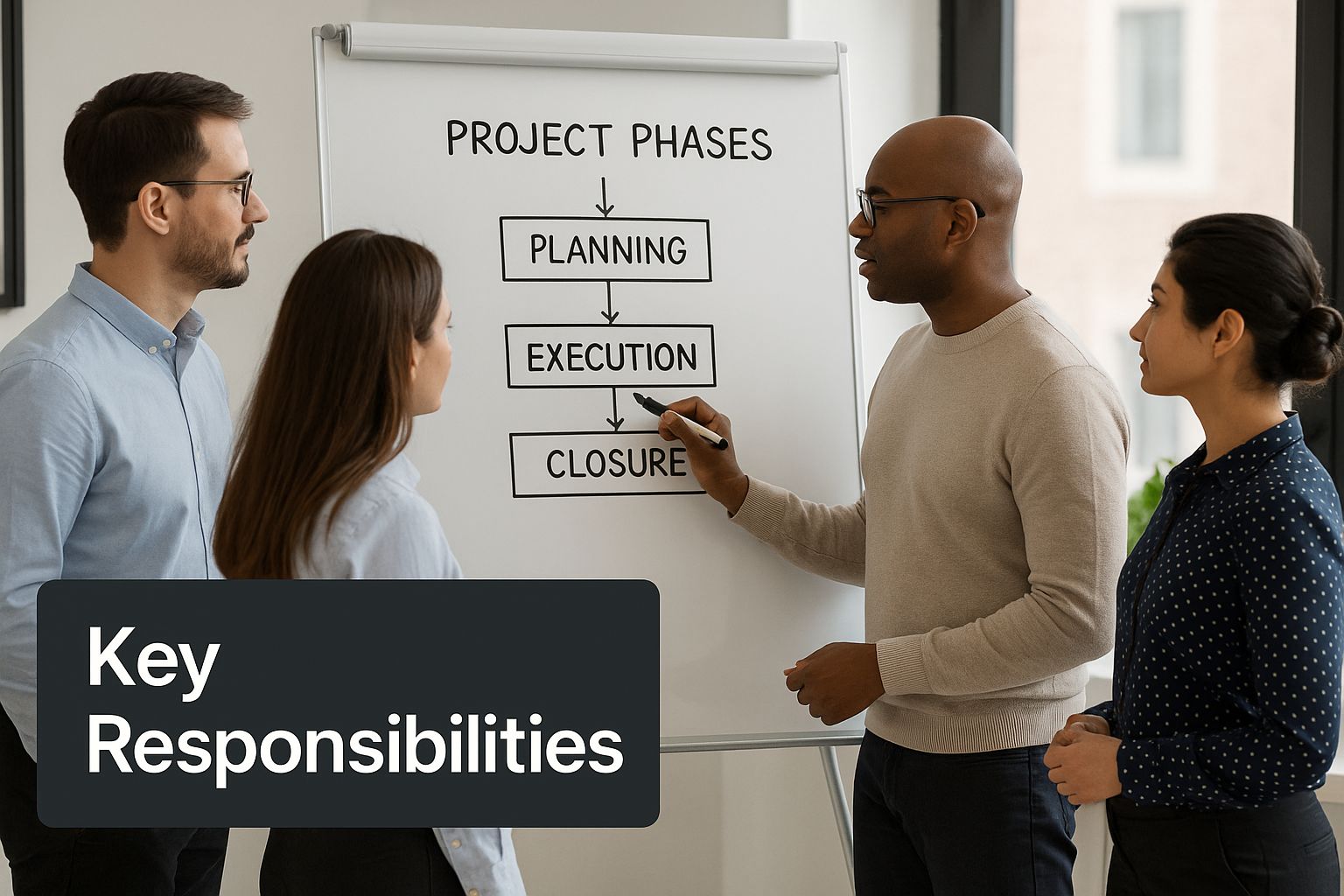
To really understand what a Project Controls Manager brings to the table, it helps to break down their main duties. The table below gives a snapshot of their primary functions and the specific actions they take to keep a project on the straight and narrow.
A Project Controls Manager's Primary Functions
Core Function | Key Activities and Objectives |
|---|---|
Cost Management | Develops budgets, tracks actual spend, forecasts final costs, and analyses variances. |
Schedule Management | Creates and maintains the project schedule, monitors progress, and identifies critical path activities. |
Change Control | Establishes a formal process to evaluate, approve, and document any changes to the project. |
Risk Management | Identifies potential threats, assesses their impact, and develops plans to mitigate them. |
Reporting | Creates detailed performance reports for stakeholders, translating complex data into clear insights. |
Each of these functions is a critical piece of the puzzle. Without any one of them, the project's foundation becomes unstable, making success much harder to achieve.
Getting to Grips with Cost and Schedule
At the very heart of project controls is the mastery of two things: cost and schedule. A good Project Controls Manager doesn’t just track what’s been spent. They carry out rigorous cost forecasting.
They use proven techniques like Earned Value Management (EVM) to figure out the true value of the work done compared to the money spent. This is how they can predict the final project cost with impressive accuracy, turning a mountain of data into a clear financial forecast.
For example, say a project has burned through 50% of its budget but has only finished 40% of the planned work. The Project Controls Manager spots this immediately. They then use EVM to calculate the project’s performance and forecast the likely budget overrun if things don’t change. This early warning gives the Project Manager time to take corrective action before it’s too late.
In the same way, schedule management is much more than just watching dates on a calendar. It requires a deep understanding of the project’s critical path—that specific sequence of tasks that dictates the project's finish date.
The Project Controls Manager meticulously analyses this path to find any activities with zero wiggle room. They know that a one-day delay on a critical task means a one-day delay for the whole project, which can have massive financial knock-on effects.
By keeping a close eye on this, they stop small hiccups from turning into major delays, keeping the project timeline realistic and achievable.
Keeping a Lid on Change and Risk
Projects are living things; change is guaranteed to happen. But uncontrolled change is one of the fastest ways to derail a project. That’s why a Project Controls Manager sets up and enforces a formal change control process.
This system makes sure that every single request to change the project’s scope, schedule, or budget is properly assessed, documented, and approved before anyone starts work on it.
Think about a stakeholder asking for a new feature during a software build. Without proper controls, the team might just agree to it, leading to unbudgeted costs and surprise delays. With a Project Controls Manager in place, that request is logged, its impact is analysed, and a formal change order is created for approval. This simple discipline is what prevents managing project scope creep, a notorious project killer.
Finally, at their core, a Project Controls Manager is a risk analyst. Their job involves:
Spotting potential risks that could throw the project off course, from supply chain problems to a key team member leaving.
Figuring out the probability and impact of each risk, so the team can focus on the biggest threats first.
Creating solid mitigation plans to reduce the chance of these risks happening or to lessen their impact if they do.
This proactive approach to risk management changes the game. Instead of being firefighters who are always reacting to problems, the team becomes strategic planners who have already thought about what could go wrong and have a plan ready. It's this combination of controlling cost, schedule, change, and risk that provides the solid framework needed to deliver complex projects successfully.
Essential Skills for a Thriving Career in Project Controls
To really succeed as a project controls manager (PCM), you need to be more than just a numbers person. The best in the business have a unique blend of deep technical know-how and sharp people skills. This mix allows them not only to crunch complex data but also to influence big decisions and steer the entire project team towards the finish line.
You really have to wear two hats. One moment, you’re the meticulous analyst, deep in the weeds of a project schedule or a cost report. The next, you’re a skilled diplomat, translating those technical details into a clear, compelling story that senior leaders and stakeholders can get behind.
Mastering the Technical Toolkit
At its heart, project controls is a data-driven world. A great project controls manager must have a firm grip on the specialised tools and methods that turn raw project data into genuinely useful insights. These technical skills aren't just a nice-to-have; they’re the foundation of your credibility.
Without this fluency, a PCM simply can't do their main job: providing accurate, reliable forecasts. It’s what separates someone who just tracks numbers from a true strategic advisor who can see trouble coming and help the project sidestep it.
Key technical skills include:
Proficiency with Project Management Software: You have to be fluent in industry-standard tools like Primavera P6, Microsoft Project, and Asta Powerproject for detailed scheduling and resource planning.
Advanced Data Analysis: Being able to use tools like Power BI and advanced Excel functions is crucial. This is how you spot trends, analyse performance, and build dashboards that actually mean something.
Cost Management Systems: You’ll need a solid understanding of cost engineering principles and experience with ERP systems to effectively track budgets, commitments, and what’s actually been spent.
Risk Analysis Software: Getting comfortable with tools for quantitative risk analysis, such as Monte Carlo simulations, is a game-changer. It helps you forecast the real-world impact of uncertainty on a project.
Think of these technical skills as your instruments; the project controls manager is the musician. Knowing how to use Primavera P6 is one thing, but knowing how to read its output to spot a looming delay on the critical path? That’s where the real value lies.
The Power of Soft Skills
While the technical stuff gets you in the door, it’s the soft skills that truly make an exceptional project controls manager. Data and reports are useless if you can't communicate them in a way that builds trust and gets people to act.
Often, a PCM acts as the bridge between the on-the-ground project team and senior management. This means you have to speak two different languages—the granular, data-heavy language of project delivery and the high-level, strategic language of business goals.
A project controls manager must be a storyteller. Their job is to take a complex spreadsheet of schedule variance data and turn it into a simple, actionable insight that an executive board can understand and act upon in minutes.
This is where influence becomes far more important than authority. A PCM rarely has direct line management over the project team, so their ability to persuade and guide is absolutely everything.
Communication and Stakeholder Management
Let’s paint a picture. Your project is forecasting a 15% budget overrun. A PCM with great technical skills but poor communication might just drop a report full of complex charts on the table, leaving everyone feeling confused and worried.
An effective project controls manager, on the other hand, handles it differently:
They simplify the message. They’ll cut through the noise with a clear statement: "Based on where we are today, we're on track to be £1.5 million over budget."
They explain the ‘why’. They’ll give a concise reason, like, "This is mainly down to unexpected rises in material costs and lower-than-planned productivity in phase two."
They propose a solution. They won’t just present the problem; they'll offer data-backed options for getting things back on track, allowing the project manager and leadership to make a smart, informed decision.
This approach transforms the PCM from a passive bearer of bad news into a proactive problem-solver. It takes strong presentation skills, the ability to really listen, and the confidence to manage expectations clearly. Ultimately, the best in this field prove that their role is as much about guiding people as it is about managing data.
Mapping Your Project Controls Manager Career Path
Becoming a project controls manager isn’t something that happens overnight. It’s a journey, a structured progression built on a solid foundation of hands-on experience and very specific knowledge. Think of it less as a starting line and more as a destination you arrive at after mastering the core disciplines of project controls from the ground up.
Each step along this path is designed to deepen your expertise. You begin by learning the "how" and "what"—the practical mechanics of project controls. Over time, you graduate to the strategic "why" that truly defines the manager's role. This steady climb ensures you have the deep, real-world understanding needed to guide complex projects with genuine confidence.
Starting Your Journey in Project Controls
Most people get their start in foundational roles, where they learn the essential nuts and bolts of monitoring and reporting. These initial jobs are the best training ground you could ask for, giving you the skills you’ll lean on for the rest of your career.
Typical entry points often include:
Project Controls Analyst or Technician: Here, you’re in the thick of it—gathering data, updating schedules, and tracking costs. You'll get to grips with the fundamentals of Earned Value Management (EVM) and become fluent in software like Primavera P6 or Microsoft Project.
Planner or Scheduler: This is a more focused starting point. Your world revolves around creating, maintaining, and analysing the project timeline. You'll become an expert in critical path methodology and learn how to skilfully model the ripple effect of any potential delays.
Cost Engineer or Analyst: In this role, you dive deep into the financial side of the project. Your days are filled with estimating costs, tracking budgets, analysing any variances, and forecasting where the final spend will land.
These roles are absolutely crucial. They provide the granular, on-the-ground experience of how project data is actually generated and handled. This hands-on knowledge is priceless later on when you need to interpret that same data and make high-level strategic calls.
Advancing to a Management Role
After a few years of sharpening your skills as an analyst, planner, or cost engineer, you’ll be ready for the next big step: a full-blown project controls manager position. This is a significant shift. You move from doing the work to overseeing it. Your focus broadens from pure data analysis to strategy, team leadership, and stakeholder communication.
A Project Controls Manager doesn't just report the numbers; they interpret them. Their real value lies in translating complex performance data into a clear story about the project's health, telling senior leadership not just where things are, but where they're heading.
The path doesn't stop there, either. Once you've proven you can manage the controls function on major projects, you can progress into senior leadership roles that have a much wider organisational impact. For a detailed look at hiring for these key positions, our guide to recruiting project managers in the UK offers valuable insights into what top companies are searching for.
Reaching Senior Leadership and Beyond
The skills you hone as a seasoned project controls manager are highly transferable to the executive level. The career ladder doesn't just stop at managing one project; it extends to overseeing entire portfolios and helping to shape the strategic direction of the whole organisation.
Further down the line, you could be looking at roles such as:
Director of Project Controls: In this position, you oversee the entire project controls function across a business unit or even the entire company. You're the one setting the standards, implementing best practices, and making sure everything runs like a well-oiled machine.
Head of the Project Management Office (PMO): This is a highly strategic role where you govern all projects within an organisation. You’d be responsible for managing the entire portfolio, allocating resources, and making sure every single project aligns with the company's biggest goals.
Throughout this journey, professional certifications can really turbo-charge your career. Earning credentials like the Association for the Advancement of Cost Engineering's (AACE) Certified Cost Professional (CCP) or the Project Management Institute's (PMI) Project Management Professional (PMP) is a powerful way to validate your expertise. It signals a serious commitment to the profession and often opens doors to more senior opportunities.
Understanding UK Salary and Market Demand
When you're looking at project controls manager roles in the UK, you need a solid grasp of what you can earn and how in-demand your skills are. Let's be clear: this isn't just another job title. It’s a vital role responsible for protecting multi-million-pound investments, and the salary reflects that level of responsibility. While pay is competitive, a few key things can really move the needle.
Unsurprisingly, your experience level is the biggest factor. Someone just starting out is still learning the ropes and building their core skills. A seasoned manager, on the other hand, walks in with a proven history of steering complex projects to success. That difference shows up directly on the payslip.
What Are the Salary Benchmarks?
To get a realistic idea of what to expect, it helps to look at the typical salary bands. Think of these as a guide rather than strict rules, but they give a strong sense of what companies are currently offering. As a project controls professional gains experience and adds more strategic value, their earnings grow accordingly.
Let's break down how salaries typically progress.
Typical UK Salary Ranges by Experience Level
Here's an overview of the annual salaries you can expect at different stages of your career as a Project Controls Manager in the UK.
Experience Level | Typical Annual Salary Range (£) |
|---|---|
Entry-Level (Analyst/Coordinator) | £35,000 – £50,000 |
Mid-Level (Project Controls Manager) | £55,000 – £75,000 |
Senior/Lead (Senior PCM/Director) | £80,000 – £100,000+ |
These figures show a clear career ladder where expertise is directly and significantly rewarded.
How Sector and Location Affect Your Pay
Beyond your years of experience, the industry you work in is a huge deal. Sectors that handle high-value, complex capital projects always pay a premium for top-tier project controls talent.
The oil and gas sector, for example, is famous for its demanding projects and, as a result, offers some of the most competitive compensation packages out there. For a closer look at this industry, our guide on UK oil and gas recruitment offers much deeper insights.
Where you're based in the country also makes a difference. Major economic hubs like London and the South East almost always offer higher salaries to compensate for the steeper cost of living. A project controls manager role for a major infrastructure project in London will definitely command a higher salary than a similar job in a smaller regional market.
The demand for skilled project controls managers is consistently strong. Companies have learned the hard way that the cost of not having effective controls—budget blowouts and endless delays—is far greater than the investment in a skilled professional to prevent them.
This isn't just a feeling; the market data backs it up. Recent job listings show average advertised salaries sitting around £67,499 a year, with a significant number of roles pushing into the £75,000 to £80,000 bracket. This tells us that if you have specialised skills, especially in high-stakes sectors like aviation and construction, you’re in a great position to negotiate. You can see the latest salary trends for yourself and find more insights about project controls manager roles on Jobsite.co.uk.
At the end of the day, a project controls manager is a high-impact professional. The market gets it. And as long as companies keep investing in big, ambitious projects, the need for people who can protect those investments isn't going anywhere.
Got Questions About Project Controls?
As you dive into the world of project controls, a few questions always seem to pop up. It’s a role that blends data science, forward-thinking strategy, and team collaboration, so it's only natural to wonder where it fits in and where it's headed.
We've pulled together the most common questions we hear about being a project controls manager to clear up any confusion. Think of this as the final piece of the puzzle, cementing your understanding of this essential profession.
What’s the Real Difference Between a Project Manager and a Project Controls Manager?
This is easily the most common question, and getting the distinction right is key.
Imagine a large cargo ship navigating a tricky sea route. The Project Manager (PM) is the captain. They are ultimately in charge of the entire voyage, the crew, and getting the cargo to its destination safely. The captain sets the course, makes the big calls during a storm, and answers to the ship's owners.
The Project Controls Manager (PCM), on the other hand, is the expert navigator on the bridge. They’re the one with the charts, compass, and weather reports. They’re constantly monitoring the ship's speed (schedule), fuel consumption (budget), and upcoming weather systems (risks). They don't steer the ship, but they provide the captain with all the critical data needed to make the smartest possible decisions. The captain makes the command decision, but the navigator ensures that decision is based on the best available intelligence.
What Does a Typical Day Look Like for a PCM?
There’s no such thing as a "typical" day, really. The job is a constant mix of deep analytical work, team meetings, and strategic reporting. What you focus on depends entirely on what stage the project is in and what challenges have cropped up overnight.
That said, there's a certain rhythm to the week. A morning might be spent head-down in the data. You could be reviewing daily progress reports from the site teams, updating the master schedule with the latest inputs, or digging into cost reports to spot any deviations from the budget.
The afternoon is often more about communication. This is when a PCM translates all that data into something meaningful for everyone else. You might be preparing a weekly performance dashboard for senior leaders, meeting with engineers to model the impact of a design tweak, or running a workshop to brainstorm new project risks. It’s a job where you have to be just as comfortable in a spreadsheet as you are in a boardroom.
What’s Changing in the World of Project Controls?
The entire field is moving fast, and technology is the main driver. The biggest shift by far is the arrival of advanced data analytics, artificial intelligence (AI), and machine learning. These tools are turning project controls from a backward-looking reporting function into a forward-looking, predictive one.
In the very near future, project controls managers will spend far less time manually pulling data together and more time interpreting what AI-driven forecasts are telling them. Their real value will come from asking the right questions of the data and turning complex predictions into solid business advice.
Instead of just telling you what went wrong last week, the PCM of tomorrow will use AI to simulate thousands of possible project outcomes, spot hidden risk patterns in huge datasets, and automate routine progress updates. This frees them up to act as strategic advisors, helping project leaders make smarter, faster decisions.
Which Industries Are Crying Out for Project Controls Managers?
You'll find strong demand for skilled project controls managers in any industry that deals with large, complex, and high-stakes projects. Basically, anywhere that finishing on time and on budget isn't just a nice-to-have, it's a business imperative.
Some of the key sectors include:
Construction and Infrastructure: This is the traditional home of project controls. Think skyscrapers, airports, railways, motorways, and massive utility projects.
Energy: From traditional oil and gas to the booming renewables sector (wind, solar, hydrogen), managing multi-billion-pound investments requires strict financial and schedule oversight.
Aerospace and Defence: These are incredibly complex engineering programmes with long timelines and tight government regulation, making rigorous controls non-negotiable.
Technology and Pharmaceuticals: As these industries scale up with huge R&D and manufacturing facility projects, the need for more formal project controls is growing fast.
How Is a Project Controls Manager Compensated in the UK?
Given how vital the role is in protecting massive project investments, a project controls manager in the UK can expect a healthy salary. Pay depends on your experience, the industry you're in, and your location, but the benchmarks are strong across the board.
As of 2025, the average salary for a project controls manager in the UK is around £58,958 per year.
For someone just starting out with 1 to 4 years of experience, the salary is typically about £40,557. This grows quickly, and professionals with 5 to 9 years under their belt can expect to be near that £58,958 average. At the top end, senior managers in high-demand sectors can command salaries of up to £81,000 per year. For more detailed figures, you can explore the project controls manager salaries in the UK on PayScale.com.
Building a team with the right project expertise is the foundation of success. Talent People specialises in connecting ambitious companies with elite project professionals in complex sectors like energy, technology, and engineering. If you're looking to hire a project controls manager or build out your entire project team, visit us at https://talentpeople.co to see how we can help.

Comments